

Cash handling in retail is one of those operational details that most business owners only pay attention to when something goes wrong — a till discrepancy at end of day, a counterfeit note that slipped through, or a staff member spending 40 minutes manually sorting notes that should take five.
A good cash sorting machine eliminates all three problems. It counts faster than any person, detects counterfeits more reliably than the human eye, and sorts by denomination automatically — turning end-of-day reconciliation from a chore into a two-minute task.
In this guide we break down exactly what retail businesses need in a cash sorter, compare the full Cashcom range across every relevant spec, and give you a clear recommendation based on your store size and daily cash volume.
| 💡 Quick summary: For most Australian retail stores, the H210 Money Counter and Sorter or the K2 Cash Recycler are the standout choices in 2026. The right pick depends on whether you need denomination sorting only, or full cash recycling capability. Both are covered in detail below. |
Why Retail Has Different Cash Sorting Needs
Retail cash handling has a distinct set of requirements compared to, say, a bank back office or a CIT operation. Understanding these differences is the starting point for choosing the right machine.
Multiple Till Drawers, Multiple Denominations
A retail store with three tills generates three separate denomination mixes to reconcile every day. Each till float needs to be checked and replenished with specific denominations for the next trading day. A machine that only counts — but doesn’t sort by denomination — means staff still have to manually separate notes afterward, which defeats much of the purpose.
End-of-Day Time Pressure
Retail staff counting cash at close of business are tired, working against clock-out time, and under pressure to reconcile accurately. This is when manual counting errors are most likely. A cash sorting machine that processes a full day’s takings in under two minutes removes this pressure point entirely and produces a reliable printed or displayed denomination breakdown.
Mixed Condition Notes
Retail businesses receive notes in all conditions — crisp new notes, worn fives, crumpled tens, occasionally taped-together notes from customers. A machine with fitness detection and damage sorting separates out compromised notes for separate handling, which simplifies the banking process and reduces the risk of a damaged note being included in a deposit bundle.
Counterfeit Risk
Retail is one of the highest-risk environments for counterfeit note acceptance. Staff are busy, transactions are fast, and scrutinising every $50 and $100 note manually during a queue is impractical. A cash sorting machine with multi-method detection (UV + magnetic + infrared + CIS imaging) catches counterfeits at the counting stage — after the transaction but before the note enters your banking — giving you both protection and a record.
Float Management
A functioning retail operation needs specific denominations in the till float every morning — typically a mix of $5s, $10s, $20s, coins. Managing floats manually is slow and error-prone, especially when making change between tills. A cash sorter that provides per-denomination counts makes float preparation and inter-till transfers accurate and fast.
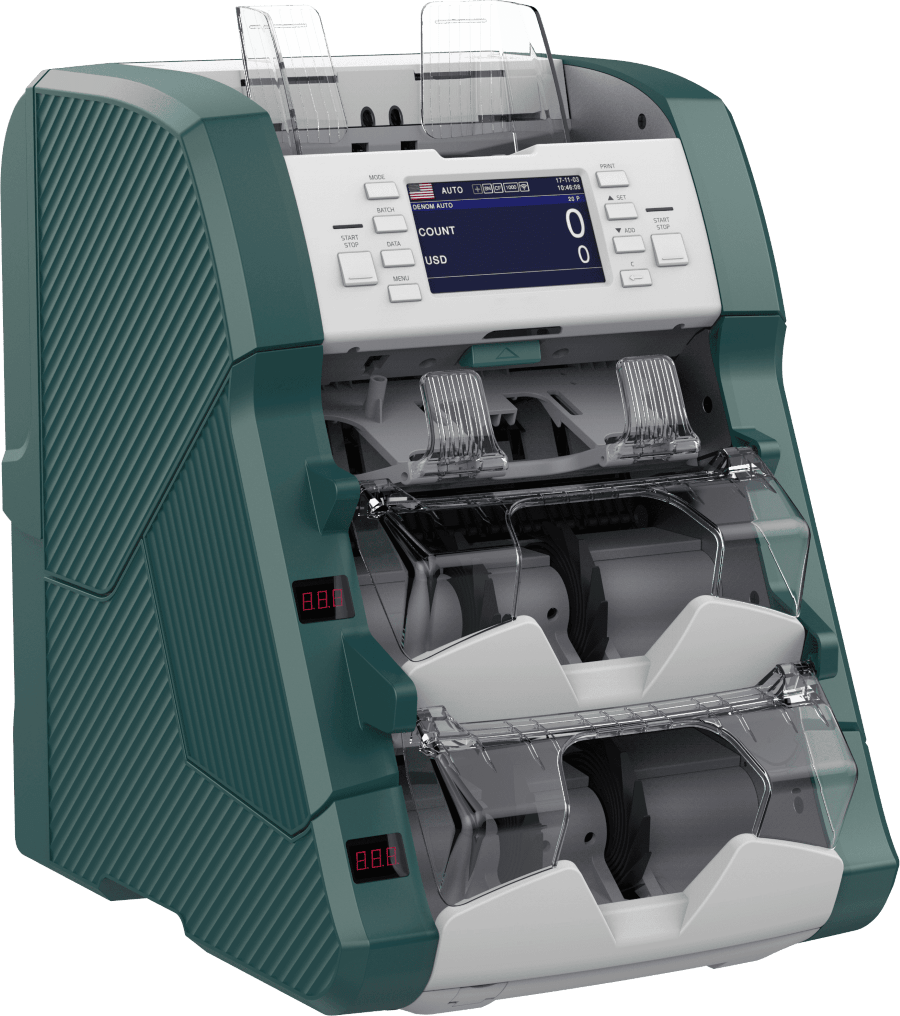

What Makes a Great Cash Sorting Machine for Retail in 2026?
The market has evolved significantly. In 2026, the features that separate a practical retail machine from an inadequate one come down to six criteria:
1. Denomination Sorting (Not Just Counting)
This is the non-negotiable for retail. A machine that counts notes into a single pile gives you a total. A machine that sorts routes $5s, $10s, $20s, $50s, and $100s into separate pockets simultaneously — giving you both a total and a denomination breakdown in one pass. For retail reconciliation and float preparation, sorting is essential, not optional.
2. Multi-Method Counterfeit Detection
UV-only detection is no longer sufficient in 2026. Sophisticated counterfeit polymer notes can pass UV checks. Look for machines that combine UV, magnetic (MG), infrared (IR), and CIS (colour image sensor) detection. The combination of these four methods is the current standard for reliable authentication of Australian polymer banknotes.
3. Speed Matched to Volume
Speed matters when you have multiple tills to process. A machine at 1,000 notes/min clears a 500-note stack in 30 seconds. The same stack takes 5+ minutes manually. For a multi-till retail store counting $3,000–$5,000 in notes per day, speed directly affects how quickly staff can close out and go home.
4. Fitness and Damage Detection
Fitness sorting identifies worn, soiled, or damaged notes and routes them to a separate reject pocket. This matters for retail because banks increasingly scrutinise the condition of deposited notes — a bundle of badly worn notes can create delays or rejections at the branch. Separating them at the counting stage means your banking bundles stay clean.
5. Compact Footprint for Counter/Back Office
Retail back offices are typically small. A machine that takes up an entire desk is a practical problem. The best retail cash sorters balance capability with a compact, desk-friendly footprint. The K2 Cash Recycler is specifically noted for being compact and relatively portable despite its high-performance spec.
6. Ease of Use for Non-Technical Staff
In a retail environment, multiple staff members use the cash sorting machine — not just a trained cashier. A touch screen interface with intuitive navigation and minimal setup reduces training time and operator error. Machines with 4.3-inch touch screens and simple mode selection (like the K2 and LS-200) are significantly easier to hand off between staff shifts.
The Best Cash Sorting Machines for Retail: Full Reviews
Here is an honest assessment of every Cashcom machine relevant to retail cash sorting — from the best entry-level option to the most advanced recycler in the range.
Best for Small Retail / Single Till
| H210 Money Counter and Sorter Machine 🏪 Best for: Single-till retail, cafés, small stores
The H210 is the entry point into genuine denomination sorting. At 900 notes/min counting speed and 750 notes/min sorting speed, it processes a full till’s worth of notes in well under a minute. The three-pocket output — two sorted denomination exits plus a rejection pocket — means you end each count with notes already separated and suspect notes already isolated. Damage sorting is thorough: it grades for dirt, adhesive tape, dog-ears, holes, and cracks simultaneously. Counting Speed: 900 notes/min Sorting Speed: 750 notes/min Sorting Types: Denomination, face/orientation, damage (dirt, tape, hole, dog-ear, crack) Structure: Vertical — 1 entry, 2 sorted exits + 1 rejection outlet Hopper Capacity: 500 notes Stacker Capacity: 200 notes per pocket Rejection Pocket: 100 notes Detection: Double-face counterfeit ID + serial number recognition Reporting: Query by serial number, time, operator, batch — statistical data Best Retail Use: End-of-day till reconciliation, denomination sorting, damage detection
View product → https://www.cashcom.com.au/product/h210/ |
Best for Medium Retail / Multi-Till Stores
| LS-200 Note Counter Machine ⚡ Best for: Medium retail, 2–4 tills, high daily volume
The LS-200 is the right machine when speed becomes a practical constraint. At 1,500 notes/min, it processes a full 600-note hopper in under 25 seconds. For a store with three or four tills generating $4,000–$8,000 in daily cash, this throughput means the entire day’s reconciliation takes minutes, not the better part of an hour. LAN connectivity makes it suitable for stores that want count data feeding directly into their accounting or POS system. Counting Speed: 1,500 notes/min (piece count) Value Count Speed: 1,200 notes/min (authentication + value) Serial Number Speed: 1,200 notes/min Hopper Capacity: 600 notes Stacker Capacity: 200 notes Reject Pocket: 100 notes Sensor System: Dual CIS / UV / MG 18-channel / IR / Ultrasonic 21-channel (F version) Sorting: Denomination, face/orientation sorting — real-time OCR serial number Connectivity: RS-232, USB, LAN Operating System: Linux — stable for continuous daily operation Display: 4.3-inch wide touch screen Optional: Fitness sorting (LS-200F version), network management, TITO Best Retail Use: Multi-till reconciliation, high-volume counting, LAN reporting
View product → https://www.cashcom.com.au/product/ls-200-note-counter/ |
Best for High-Volume Retail / Multi-Location
| K2 Cash Recycler Sorter Machine 🔄 Best for: High-volume retail, large stores, multi-department
The K2 Cash Recycler is the most capable machine in the Cashcom retail range. The 1,000-note hopper is the standout spec — it means a large day’s takings can often be processed in a single load, without the mid-count emptying and reloading that smaller hoppers require. The full four-method detection (UV + MG + IR + CIS) combined with denomination, orientation, facing, and fitness sorting in a single pass is what you want when processing large volumes where any oversight is costly. The compact design is a genuine differentiator at this performance level. Counting Speed: 1,000 notes/min (value counting) Fitness Sorting: 800 notes/min Hopper Capacity: 1,000 notes — largest in the Cashcom range Stacker Capacity: 200 notes Reject Pocket: 100 notes Sensor System: UV, MG, IR, CIS — full 4-method detection Sorting: Denomination, orientation, facing, fitness — all in one pass Currency Support: Up to 7 currencies simultaneously with auto-detect Display: 4.3-inch touch screen — intuitive navigation Optional: Barcode and ticket detection Portability: Compact design — relatively portable for its capability level Best Retail Use: Large volume daily counts, multi-currency retail, fitness-sorted banking prep
View product → https://www.cashcom.com.au/product/k2-cash-recycler/ |
Best for Multi-Currency Retail (Tourism / International)
| H-890 Note Counting Machine 🌍 Best for: Tourism retail, currency exchange, international visitors
The Counting: Mixed value count — multi-currency auto identification Currency Support: Up to 60 currencies (USD, EUR, GBP, JPY, SGD, AED, CAD + more) Detection: Image, Magnetic, Infrared, UV — 4-method Serial Numbers: Real-time OCR serial number reading Error Detection: Double note, half note, chained note Display: Large TFT touch panel Connectivity: RS-232, USB, SD card Compliance: 100% ECB (European Central Bank) pass rate Best Retail Use: Tourism retail, duty-free, airport retail, currency-diverse hospitality
View product → https://www.cashcom.com.au/product/h-890-note-counter/ |
Top of Range — Professional Retail / Flagship Stores
| LS-300 Note Counter Machine 🏆 Best for: Large-format retail, flagship stores, premium operations
The LS-300 is built for retail operations that run their cash sorting machine all day, every day. The dust-free vertical path mechanism is the key practical differentiator — it dramatically reduces jam frequency compared to horizontal-path machines in high-throughput environments. The stacker side LED display means staff can monitor counts from across the room. Remote upgrade capability keeps currency databases current without a service visit — important for operations processing both AUD and foreign currency notes. Counting Speed: 1,200 notes/min (value/authentication) Serial OCR Speed: 1,000 notes/min Sensor System: Dual CIS / UV / MG 18-channel / IR / Ultrasonic 21-channel Sorting: Denomination, face/orientation, fitness — all in one pass Multi-Currency: Up to 48 currencies (auto recognition: 20 currencies) Connectivity: LAN, USB, RS-232 — network management + remote upgrade Display: 4.3-inch touch screen + stacker side LED display Special Feature: Vertical dust-free jam-resistant path — built for all-day operation Optional: Voucher/TITO, real-time monitoring, remote upgrade Best Retail Use: Flagship stores, department stores, continuous high-volume operation
View product → https://www.cashcom.com.au/product/ls-300-note-counter/ |
Side-by-Side Comparison: All Retail Cash Sorting Machines
| Spec | H210 | LS-200 | K2 Recycler | H-890 | LS-300 |
| Best For | Small retail | Medium retail | High volume | Multi-currency | Large/flagship |
| Counting Speed | 900/min | 1,500/min | 1,000/min | High speed | 1,200/min |
| Denomination Sort | ✅ | ✅ | ✅ | ❌ | ✅ |
| Fitness Sort | ✅ | ✅ (F ver) | ✅ | ❌ | ✅ |
| UV Detection | ✅ | ✅ | ✅ | ✅ | ✅ |
| Magnetic Detection | ✅ | ✅ | ✅ | ✅ | ✅ |
| CIS Imaging | ✅ | ✅ | ✅ | ✅ | ✅ |
| Serial Number Read | ✅ | ✅ | ✅ | ✅ | ✅ |
| LAN Connectivity | ❌ | ✅ | Contact | ❌ | ✅ |
| Touch Screen | ❌ | ✅ | ✅ | ✅ | ✅ |
| Hopper Capacity | 500 notes | 600 notes | 1,000 notes | N/A | N/A |
| Multi-Currency | AUD+ | 20 auto | 7 currencies | 60 currencies | 20 auto |
| Footprint | Compact | Compact | Compact | Compact | Medium |
Quick Matcher: Find Your Machine by Store Type
| Your Retail Operation | Best Machine |
| Single-till shop, café, or service counter | H210 — best value denomination sorter |
| Small boutique or specialty store (2 tills) | H210 or LS-200 — LS-200 if LAN reporting matters |
| Medium retail (3–5 tills, $3k–$8k daily cash) | LS-200 — speed + LAN connectivity |
| Large supermarket or department store | K2 Cash Recycler or LS-300 |
| High-volume outlet or flagship location | LS-300 — built for all-day operation |
| Tourism, airport, or duty-free retail | H-890 — 60-currency support |
| Multi-location retail group | LS-200 or LS-300 with LAN + network management |
| Cash-intensive (gaming, club, entertainment) | K2 Cash Recycler — 1,000-note hopper |
| Growing business, not sure yet | H210 to start — proven upgrade path to K2 or LS-200 |
Retail Cash Handling Best Practices for 2026
A cash sorting machine is only part of a solid retail cash management process. These practices, developed from a decade of working with Australian retailers, complete the picture:
Count Every Till Separately
Even if your machine processes all tills in one go, run each till’s cash as a separate batch and note the results individually. This preserves accountability — if a discrepancy occurs, you know exactly which till it came from. Most machines allow batch separation through the count memory or reporting function.
Set Float Targets by Denomination
Know exactly how many of each denomination you need in each till float at open. Use the per-denomination display on your sorter to confirm this during float preparation rather than guessing by weight or feel. The H210 and K2’s denomination breakdown makes this a two-minute process each morning.
Run Suspect Notes Through Twice
If a machine flags a note in the reject pocket, don’t automatically assume it’s a counterfeit — worn notes sometimes trigger false positives. Run it through again as a standalone count. A genuine counterfeit will consistently fail; a legitimate worn note will often clear on a second pass. If it fails twice, set it aside and contact your bank.
Log Serial Numbers for High-Value Notes
Machines with serial number reading (all Cashcom models in this guide) can log serial numbers for $50 and $100 notes. Enable this feature and retain logs. In the event of a dispute or fraud investigation, serial number records can be invaluable. This takes no extra time — the machine does it automatically during every count.
Keep the Machine Clean
Dust and note debris are the primary causes of counting errors and jams in cash sorting machines. Wipe the note path and input rollers with a dry cloth weekly. Use cleaning cards monthly. Keep the machine away from direct dusty environments if possible. The LS-300’s dust-free vertical path design reduces this maintenance burden, but all machines benefit from regular basic cleaning.
Frequently Asked Questions
| Q: What is the best cash sorting machine for a retail store in Australia?
A: For most Australian retail stores in 2026, the H210 Money Counter and Sorter is the best starting point — it provides denomination sorting, damage detection, and 900 notes/min speed in a compact footprint. For higher-volume stores, the K2 Cash Recycler offers a 1,000-note hopper with full four-method detection. Call Cashcom on 0451 353 676 for a personalised recommendation based on your daily volume. |
| Q: What is the difference between a cash counter and a cash sorter?
A: A cash counter tallies the total value or quantity of notes, depositing everything into a single output pile. A cash sorter counts AND physically separates notes by denomination, orientation, and condition into individual pockets simultaneously. For retail use, a sorter is almost always the right choice — it provides the denomination breakdown needed for float management and banking preparation. |
| Q: How important is counterfeit detection in a retail cash sorting machine?
A: Extremely important. Retail is a high-risk environment for counterfeit acceptance — busy staff, fast transactions, and customer pressure make manual note scrutiny unreliable. A machine using UV + magnetic + infrared + CIS detection catches counterfeits at the counting stage with far greater reliability than visual checking. All machines in this guide use multi-method detection. |
| Q: How fast should a cash sorting machine be for retail?
A: For a single-till store, 720–900 notes/min is more than adequate. For stores with 3+ tills or $5,000+ in daily cash, 1,000–1,500 notes/min makes a practical difference to how long reconciliation takes. The K2 at 1,000 notes/min and the LS-200 at 1,500 notes/min are both suited to multi-till retail environments. |
| Q: Can cash sorting machines connect to a POS or accounting system?
A: Some models can. The LS-200 and LS-300 include LAN connectivity and USB outputs, allowing count data to be exported to networked systems. This is particularly useful for multi-location retail groups that want centralised cash reporting. Contact Cashcom to discuss integration requirements for your specific POS or accounting setup. |
| Q: Do I need fitness sorting for a retail cash sorting machine?
A: Fitness sorting (separating worn or damaged notes from fit ones) is a useful feature for retail businesses that receive large volumes of mixed-condition notes. It simplifies banking by keeping your deposit bundles clean and reducing the risk of a bank rejecting damaged notes in a deposit. The H210, K2, and LS-300 all include fitness sorting as a standard or key feature. |
| Q: How much counter space does a cash sorting machine take up?
A: All Cashcom retail machines are designed for counter or back-office use. The H210 and K2 are particularly compact. The K2 is specifically noted for being relatively portable despite its high-performance specification — an important factor in a busy retail back office where counter space is at a premium. |
| Q: Where can I buy a cash sorting machine for my retail store in Australia?
A: Cashcom supplies professional cash sorting machines to retail businesses Australia-wide from our base in Haberfield, NSW. We ship to all states and territories with fast turnaround. Browse the full range at cashcom.com.au/products, call 0451 353 676, or email sales@cashcom.com.au. We’re available Monday to Friday, 9am–6pm, and happy to recommend the right machine for your store. |
Final Verdict: The Best Cash Sorting Machine for Retail in 2026
The right cash sorting machine for your retail business depends on three things: how many tills you’re reconciling daily, whether you need basic denomination sorting or full fitness sorting and recycling capability, and whether LAN connectivity for system integration matters to your operation.
For the majority of Australian retail businesses — a single-location store with one to three tills — the H210 delivers everything you need at the right price point. Denomination sorting, damage detection, 900 notes/min, and a compact footprint make it the most practical starting point. As volume grows, the K2 Cash Recycler is the natural step up: 1,000-note hopper, four-method detection, and denomination-to-fitness sorting all in one pass.
For high-volume operations, multi-location retailers, or flagship stores where cash processing runs all day, the LS-300 is built for it — dust-free, remote-upgradeable, and capable of handling the throughput of a major retail operation without downtime.
Explore the full Cashcom cash handling range at cashcom.com.au/products, call 0451 353 676 for direct advice, or email sales@cashcom.com.au. Our team is available Monday to Friday, 9am–6pm, and has matched Australian retail businesses to the right cash handling equipment since 2015.