
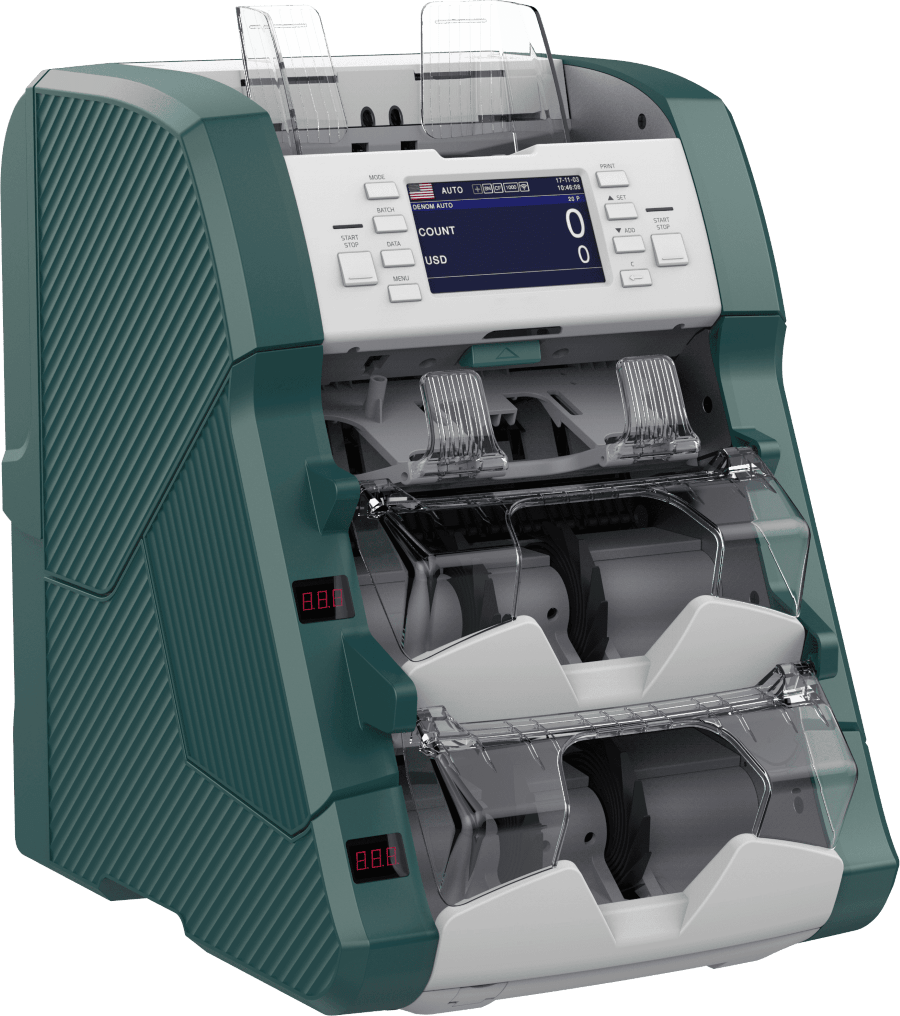
The term “industrial money counter” gets used loosely in Australia — sometimes to mean any machine that’s better than a basic desktop counter, sometimes to mean the kind of high-speed processing equipment used in bank cash centres. The reality sits somewhere in between, and knowing where your business falls on that spectrum is the key to avoiding both underspending (buying a machine that can’t keep up with your volume) and overspending (paying for capabilities you’ll never use).
This guide answers the question directly: what makes a money counter industrial-grade, which businesses genuinely need one, and which machines in the Cashcom range match industrial requirements. We’ll also be honest about when a mid-range professional machine is the smarter choice — because for many businesses asking this question, the answer is “you don’t need a true industrial unit, but you’ve outgrown your current machine.”
| 📋 Quick answer:
If your business counts more than 5,000–10,000 notes per day, runs cash counting continuously across multiple shifts, or requires centralised multi-location reporting with remote management — you need a machine in the industrial-professional tier. For most Australian businesses below that volume, a high-quality professional machine (like the LS-200 or LS-300) delivers industrial-grade reliability without the cost and complexity of true bank-level equipment. |
What Actually Makes a Money Counter ‘Industrial Grade’?
“Industrial” is a marketing term as much as a technical one. When Cashcom uses it — and when we advise clients on whether they need industrial-level equipment — we mean machines that meet specific performance thresholds across four dimensions:
1. Continuous Duty Cycle
Consumer-grade and entry business machines are designed for intermittent use — a burst of counting at end of day, then rest. Industrial machines are designed to run continuously for hours at rated speed without thermal throttling, increased error rates, or mechanical wear acceleration. The key specs to look for are duty cycle ratings and whether the manufacturer specifies continuous versus intermittent use. The Cashcom LS-300’s dust-free vertical path design is a direct response to continuous-duty requirements — it reduces debris accumulation that accelerates wear in all-day operation.
2. High Sustained Throughput
Industrial environments count cash in volumes that make throughput speed a genuine operational constraint. The threshold where speed meaningfully matters is typically above 3,000–5,000 notes per day. Below that, the difference between 720 notes/min and 1,500 notes/min is measured in seconds. Above it, the cumulative difference across multiple counting sessions becomes significant. Industrial machines sustain their rated speeds across long running periods — not just peak speeds in short bursts.
3. Advanced Detection Depth
Industrial-grade machines use the most comprehensive detection systems available — typically Dual CIS imaging with multi-channel magnetic detection (18-channel MG), infrared, UV, and multi-channel ultrasonic. This combination provides the detection depth required in environments where the cost of a missed counterfeit is high and where high-value note volumes ($50 and $100) are significant.
4. Network Integration and Remote Management
Industrial deployments typically span multiple machines, multiple locations, or both. The ability to manage machines remotely — update currency databases, monitor count data, receive alerts for jams or errors — is a practical requirement at industrial scale that desktop machines don’t offer. LAN connectivity with network management software is the minimum standard for industrial deployment.
| Tier | Typical Specs |
| Consumer/Home | <600 notes/min, UV only, no network, low duty cycle |
| Entry Business | 600–800 notes/min, UV+MG, LAN optional, daily use |
| Professional Business | 800–1,200 notes/min, Dual CIS + UV+MG+IR, LAN, continuous use |
| Industrial / Commercial | 1,200–1,500 notes/min, 18ch MG, 21ch ultrasonic, remote management |
| Bank / CIT Grade | 1,500+ notes/min, full processing suite, integrated systems |
5 Clear Signs Your Business Needs an Industrial Money Counter
1. Your Current Machine Can’t Keep Up
The most obvious sign. If end-of-day counting is consistently taking longer than it should — staff waiting for the machine to finish, multiple reload cycles, or counting running into the next shift — your machine has been outgrown. An industrial-tier machine’s larger hopper and sustained high-speed operation eliminates these bottlenecks. The K2 Cash Recycler’s 1,000-note hopper and the LS-300’s dust-free continuous design are specifically engineered for this scenario.
2. You Count Cash Across Multiple Shifts
A machine that runs for 30 minutes at end of day is in a fundamentally different operating environment from one that runs for 2–4 hours across morning, afternoon, and evening shifts. If your cash counting machine runs during trading hours — for till top-ups, shift changes, or mid-day banking — you need a machine designed for continuous rather than intermittent use. Consumer and entry-level machines used in continuous applications develop accelerated wear and increased error rates, typically requiring replacement within 12–18 months.
3. You Manage Cash Across Multiple Locations
A single-location business can tolerate manual reporting of daily counts. A business with three, five, or ten locations cannot practically manage cash oversight without centralised reporting. Industrial-tier machines with LAN connectivity and network management software allow area managers and finance teams to monitor daily count totals, detect discrepancies, and receive operational alerts across all locations from a single dashboard — without being physically present at each site.
4. Your Daily Note Volume Exceeds 5,000 Notes
This is the practical threshold where the performance gap between professional and industrial machines becomes operationally meaningful. At 5,000 notes per day, a machine running at 720 notes/min needs approximately 7 minutes of active counting time. A machine at 1,200 notes/min needs about 4 minutes. The difference seems small — but across five days of counting, plus reload time, plus multiple tills, the cumulative time saving from industrial-tier throughput is measurable. More importantly, a machine handling 5,000+ notes daily needs the sustained duty cycle industrial machines provide.
5. Counterfeit Detection at Scale Is a Business Risk
For banks, CIT operations, gaming venues, and large retail where note volumes are high and the financial exposure from accepted counterfeits is significant, the detection depth of an 18-channel magnetic system combined with Dual CIS and 21-channel ultrasonic represents a materially better protection level than standard multi-method detection. At industrial scale, the improvement in detection reliability justifies the additional specification.
Industries That Genuinely Need Industrial-Grade Money Counters
Not every business needs industrial equipment. These are the industries where industrial-grade money counters are standard rather than optional:
Banks and Credit Unions
Bank branches and back-office cash centres process notes from teller drawers, customer deposits, ATM top-ups, and CIT transfers throughout the day. A busy branch may process 10,000–30,000 notes across a full trading day. Downtime is not acceptable — a jammed machine during peak branch hours creates immediate customer service problems. The LS-300’s dust-free design and remote upgrade capability make it the appropriate machine for branch-level deployment.
Cash-in-Transit (CIT) Operations
CIT companies — organisations that collect, transport, and process cash on behalf of businesses and financial institutions — operate at the highest end of note processing volume. Their machines run continuously across long shifts, processing notes from multiple client businesses. The combination of all-day continuous operation, highest detection standards, and network reporting for client reconciliation all point to the top end of the professional tier.
Licensed Clubs and Gaming Venues
Clubs with electronic gaming machines (pokies), bars, restaurants, and membership services generate cash across every hour of operation. The combination of continuous throughout-the-day cash handling, high note volumes ($50 and $100 notes are common in gaming environments), and the need for detailed transaction reporting makes industrial-tier equipment the appropriate choice. The K2 Cash Recycler’s 1,000-note hopper and continuous operation capability are specifically suited to club environments.
Large-Format Retail and Supermarkets
A large supermarket with 20+ checkout lanes processes notes continuously throughout trading hours — till top-ups, customer change, end-of-lane drops, and shift changes all generate note handling requirements that smaller machines cannot sustain. Centralised cash rooms in large retail operations typically run industrial-tier equipment all day with multiple operators.
Casinos and Entertainment Venues
Casinos represent perhaps the most demanding cash handling environment commercially available. Note volumes are extremely high, operating hours are typically 24 hours, detection standards must be maximised, and full audit trail requirements apply to every transaction. Industrial machines in casino environments often run in fully integrated cash management systems rather than standalone units.
National Retailers and Franchise Groups
While individual franchise locations may not each require industrial-tier equipment, the head-office cash management function — consolidating daily counts, monitoring for discrepancies, maintaining currency database updates — benefits significantly from industrial-tier network management capabilities. The LS-300’s remote upgrade and real-time monitoring via LAN are designed for exactly this multi-location oversight requirement.
Honest Assessment: Do You Actually Need Industrial, or Just a Better Machine?
This is the question most buyers asking about industrial money counters should ask themselves first. Because the answer for many is: you don’t need a true industrial unit — you’ve outgrown your current machine and need a professional-grade one.
Here is the practical breakdown:
You Don’t Need Industrial If…
- You count cash once per day at end of shift — even with 3–5 tills
- Your daily note volume is under 5,000 notes
- You operate from a single location with one cash counting session
- You don’t require remote management or network reporting
- Your current machine occasionally struggles but doesn’t fail under daily use
In these situations, the right answer is a high-quality professional machine — the LS-200, H210, or for coin counting the Con200 — rather than an industrial unit. You get the reliability and detection depth you need without paying for throughput and remote management capabilities you won’t use.
You Do Need Industrial If…
- Your machine runs for more than 2 hours of continuous active counting daily
- You manage cash across 3+ locations and need centralised reporting
- Your daily note volume regularly exceeds 5,000–10,000 notes
- Machine downtime directly impacts your operation — you cannot afford jams or failures
- You need remote currency database updates without scheduling service visits
- You are in banking, CIT, gaming, or large-format retail
| 💡 The honest truth about ‘industrial’:
Most Australian small and medium businesses don’t need a true industrial money counter. What they typically need is a professional-grade machine designed for daily continuous business use — like the LS-200 or LS-300 — that is significantly more capable than entry-level machines without being the full industrial bank-grade equipment used in cash processing centres. Cashcom’s professional range covers this ground completely. |
Cashcom’s Industrial-Grade Money Counter Range
The Cashcom machines that meet industrial-grade requirements are the LS-300, LS-200 (for high-volume mid-tier), and K2 Cash Recycler. Here is an honest assessment of each.
The Industrial-Grade Flagship: LS-300
| LS-300 Note Counter Machine 🏆 Industrial flagship — all-day continuous, remote managed, dust-free
The LS-300 is the machine that earns the industrial label in the Cashcom range. Three features define its industrial status: the dust-free vertical path (continuous operation without progressive jam risk), the 18-channel MG system (full-width magnetic scanning at bank-grade sensitivity), and remote upgrade capability (currency databases stay current without service visits). For any operation running cash counting as a sustained daily function rather than an end-of-day task, this is the specification to match. Counting Speed: 1,200 notes/min (value + authentication) Serial OCR Speed: 1,000 notes/min — TITO, clearance, real-time Sensor System: Dual CIS + UV + MG 18-channel + IR + Ultrasonic 21-channel Duty Cycle: Continuous — dust-free vertical path, jam-resistant design Multi-Currency: Up to 48 currencies (auto recognition: 20) Remote Management: Real-time monitoring + remote upgrade via LAN — no service visit Display: 4.3-inch touch screen + stacker side LED for remote monitoring Connectivity: LAN, USB, RS-232 Sorting: Denomination, face, orientation, fitness — all in one pass Dimensions: 315mm × 410mm × 425mm Best For: Banks, CIT, large retail, gaming venues, all-day continuous operation
View product → https://www.cashcom.com.au/product/ls-300-note-counter/ |
High-Volume Industrial: K2 Cash Recycler
| K2 Cash Recycler Sorter Machine ♻️ Industrial volume — 1,000-note hopper, full-cycle cash management
The K2’s industrial credential is primarily its 1,000-note hopper — the largest in the Cashcom range. For environments where continuous note input is the operational requirement (gaming venues, large clubs, entertainment operations), loading 1,000 notes at once and processing without interruption is meaningfully different from repeatedly loading 500-note batches. Combined with full 4-method detection and fitness sorting, it handles the detection depth industrial environments require. Counting Speed: 1,000 notes/min (value counting) Fitness Sort Speed: 800 notes/min Hopper Capacity: 1,000 notes — largest in the Cashcom range Sensor System: UV + MG + IR + CIS — full 4-method detection Sorting: Denomination, orientation, facing, fitness — all in one pass Currency Support: Up to 7 currencies simultaneously with auto-detect Display: 4.3-inch touch screen Build: Compact — relatively portable for its performance level Optional: Barcode and ticket detection Best For: Clubs, gaming, large hospitality, high-volume retail
View product → https://www.cashcom.com.au/product/k2-cash-recycler/ |
Professional Industrial: LS-200 (High-Speed Tier)
| LS-200 Note Counter Machine ⚡ Professional industrial — 1,500 notes/min, 18ch MG, LAN reporting
The LS-200 sits at the boundary between high-end professional and industrial — it has the 18-channel MG and 21-channel ultrasonic detection depth of industrial equipment, and the 1,500 notes/min peak throughput to match. For businesses that need industrial detection standards without the full continuous-duty design of the LS-300, the LS-200 is the right machine. It handles multi-till retail at scale and delivers the LAN connectivity needed for centralised reporting. Counting Speed: 1,500 notes/min (piece count) Value Count Speed: 1,200 notes/min (authentication + value simultaneously) Sensor System: Dual CIS + UV + MG 18-channel + IR + Ultrasonic 21ch (F ver) Hopper Capacity: 600 notes Sorting: Denomination, face, orientation — real-time serial OCR Operating System: Linux — stable for continuous daily operation Connectivity: LAN, USB, RS-232 Display: 4.3-inch touch screen Optional: Fitness sorting (LS-200F), network management, TITO Best For: Multi-till retail, financial institutions, high daily note volumes
View product → https://www.cashcom.com.au/product/ls-200-note-counter/ |
Comparison: Entry Business vs Professional vs Industrial
| Feature | Entry (H110) | Professional (LS-200) | Industrial (LS-300) | High-Vol (K2) |
| Counting Speed | 720/min | 1,500/min | 1,200/min | 1,000/min |
| Duty Cycle | Daily use | Continuous | All-day | Continuous |
| 18-ch MG Detection | ❌ | ✅ | ✅ | ❌ |
| 21-ch Ultrasonic | ❌ | ✅ (F ver) | ✅ | ❌ |
| Dual CIS | ✅ | ✅ | ✅ | ✅ |
| Remote Upgrade | ❌ | ❌ | ✅ | ❌ |
| Dust-free design | ❌ | ❌ | ✅ | ❌ |
| Hopper Capacity | 500 notes | 600 notes | N/A | 1,000 notes |
| LAN Connectivity | ✅ | ✅ | ✅ | Contact |
| Touch Screen | ❌ | ✅ | ✅ | ✅ |
| Best Daily Note Volume | <3,000 | 3,000–10,000 | 10,000+ | 5,000–15,000 |
How to Choose the Right Level for Your Business
Use this framework to identify whether you need entry, professional, or industrial:
Step 1: Estimate Your Daily Note Volume
Count the number of notes processed in a typical full day — all tills, all counting sessions. Under 2,000: entry professional is appropriate. 2,000–8,000: high-end professional tier. 8,000+: industrial tier. If you are unsure, count a sample week and average it.
Step 2: Assess Your Operating Pattern
How long does your machine run in active counting mode each day? Under one hour in a single session: entry to professional is fine. Over two hours total, or across multiple sessions throughout the day: continuous-duty design matters — look at LS-300 or K2.
Step 3: Consider Your Reporting Needs
Single location, manual reporting: LAN connectivity is a nice-to-have. Multiple locations, centralised oversight: LAN with network management is essential. Remote upgrade required (no service visit for currency updates): LS-300.
Step 4: Match to the Right Machine
| Your Profile | Recommended Machine |
| Daily count < 2,000 notes, single till | H110 — right-sized, bank-grade detection |
| 2,000–5,000 notes, 2–4 tills, sorting | H210 or LS-200 |
| 5,000–10,000 notes, multi-till, LAN | LS-200 — industrial detection, high speed |
| 10,000+ notes, all-day continuous | LS-300 — dust-free, remote managed |
| High-volume club/gaming/entertainment | K2 Cash Recycler — 1,000-note hopper |
| Bank branch or CIT operation | LS-300 — contact Cashcom for exact spec |
| Multi-location franchise group | LS-200 or LS-300 with LAN management |
Frequently Asked Questions
| Q: What makes a money counter ‘industrial grade’?
Industrial-grade money counters are defined by four characteristics: continuous duty cycle design (able to run for hours without performance degradation), sustained high throughput speed (1,000+ notes/min at rated speed, not just peak speed), advanced detection depth (18-channel MG, 21-channel ultrasonic, Dual CIS), and network integration for remote management across multiple machines or locations. The Cashcom LS-300 meets all four criteria. |
| Q: How do I know if my business needs an industrial money counter?
The key indicators are: daily note volume above 5,000 notes, cash counting running across multiple shifts or more than two hours per day, the need to manage cash across multiple locations with centralised reporting, or operating in banking, CIT, gaming, or large-format retail. For businesses below these thresholds, a high-quality professional machine like the LS-200 typically provides the right capability without industrial-tier cost. |
| Q: What is the difference between the LS-200 and LS-300 for industrial use?
Both machines have 18-channel MG and 21-channel ultrasonic detection. The key differences are: the LS-300 has a dust-free vertical path design for continuous all-day operation (the LS-200 does not specify continuous-duty design), the LS-300 includes remote upgrade capability for currency database updates without service visits, and the LS-300 has stacker side LED displays for remote monitoring. For genuinely continuous all-day industrial use, the LS-300 is the appropriate choice. For high-volume but intermittent counting, the LS-200 performs equivalently. |
| Q: How many notes per day do industrial money counters handle?
Professional business machines (H110, H210) are designed for 1,000–5,000 notes per day. High-end professional machines (LS-200) handle 3,000–10,000 notes per day comfortably. Industrial machines (LS-300, K2) are designed for 10,000+ notes per day in continuous operation. These are practical guidelines for duty cycle matching — machines can process higher volumes occasionally without damage, but sustained operation above design volume accelerates wear. |
| Q: Do industrial money counters need special installation?
No special installation is required for the machines in the Cashcom industrial range. The LS-300 and K2 are desktop units that connect via standard power supply and LAN for network connectivity. They do not require wall mounting, dedicated power circuits, or specialist installation. Network configuration (IP setup for LAN connectivity) follows standard IT procedures. Cashcom provides setup guidance with every machine. |
| Q: Are industrial money counters worth it for a medium-sized business?
It depends on your specific volume and operating pattern. For a medium business counting 2,000–5,000 notes daily in a single end-of-day session, the LS-200 is typically the right machine — it has industrial-grade detection depth (18-channel MG) without the continuous-duty design that adds cost to the LS-300. The LS-300’s premium is justified when counting runs all day rather than in a single session. Call Cashcom on 0451 353 676 for a direct recommendation. |
| Q: What is the best industrial money counter in Australia?
The Cashcom LS-300 is the top-specification professional money counter in our Australian range — dust-free continuous operation, 18-channel MG + 21-channel ultrasonic + Dual CIS detection, remote upgrade via LAN, and 1,200 notes/min sustained speed. For high-volume environments prioritising hopper capacity, the K2 Cash Recycler’s 1,000-note hopper is the relevant specification. Contact Cashcom on 0451 353 676 to discuss the right match for your operation. |
Match the Machine to the Real Requirement
The most common mistake businesses make when searching for an industrial money counter is either buying one they don’t need — paying for continuous-duty design and remote management that a once-daily counting session doesn’t require — or not buying one when they do need it, running a professional machine at industrial duty cycles until it fails prematurely.
The honest answer for most Australian businesses asking this question: if you are counting more than 5,000 notes daily, running counting across multiple shifts, or managing cash across multiple locations, you are in industrial territory — and the LS-300 is the right machine. If your volume is below that and you count once daily, the LS-200 gives you industrial-grade detection depth (18-channel MG, Dual CIS) in a high-end professional package that is better matched to your actual operating pattern.
For banks, CIT operations, clubs, gaming venues, and large retail — the industrial machines in the Cashcom range (LS-300, K2) are the appropriate tools. They are designed for the environments where downtime is not acceptable, detection must be maximised, and machines run all day rather than for thirty minutes.
To discuss the right machine for your volume and operating pattern, contact Cashcom at 0451 353 676, email sales@cashcom.com.au, or visit cashcom.com.au/products. Our team is available Monday to Friday, 9am–6pm.