

At the end of a long trading day, most business owners face the same two tasks back-to-back: count the cash, then lock it away safely until it can be banked. These are treated as separate steps — count on the machine, then transfer to the safe. It works, but it creates a window of vulnerability between the two actions, adds handling time, and requires staff to move cash between two locations.
A money counting safe — also called a cash counting safe or smart safe — combines both functions in a single unit. Cash goes in, gets counted, authenticated, and secured simultaneously. No transfer step. No second machine. No unsecured cash sitting on a back-office counter while staff deal with something else.
This guide explains exactly how money counting safes work, what the real benefits and limitations are compared to a dedicated money counter plus a separate safe, and what Australian businesses should look for when considering this option in 2026.
| 💡 Key distinction upfront:
A money counting safe is not a money counter you can lock. It is an integrated security unit — typically a steel safe-grade enclosure — with built-in note validation and counting technology. The note validator authenticates and counts as cash is deposited, storing it securely in a tamper-resistant chamber. This is different from, and more limited than, a standalone professional money counter in certain capabilities — but it adds security features a counter alone cannot provide. |
How a Money Counting Safe Works
Unlike a standalone money counter — where you load a full stack of notes into a hopper and process them in batch — a money counting safe is designed for continuous throughout-the-day deposit use. Here is the typical workflow:
- A cashier or staff member completes a shift, till check, or cash drop.
- Notes are fed individually or in small batches into the safe’s bill validator slot — not a large hopper, but a controlled input mechanism similar to an ATM deposit slot.
- Each note is authenticated as it enters: UV and magnetic sensors verify the note is genuine. A counterfeit or damaged note is rejected and returned to the staff member.
- Genuine notes are counted, the denomination is identified, and the value is added to the running total stored in the safe’s internal log.
- The note is deposited into a secure, tamper-resistant internal cassette — separated from the counting mechanism by a one-way barrier. Once deposited, notes cannot be accessed without authorised safe access.
- The staff member receives a transaction receipt (printed or on screen) confirming the deposited amount. This is their record for shift reconciliation.
- At end of day or banking time, the authorised manager opens the safe, removes the cassette, and the count totals are already recorded — no separate counting required.
| 🔒 Security design principle: The key feature of a money counting safe is the separation between the counting mechanism and the storage vault. Cash passes through the counting section and into a secured, sealed chamber. Only authorised access — typically requiring a manager key or combination — can open the storage section. This design prevents staff from accessing previously deposited cash even if they have permission to make deposits. |
Who Benefits Most from a Money Counting Safe?
A money counting safe is not the right solution for every cash-handling business. It is specifically designed for businesses where these conditions apply:
Multiple Staff Handling Cash Throughout the Day
When multiple cashiers, servers, or tellers make cash deposits at different points in the day — shift changes, till drops, tip collection — a money counting safe creates a controlled, auditable deposit process. Each deposit is logged with a timestamp and, on most systems, the depositing employee’s PIN or ID. This creates a complete audit trail that manual shift-change processes cannot match.
Internal Shrinkage Risk
Research by the Association of Certified Fraud Examiners consistently shows that small businesses are disproportionately affected by internal theft — and that cash is the most common target. A money counting safe reduces internal theft opportunity by creating an authenticated, logged deposit process where the amount deposited is recorded at the point of deposit. Discrepancies between what was at the till and what was deposited become immediately visible, and the depositing employee’s identity is recorded.
Businesses That Cannot Do Nightly Bank Runs
For businesses that accumulate significant cash across multiple trading days before banking — particularly those in areas without convenient banking access or those operating outside branch hours — a secured, counted cash holding solution reduces the risk of holding large amounts without a record of exactly what is stored.
Franchise and Multi-Location Operations
Money counting safes with network connectivity allow head office or area managers to monitor daily deposit totals across multiple locations remotely — without being physically present. This visibility is a significant operational advantage for franchise groups and retail chains where individual location cash management is difficult to oversee manually.
High Internal Traffic Environments
Retail, hospitality, and food service operations where the back office sees frequent staff traffic present higher cash handling risk than controlled single-person cashier environments. A money counting safe limits the number of staff who can handle cash after it leaves the till — deposits go directly into the safe rather than being left on a counter for processing.
Honest Limitations of Money Counting Safes
Money counting safes are genuinely useful tools in specific contexts. They are not universally superior to a standalone money counter plus a separate safe. Here are the limitations worth understanding before making a decision.
Note-by-Note Input, Not Batch Processing
A standalone money counter processes a full stack of notes in a single batch pass — 500 notes in under 45 seconds on a professional machine. A money counting safe uses a note validator slot designed for individual or small-group note deposits, not batch processing. For end-of-day reconciliation of a full day’s takings across multiple tills, this sequential deposit process takes significantly longer than batch counting on a dedicated machine.
Detection Capability Is Typically Less Sophisticated
Professional standalone money counters like the Cashcom H110 use Dual CIS imaging combined with UV, MG, and IR detection — the same technology standard as banking equipment. Most money counting safes use single-method or dual-method note validation (commonly UV + MG). This provides good baseline protection but falls short of the multi-method depth that professional counting machines provide for $50 and $100 polymer notes.
Higher Cost, More Complex Maintenance
A quality money counting safe combines two complex systems — a precision steel safe enclosure and a note validation mechanism — into a single unit. This means higher purchase cost than a standalone counter or a standalone safe, and maintenance requires specialist service for both the physical safe mechanism and the electronic validator. Replacement parts and servicing are less commoditised than for standalone units.
Not Designed for Denomination Breakdown Output
Most money counting safes provide a total deposited value — what went in, authenticated. They do not typically provide a denomination breakdown suitable for float preparation the next morning. A standalone money counter with denomination sorting capability (like the Cashcom H210, LS-200, or LS-300) provides per-denomination output that money counting safes generally do not.
Banking Preparation Still Requires a Separate Process
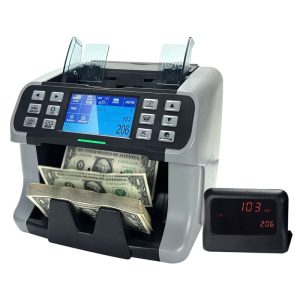
A money counting safe secures and records deposited cash. It does not prepare denominated banking bundles, coin rolls, or structured float packages. For businesses that need to prepare denomination-specific banking bundles from their daily takings, a separate counting machine is still needed even if a safe is also in place.
| Feature | Money Counting Safe | Standalone Counter + Safe |
| Cash secured during counting | ✅ | ❌ (transfer required) |
| Audit trail per deposit | ✅ | ⚠️ (depends on process) |
| Employee access control | ✅ | ⚠️ (manual process) |
| Remote monitoring | ✅ (advanced models) | ❌ |
| Batch processing speed | ❌ | ✅ |
| Detection depth | ⚠️ | ✅ (Dual CIS + MG + IR) |
| Denomination sorting | ❌ | ✅ (H210/LS-200/LS-300) |
| Banking prep output | ❌ | ✅ |
| Maintenance simplicity | ⚠️ | ✅ (separate units) |
| Total cost | High | Medium (two units) |
What to Look for in a Money Counting Safe
Steel Grade and Physical Security Rating
Safe enclosures are rated by their resistance to physical attack — typically expressed as a time rating (e.g., TL-15 means 15 minutes of attack resistance using common tools). For a business cash safe, a minimum of 3mm solid steel body with anti-drill protection is the practical baseline. Higher-specification units include anchoring options for floor or wall mounting, which prevents the entire unit being removed.
Note Validator Detection Methods
Check specifically what detection methods the built-in validator uses. UV only is not adequate for Australian $50 and $100 polymer notes in 2026 — as detailed in our full guide to counterfeit detection. Look for units specifying UV + MG (magnetic) as a minimum. Some advanced units include IR and CIS imaging — these provide protection closer to standalone professional counter standards.
Storage Capacity
How many notes can the safe hold before it needs to be emptied? Entry-level units typically hold 300–600 notes. Mid-range units hold 1,200–2,200 notes. High-capacity units used in large retail and hospitality hold 4,000–15,000 notes. Match capacity to your typical between-banking-trip volume — a unit that fills up mid-day requires frequent intervention that defeats the purpose of the system.
Audit Trail and Reporting
A quality money counting safe logs every transaction — time, amount, denomination total, and depositing employee ID — and retains this log internally and/or exports it to connected systems. Look for units that can export to your POS or accounting software, and that can be accessed remotely for head-office visibility in multi-location setups.
Access Control
Employee access (deposit only) should be separate from manager access (full open). PIN-based employee identification — where each staff member has a unique PIN — creates individual accountability for each deposit. Multi-level access (employee deposit, supervisor balance check, manager full access) is the standard for professional units.
Network Connectivity
For multi-location businesses, network connectivity (typically via LAN or cellular) allows centralised reporting of daily deposit totals without requiring physical access to each unit. Some advanced systems transmit deposit data directly to a nominated bank account, enabling same-day provisional credit — the deposited cash is credited to your account before physical collection by CIT.
The Cashcom Approach: Professional Counting + Secure Storage
Cashcom’s specialisation is professional cash handling equipment — money counters, note sorters, and coin sorting machines. Our range does not include dedicated money counting safes as a product category.
For Australian businesses asking about money counting safes, our recommendation is based on a decade of working with businesses across retail, hospitality, banking, and CIT: the combination of a professional standalone money counter and a separate quality safe almost always delivers better cash handling capability than an integrated unit — at comparable or lower cost, with better detection performance and more useful output.
Here is why this combination works better for most Australian businesses:
Better Detection, Faster Processing
A professional standalone counter like the Cashcom H110 uses Dual CIS imaging with UV + MG + IR detection simultaneously — processing 720 notes per minute. A typical money counting safe uses UV + MG validation on a note-by-note input mechanism. For a business counting $3,000–$5,000 in daily notes, the speed and detection quality difference is significant.
Full Denomination Output
A standalone counter with sorting capability (H210, LS-200, LS-300) provides per-denomination output for float preparation and denomination-specific banking bundles. Money counting safes provide a total value. If you need the denomination breakdown — and most businesses doing daily reconciliation do — the standalone counter is the better tool.
Independent Serviceability
If your integrated money counting safe develops a validator fault, the entire unit is out of service — you lose both the counting and security functions simultaneously. With a standalone counter and a standalone safe, a fault in one unit leaves the other functional. Service, repair, and replacement are handled independently.
The Recommended Setup
For most Australian businesses, the practical answer to the money counting safe question is:
- Step 1: Count and verify cash using a professional Cashcom counter at end of shift or end of day.
- Step 2: Transfer counted and authenticated cash directly into a quality floor or wall safe — bolted in place, with controlled access.
- Step 3: Record the counted total against the safe deposit in your reconciliation log.
This process takes under 5 minutes for a typical business till, provides bank-grade detection via the counter, and physical security via the safe — at a total cost that is generally lower than a quality integrated money counting safe unit.
Cashcom Products for Your Counting Step
| H110 Cash Counting Machine 🏪 Best for: Small–medium business daily till count
The H110 provides the counting and authentication step of a money counting safe’s function — with better detection depth than most integrated units. Pair with a quality floor safe for the complete secure cash management workflow. Detection: Dual CIS + UV + MG + IR — bank-grade Speed: 720 notes/min (detection simultaneous) Fitness Detection: 12 types including soil, tape, hole, watermark, dog-ear Serial Numbers: Full logging — audit trail per note Mixed Value: Auto AUD denomination recognition Connectivity: LAN + USB — integrates with reporting systems
View product → https://www.cashcom.com.au/product/h110-cash-counting-machine/ |
| H210 Money Counter and Sorter Machine 🔄 Best for: Businesses needing denomination breakdown + detection
The H210 adds denomination sorting to the detection and counting capabilities — giving you per-denomination totals alongside the authenticated count. This is the output a money counting safe cannot provide, and it is what most businesses actually need for banking preparation. Detection: Double-face counterfeit ID — full dual-face Speed: 900 notes/min counting | 750 notes/min sorting Sorting: Denomination, face, orientation, damage Output: 3 pockets: 2 sorted exits + 1 rejection outlet Serial Numbers: Real-time ID — queryable by serial, operator, batch Best Use: Businesses needing denomination-sorted output for banking
View product → https://www.cashcom.com.au/product/h210/ |
| LS-200 Note Counter Machine ⚡ Best for: High-volume multi-till — 18-channel MG, 1,200 notes/min
For medium to large operations where multiple tills need counting nightly and detection depth is a priority, the LS-200’s 18-channel magnetic system and LAN connectivity make it the professional-level counting component in any cash management setup. Detection: Dual CIS + UV + MG 18-channel + IR + Ultrasonic 21ch (F ver) Speed: 1,200 notes/min (authentication + value) Sorting: Denomination, face, orientation — real-time Hopper: 600 notes — fewer interruptions for large counts Connectivity: LAN — centralised reporting for multi-location Display: 4.3-inch touch screen
View product → https://www.cashcom.com.au/product/ls-200-note-counter/ |
When a Money Counting Safe DOES Make Sense
Despite recommending standalone equipment for most Australian businesses, there are specific situations where an integrated money counting safe is genuinely the better solution. Being honest about this is part of giving useful advice.
High Staff Turnover Environments
In businesses with frequent staff changes, temporary workers, or high-risk internal shrinkage environments, the per-employee deposit logging and access control of a money counting safe provides accountability that a standalone counter cannot. When an employee deposits cash into a money counting safe under their PIN, there is an unambiguous record of what they deposited and when.
Businesses Without a Back Office
Some retail formats — kiosks, pop-up stores, small franchises — have no dedicated back office where a counter can be operated separately from the trading floor. An integrated money counting safe can be positioned at the point of sale and allows cash deposits directly from the till without requiring a separate counting area.
Provisional Credit Requirements
Some advanced money counting safe systems connect directly to bank partners and provide provisional credit — your account is credited with the deposited amount before the CIT collects the physical cash. For cash-intensive businesses managing tight working capital, this can meaningfully improve daily cash flow versus the standard 1–2 day delay for physical deposits.
Multi-Location Visibility Without Physical Presence
For franchise groups or retail chains where an area manager cannot visit every location daily, network-connected money counting safes provide real-time deposit visibility across all sites. This specific capability — remote monitoring of daily cash deposits — is not available from a standalone counter.
Frequently Asked Questions
| Q: What is a money counting safe?
A money counting safe is an integrated unit that combines a secure steel safe enclosure with a built-in note validation and counting mechanism. As cash is deposited into the safe’s input slot, each note is authenticated (checking for counterfeits) and counted, with the value added to a logged total. The deposited cash is secured in a tamper-resistant internal chamber. This is different from a standard safe with a money counter placed next to it — the counting and securing happen as a single integrated step. |
| Q: Is a money counting safe better than a money counter plus a separate safe?
It depends on your specific requirements. For most Australian businesses, a professional standalone money counter paired with a quality separate safe provides better detection capability, faster batch processing, denomination sorting output, and lower total cost. A money counting safe is the better choice in specific scenarios: high staff turnover environments where individual deposit accountability is critical, businesses needing provisional credit via bank-connected systems, or multi-location operations needing real-time remote deposit monitoring. |
| Q: Do money counting safes detect counterfeit notes?
Yes — quality money counting safes include note validators that check for counterfeits as notes are deposited. Most use UV and magnetic detection. However, the detection capability in most integrated safe units is less sophisticated than professional standalone money counters, which use Dual CIS imaging combined with UV, MG, and IR. For businesses accepting large volumes of $50 and $100 notes, a professional standalone counter provides deeper detection protection. |
| Q: How much does a money counting safe cost in Australia?
Quality money counting safes for business use typically range from $2,000 to $15,000+ depending on capacity, steel grade, network connectivity, and detection capability. Enterprise-grade units with high capacities and bank connectivity can be significantly higher. For many small and medium businesses, a professional standalone counter ($400–$2,000) plus a quality separate safe ($300–$1,500) provides comparable or better capability at lower combined cost. Contact Cashcom on 0451 353 676 to discuss the right solution for your budget. |
| Q: Can a money counting safe replace end-of-day reconciliation?
Partially. A money counting safe logs every deposit with amount, time, and employee ID — this replaces the manual recording step in end-of-day reconciliation. However, most safes provide a total deposited value, not a denomination breakdown. Float preparation for the next trading day — knowing exactly how many $5s, $10s, $20s are available — typically still requires a separate denomination counting step or a standalone machine with denomination sorting capability. |
| Q: What is provisional credit and do I need it?
Provisional credit is a banking arrangement where the amount deposited into a network-connected money counting safe is credited to your account before the physical cash is collected by CIT. This means cash deposited on Monday night is in your account on Tuesday rather than waiting for Wednesday’s physical bank deposit. For businesses with tight working capital or high daily cash volumes, provisional credit improves cash flow meaningfully. It requires a specific money counting safe model with bank connectivity — not available on standalone counters. |
| Q: What is the difference between a drop safe and a money counting safe?
A drop safe (or deposit safe) is a basic secure box with a one-way slot — cash is deposited without counting, and the depositing employee receives no confirmation of amount. A money counting safe validates and counts each note as it is deposited, providing a receipt confirming the amount. Drop safes provide physical security only. Money counting safes provide physical security plus an authenticated count and audit trail. |
| Q: Does Cashcom supply money counting safes?
Cashcom specialises in standalone professional money counters, note sorters, and coin sorting machines rather than integrated safe units. For most Australian businesses, we recommend the combination of a Cashcom professional counter and a quality separate safe — this typically provides better detection capability, denomination output, and value than an integrated unit. Call us on 0451 353 676 to discuss the right cash management setup for your specific situation. |
Does Your Business Need a Money Counting Safe?
A money counting safe is a genuinely useful product for a specific set of business conditions — primarily those where per-employee deposit accountability, all-day continuous secured cash deposit, and remote monitoring are priorities. For franchise groups, high-turnover staff environments, and businesses needing provisional credit, the integrated approach has real advantages that standalone equipment cannot replicate.
For the majority of Australian small and medium businesses — a café, retail store, club, or hospitality venue — the combination of a professional Cashcom money counter and a quality floor or wall safe delivers better detection capability, faster end-of-day processing, denomination-sorted output for banking preparation, and independent serviceability. At comparable or lower cost.
The question to ask is not “which is better overall” but “which combination of features does my business actually need.” If the answer includes per-employee deposit logging, all-day secured cash access at point of sale, or network-connected remote monitoring — a money counting safe is worth investigating seriously. If the answer is fast end-of-day reconciliation with bank-grade detection and denomination output — standalone equipment is the better fit.
To discuss the right cash handling solution for your business, call Cashcom on 0451 353 676, email sales@cashcom.com.au, or browse our range at cashcom.com.au/products. Our team is available Monday to Friday, 9am–6pm.