
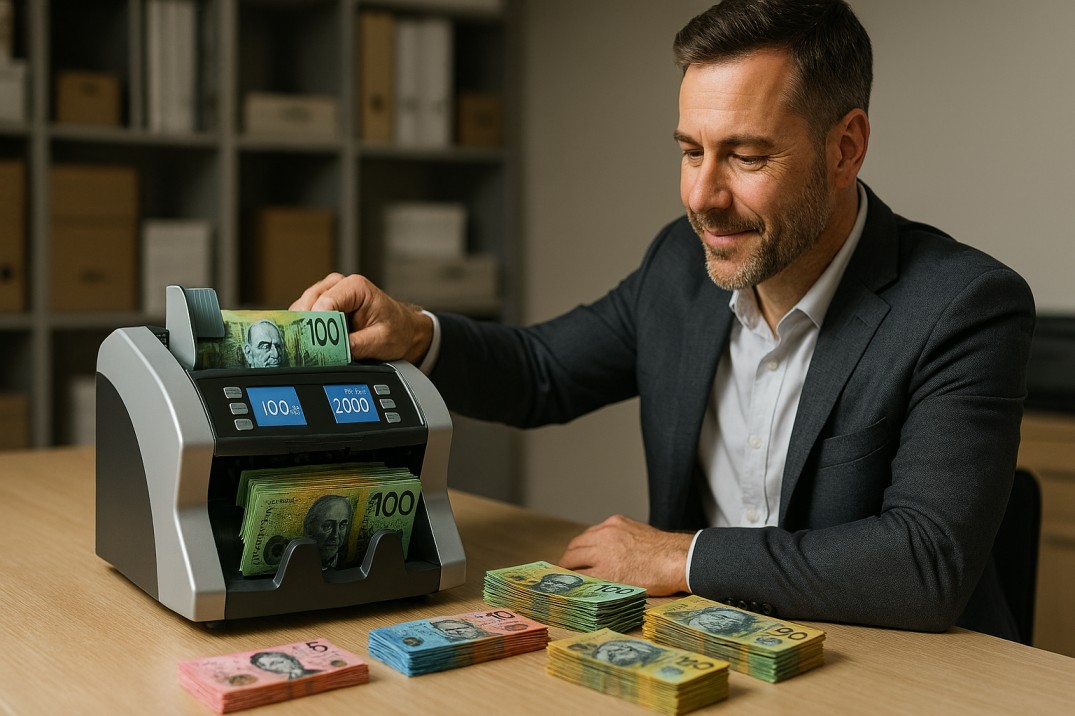
If you run a small business that handles cash daily — a café, a boutique retail store, a small restaurant, a market stall, or a service counter — the end-of-day count is a task you cannot skip. It has to be done. The only question is how long it takes and how reliably it catches errors and counterfeits.
A professional notes counter machine changes this process from a 20–30 minute manual exercise to a 2-minute automated one. Notes go in, the count comes out — total value, denomination breakdown, suspect notes separated, serial numbers logged. Done. Staff go home earlier. Errors are caught by the machine rather than discovered the next morning during a banking query.
But small business owners buying a notes counter machine for the first time face a genuine information problem. The market is full of machines with similar-sounding specs, some of which are well-suited to daily business use and some of which are consumer-grade equipment that will underperform or fail within 12 months of daily operation. This guide cuts through that confusion with a direct, practical assessment of what a small business actually needs.
| Bottom line upfront:
For most Australian small businesses, the Cashcom H110 Cash Counting Machine is the right notes counter. Bank-grade Dual CIS detection, 720 notes per minute, serial number logging, LAN connectivity, and 12-type fitness detection — in a compact machine at a price point accessible to any business that counts cash daily. Read on for the full explanation of why. |
Does Your Small Business Actually Need a Notes Counter Machine?
The honest answer: if your business accepts cash payments regularly and you count notes at the end of every trading day, a professional notes counter machine will improve your operation. The question is not whether it helps — it will — but whether the improvement justifies the cost for your specific situation.
Signs You Should Buy One
- Your end-of-day cash count takes more than 10 minutes
- You have found counting errors in your end-of-day reconciliation more than twice in the past six months
- You accept $50 and $100 notes regularly and have no reliable way to check for counterfeits
- You have more than one person handling cash, and accountability is important to you
- Your business takes in more than $500 in cash on a typical trading day
Signs You Can Probably Wait
- You take in fewer than 50 notes per day and counting takes under 5 minutes
- You rarely accept $50 or $100 notes — mostly coins and $10s or $20s
- Cash is a very small percentage of your total revenue (below 10–15%)
For most small businesses that accept cash regularly, the case for a notes counter machine is straightforward: at 720 notes per minute, the H110 processes a typical small business till in under 45 seconds. At $30–40 per hour in staff time, the machine pays for itself within a year from reconciliation time saving alone — before accounting for counterfeit protection.
| Quick calculation:
If your end-of-day count currently takes 20 minutes, and a notes counter machine reduces that to 3 minutes: that is 17 minutes saved per day. At $35/hour staff cost: $9.92 per day saved. Over 250 trading days: $2,480 per year in recovered staff time. A professional notes counter machine costed against this recovers its investment within the first year for most small businesses. |
What Features Actually Matter for a Small Business Notes Counter
Small business buyers are often oversold on specifications they will never use. Here is an honest breakdown of what matters and what you can safely ignore at the small business level:
Must Have: Multi-Method Counterfeit Detection
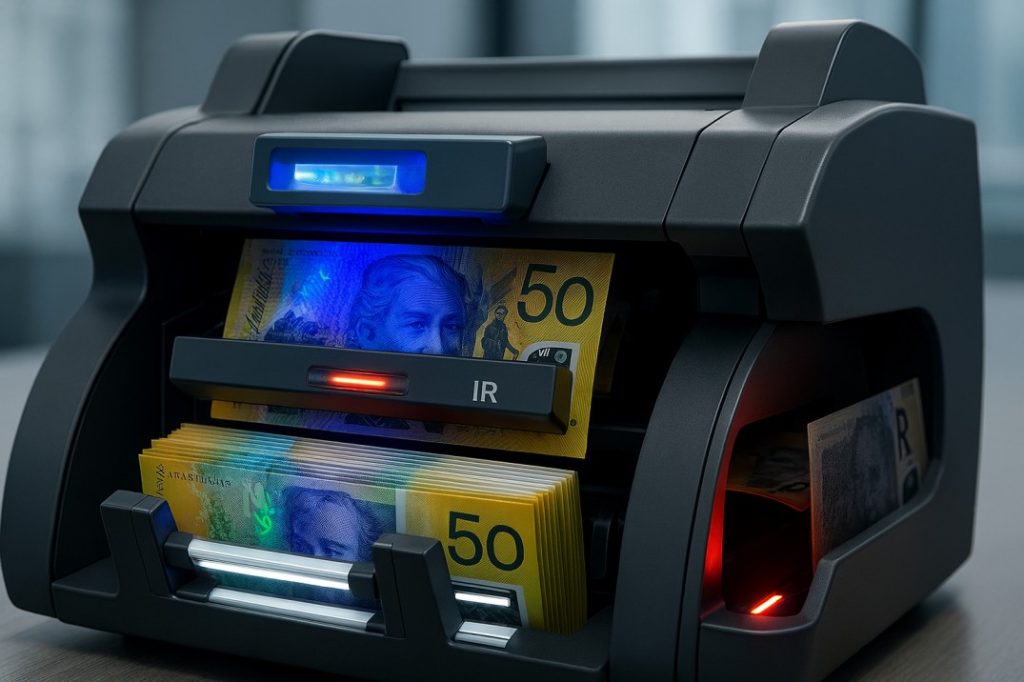
This is non-negotiable in 2026. UV-only detection — which is standard on cheap consumer notes counters — is not adequate for Australian polymer $50 and $100 notes. Sophisticated counterfeits can pass UV checks reliably. The minimum standard for reliable protection is UV combined with magnetic (MG) and infrared (IR) detection. Dual CIS colour image sensing is the gold standard. Every Cashcom professional notes counter machine uses all four methods simultaneously.
The practical implication: if a notes counter machine is marketed as having ‘UV detection’ with no mention of MG or IR, it is a consumer-grade unit. Do not use it as your primary counterfeit protection.
Must Have: Mixed Value Counting
Without mixed value counting, notes must be pre-sorted by denomination before the machine can count them. This requires 10–20 minutes of manual sorting per till — defeating much of the purpose of having a machine. With mixed value counting, load a completely unsorted stack and receive a denomination breakdown and total value automatically. Every Cashcom professional notes counter machine supports mixed value counting. Confirm this feature before purchasing any machine.
Nice to Have: Serial Number Logging
Most professional notes counter machines log the serial number of every note processed. For a small business, this is primarily useful when a dispute or suspected counterfeit arises after the fact — the log can show exactly when a specific note was processed and in which batch. Not critical for most small businesses but useful when it is needed.
Nice to Have: LAN Connectivity
LAN connectivity allows count data to be exported directly to networked systems — accounting software, reporting dashboards, or the cloud. For a small business with straightforward daily reconciliation, manually recording totals from the screen is not a significant burden. LAN becomes genuinely useful as the business grows to multiple tills or locations. The H110 includes a LAN port for when it is needed.
Skip for Small Business: Industrial Speed
The difference between 720 notes per minute and 1,500 notes per minute is the difference between processing 500 notes in 45 seconds versus 20 seconds. For a small business counting one till per day, this 25-second difference is not a meaningful operational consideration. Do not pay for industrial speed if your daily count is below 1,000 notes. Save that budget for detection depth instead.
Skip for Small Business: All-Day Continuous Design
Features like dust-free vertical paths and remote management are designed for machines that run for hours every day in banks, CIT operations, and large retail environments. A small business notes counter machine that runs for 5–10 minutes per day does not need these industrial-duty specifications. They add cost without adding value for a single-till daily count use case.
Our Recommended Notes Counter Machine for Small Business: The H110
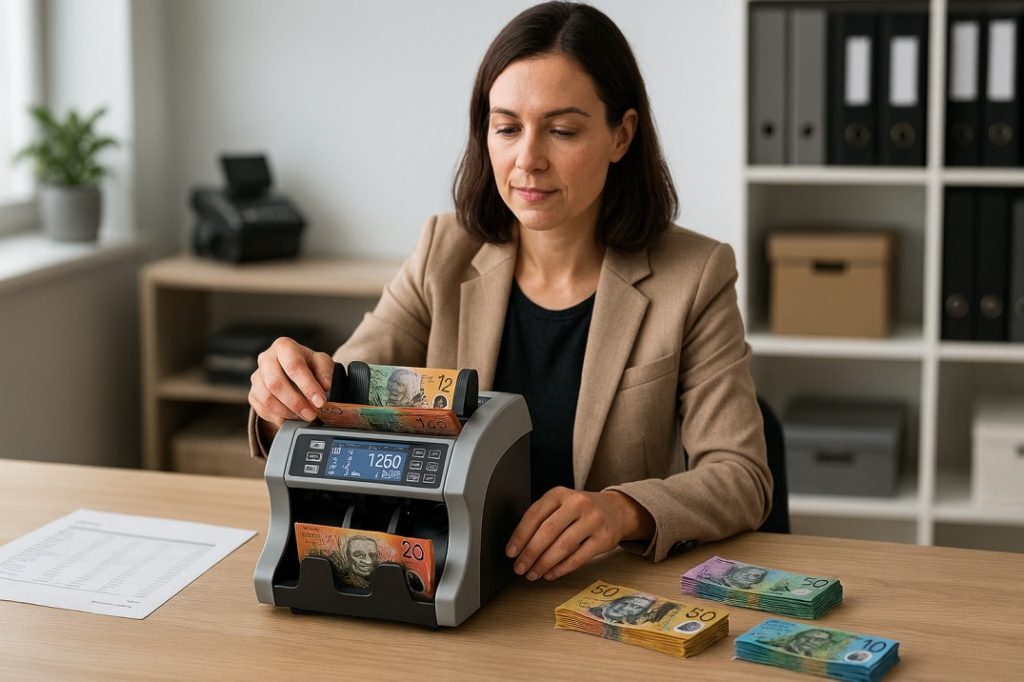
The Cashcom H110 Cash Counting Machine is the notes counter machine we recommend to small Australian businesses. Here is why it specifically addresses what a small business needs — without paying for what it does not.
| Specification | H110 Details |
| Counting Speed | 720 notes per minute |
| Detection | Dual CIS + UV + Magnetic (MG) + Infrared (IR) — all four simultaneously |
| Fitness Detection | 12 types: soil, tape, graffiti, stain, hole, tear, watermark, dog-ear, missing corner, missing edge, de-ink, double notes |
| Mixed Value Counting | Auto denomination recognition — AUD and major international currencies |
| Hopper Capacity | 500 notes |
| Stacker Capacity | 200 notes |
| Reject Pocket | 100 notes — automatic separation of suspect and damaged notes |
| Serial Numbers | Full logging, data analysis, statistical reports |
| Connectivity | LAN port + 2× USB + 1× Serial Port + optional printer |
| Compliance | CE, CB, FCC certified |
| Design | Compact desktop — fits any back-office counter |
| Best For | Small–medium business, 1–3 tills, daily cash reconciliation |
Why the H110 Is Right for Small Business
The H110 uses Dual CIS detection — the same core technology standard used in bank teller equipment and Reserve Bank processing machinery. This is not a marketing claim. Dual CIS means colour image sensors scan both faces of every note simultaneously and compare the images against a genuine note reference database. Combined with MG and IR, it provides the authentication depth that protects against the quality of counterfeits circulating in Australia in 2026.
The 500-note hopper is correctly sized for small business use. Most single-till businesses end the day with 200–400 notes. The H110 processes the entire till in a single load in under 45 seconds. No reloading required.
The LAN port and USB connectivity mean the H110 is future-proof as your business grows. If you expand to multiple tills or want count data to flow into your accounting system, the hardware is already there.
At 720 notes per minute, it is not the fastest machine in the Cashcom range. For a small business counting one till per day, it is exactly the right speed — fast enough to complete the count quickly, without paying for industrial throughput that adds no value to a single-session daily use case.
Read More: Complete notes counting machine guide
How to Get the Most From Your Notes Counter Machine
A professional notes counter machine is simple to use — most staff can operate it correctly within 5 minutes of first use. The following practices ensure you get accurate results consistently:
Prepare Notes Before Loading
Remove staples, paper clips, and elastic bands from note stacks before loading. Straighten folded or curled notes where possible. You do not need to sort by denomination — the machine handles mixed stacks. But removing foreign objects prevents jams and ensures every note passes through the sensor array cleanly.
Set the Right Counting Mode
For daily till reconciliation, use mixed value counting mode — this identifies denominations automatically and gives you a total value. For batch work where you want to count a specific number of notes (e.g. preparing a float), use batch mode with the H110’s preset batch function.
Check the Reject Pocket After Every Count
Any notes that fail authentication or fitness checks are routed to the reject pocket. Do not mix these back into the counted stack. Examine each rejected note manually — check the clear window, feel for raised print, check the serial number format. If a note appears suspect, do not deposit it. Contact your bank and local police.
Log the Count Results
Record the denomination totals from the screen against your expected figures. Even with a machine, end-of-day reconciliation requires comparing the counted total against the POS or cash register total. The machine handles the counting — you handle the comparison.
Clean Weekly
Wipe the hopper and external surfaces with a dry lint-free cloth weekly. Use manufacturer-approved cleaning cards monthly for sensor and roller cleaning. Keep coins, paper clips, and liquids away from the hopper. These simple maintenance habits extend the machine’s working life significantly.
Notes Counter vs Cash Counter vs Money Counter: Is There a Difference?
When small business owners search for cash counting equipment, they encounter several terms that seem to describe the same thing: notes counter, cash counter, money counter, notes counting machine, cash counting machine. The confusion is understandable.
In practice, these terms all describe the same type of equipment. A notes counter machine, cash counter machine, and money counter machine are all automated devices that count and authenticate banknotes. The terminology varies by industry, region, and preference — but the machines are functionally identical when describing the same specifications.
| Term Used | What It Means |
| Notes counter | Counts and authenticates banknotes (notes = paper/polymer money) |
| Cash counter | Same — ‘cash’ is used interchangeably with ‘notes’ in most contexts |
| Money counter | Same — broader term covering notes specifically in most products |
| Notes counting machine | Same — longer form of ‘notes counter’, more common in search queries |
| Cash counting machine | Same — longer form of ‘cash counter’ |
| Notes counter machine | Same — direct combination of the two most common variations |
The one distinction worth knowing: a ‘notes counter’ specifically processes banknotes. A ‘coin counter’ or ‘coin sorter’ processes coins. They are separate machines for separate functions. If your business handles significant volumes of coins daily alongside notes, the Con200 Coin Sorting Machine handles coins separately — no notes counter machine can sort coins.
When to Step Up from the H110 — and When to Step Down
Step Down: When the H110 Is More Than You Need
If your business processes fewer than 100 notes per day and primarily handles coins and small denominations, a basic UV + MG counter at a lower price point may be adequate. Contact Cashcom on 0451 353 676 — our team will give you an honest answer about whether the H110 is the right investment for your specific volume.
Step Up to the H210: When You Need Denomination Sorting
If you prepare denomination-specific banking bundles daily — separating your $5s, $10s, $20s, $50s, and $100s into separate piles for deposit — the H210 Money Counter and Sorter Machine does this automatically in the same pass as counting. For businesses currently spending 15+ minutes sorting notes after counting, the H210 eliminates that step.
Step Up to the LS-200: When Speed Becomes a Bottleneck
If you are counting 3+ tills per day and the H110’s 720 notes/min feels slow for your volume, the LS-200 at 1,500 notes/min (1,200 in value counting mode) and 600-note hopper handles significantly higher volumes without reloading. The 18-channel magnetic detection also provides greater protection depth for businesses with high $50 and $100 note volumes.
| Upgrade path:
H110 → H210 (add denomination sorting) → LS-200 (add speed and 18-channel MG) → LS-300 (add all-day design and remote management). Each step up addresses a specific operational need. There is no reason to start at H110 and stay there if your volume grows — Cashcom’s range has a clear upgrade path for every stage of business growth. |
Frequently Asked Questions
| Q: What is the best notes counter machine for a small business in Australia?
The Cashcom H110 Cash Counting Machine is the recommended notes counter for most Australian small businesses. It provides bank-grade Dual CIS detection combined with UV, magnetic, and infrared authentication — the detection standard needed for Australian polymer $50 and $100 notes in 2026 — at a price accessible to small businesses. 720 notes per minute processes a typical small business till in under 45 seconds. Call Cashcom on 0451 353 676 for a direct recommendation based on your daily volume. |
| Q: Does a small business really need a professional notes counter machine?
For any small business accepting cash daily, a professional notes counter machine saves meaningful staff time, provides reliable counterfeit protection, and creates an audit trail that manual counting cannot replicate. The time saving alone typically recovers the investment within 12 months. The counterfeit protection is valuable whenever it catches a fake $50 or $100 note that would otherwise be deposited and subsequently removed from your bank account. |
| Q: Is a notes counter machine the same as a cash counter machine?
Yes — notes counter machine, cash counter machine, and money counter machine are all terms for the same type of equipment. They describe automated devices that count and authenticate banknotes. The terminology varies by industry and preference but the machines are functionally identical. When comparing machines, focus on the specifications rather than the label used. |
| Q: How long does it take to learn to use a notes counter machine?
Most professional notes counter machines can be learned in under 5 minutes. The basic operation is: load notes into the hopper, select counting mode, press start, read the results. The H110’s button interface is straightforward and consistent. Most staff are fully comfortable operating it within their first shift. |
| Q: Do notes counter machines work with Australian polymer banknotes?
All Cashcom notes counter machines are configured specifically for Australian polymer banknotes. The detection parameters — UV fluorescence patterns, magnetic ink signatures, infrared absorption profiles, and CIS reference images — are all calibrated for AUD denominations ($5 through $100). This is an important distinction from cheap imported machines that may be configured for paper-based currencies and provide unreliable results for Australian notes. |
| Q: What should I do if the notes counter flags a suspect note?
Remove the flagged note from the reject pocket. Do not return it to the till. Examine it manually — check the clear window, feel for raised print, look for clean microprint. If it appears counterfeit, do not attempt to deposit it or return it to a customer. Contact your bank and local police. The H110’s serial number log will have recorded the serial number of the flagged note, which is useful evidence for any investigation. |
| Q: How much does a notes counter machine cost for a small business?
Professional notes counter machines suitable for small business use — with multi-method detection and mixed value counting — are available at prices that are accessible to most small businesses. Contact Cashcom on 0451 353 676 or email sales@cashcom.com.au for current pricing on the H110 Cash Counting Machine. Our team can confirm whether the H110 is the right investment for your specific volume and daily workflow. |
A professional notes counter machine is one of the most straightforward investments a cash-handling small business can make. The time saving is immediate and measurable. The counterfeit protection is reliable and ongoing. The audit trail is a genuine operational improvement over manual counting.
For most Australian small businesses — cafés, restaurants, boutique retail, service counters, small clubs — the H110 Cash Counting Machine provides everything needed. Bank-grade detection, mixed value counting, serial number logging, and LAN connectivity in a compact machine that pays for itself within a year of daily use.
If your volume grows, the upgrade path is clear. If you need denomination sorting now, the H210 is the step up. If you have three or more tills and speed matters, the LS-200 is the professional solution.
To find the right notes counter machine for your small business, call Cashcom on 0451 353 676, email sales@cashcom.com.au, or visit cashcom.com.au/products. Monday to Friday, 9am–6pm.