
| Quick Answer
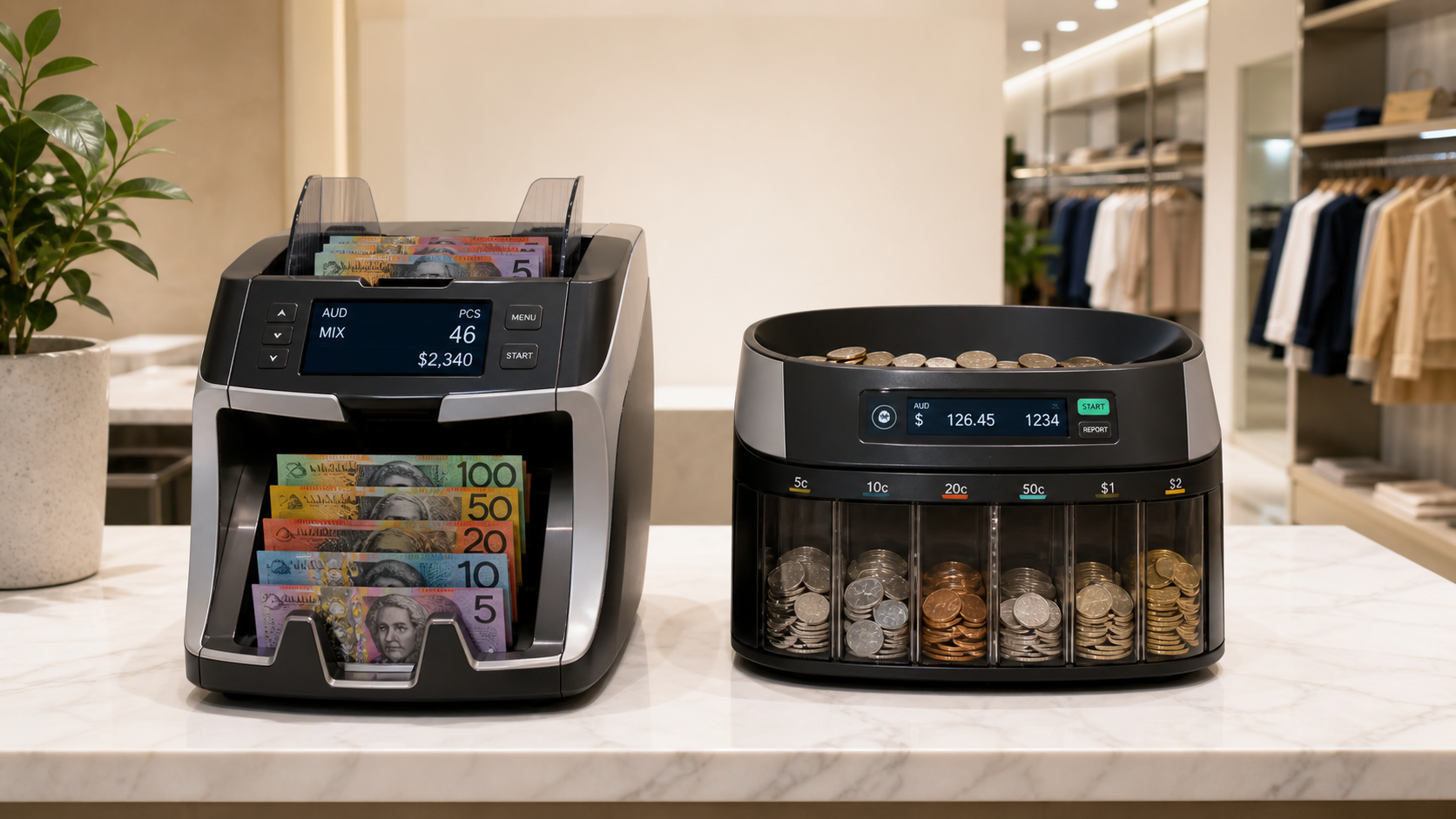
The short answer: note counters and coin counters are separate machines, and no single machine does both well. Whether you need both depends entirely on your cash mix. • Note counter only: if your business is primarily note-based with minimal coin handling — a restaurant, a boutique, most hospitality venues — a note counter like the Cashcom H110 covers your needs. Counting coins occasionally by hand is faster than buying and maintaining a second machine you use twice a week. • Both machines: if your business handles significant coin volume daily — a petrol station, a supermarket, a market stall, a laundromat, a high-volume café — you need both. Counting coins by hand at meaningful volume is time-consuming and error-prone. • Coin counter only: businesses that are almost entirely coin-based (laundromats, some vending operations) may only need the Con200 coin sorter, with banknote handling being minimal enough to manage manually. |
The Fundamental Rule: Note Counters Count Notes, Coin Sorters Count Coins
This sounds obvious until you are standing in front of a product listing that says ‘cash counting machine’ and wondering whether it handles the coins in your till drawer as well as the notes. It does not.
A note counter — also called a money counter, cash counter, or cash counting machine — is engineered to process flat polymer banknotes. Its transport mechanism uses rollers and sensors designed for the specific dimensions, weight, and security features of banknotes. Inserting coins into a note counter will jam the transport, damage the rollers, and potentially damage the counterfeit detection sensors.
A coin sorter — also called a coin counter or coin sorting machine — is engineered for the specific dimensions of Australian coins: 5c, 10c, 20c, 50c, $1, and $2. It uses gravity-fed sorting gates or rotating disc mechanisms calibrated to Australian coin diameters and weights. It cannot process banknotes.
These are two genuinely different machines solving two different problems. The question is not whether one machine can replace the other — it cannot — but whether your business generates enough coin volume to justify adding a dedicated coin sorter to your cash handling setup.
| A Note on Terminology
‘Cash counter,’ ‘money counter,’ ‘notes counter,’ and ‘cash counting machine’ are all names for the same equipment — a machine that counts banknotes. None of these terms implies coin-counting capability. A ‘coin counter’ or ‘coin sorter’ is a separate and distinct machine. See also: Cash Counter vs Money Counter vs Notes Counter: What’s the Difference? |
| A Day in the Life
A petrol station manager closes the shift at 10:00 pm. The day’s till includes a mixed stack of notes and a substantial collection of coins — the servo’s car wash machine and convenience store together generate hundreds of coin transactions daily. Without a coin sorter, a staff member spends 20–25 minutes manually sorting and counting coins into denomination bags for the banking deposit. With a Cashcom Con200 beside the H110, both machines run simultaneously: notes through the H110 in under 90 seconds, coins through the Con200 in under 4 minutes. The entire cash close is done in under 6 minutes. |
What Each Machine Does — and What It Cannot Do
| Feature | Note Counter (H110) | Coin Sorter (Con200) |
| Counts banknotes ($5–$100) | Yes | No |
| Counts coins (5c–$2) | No | Yes |
| Counterfeit detection (UV/MG/IR/CIS) | Yes | No (coins are authenticated differently) |
| Value counting (mixed denominations) | Notes only | Coins only |
| Sorts by denomination | Basic / H210 sorter | Separates all AUD coin denominations |
| Fitness detection | 12-type (H110) | No |
| Serial number logging | Yes | No |
| Processing speed | 720 notes/min (H110) | Coin-specific — contact Cashcom |
| Works without the other machine | For note-heavy operations | For coin-heavy operations |
When You Need a Coin Sorter Alongside Your Note Counter
High Coin Volume Is the Primary Trigger
The threshold question is straightforward: how long does it take you to manually count and sort your daily coins right now? If the answer is under five minutes, a coin sorter is a convenience purchase rather than a necessity. If the answer is fifteen minutes or more, a coin sorter is a genuine time-saving investment.
The types of businesses where coin volume typically justifies a dedicated sorter:
- Petrol stations and service centres: car wash machines, convenience stores, and multiple pump sites generate high coin volumes from both vending and over-the-counter transactions.
- Market stalls and festival vendors: cash-heavy, coin-intensive trading environments where every denomination appears and the day’s coin collection can fill a bag.
- Cafés and takeaway food: particularly those with under-$10 transactions where change dispensing is coin-heavy. A busy lunch café can accumulate 200–300 coins in a trading day.
- Supermarkets and convenience stores: high transaction volume, mixed coin change on most sales, multiple tills — coin counting by hand at this scale is a material cost.
- Laundromats and vending operators: coin-primary or coin-exclusive revenue collection — a coin sorter is the core cash handling equipment for these businesses.
- Parking stations: coin-fed metres and pay machines generate large denomination-sorted coin collections that need processing for banking.
Float Preparation Is the Second Trigger
Beyond counting the day’s takings, businesses that prepare coin floats for multiple tills each morning benefit significantly from a coin sorter. Manually counting and bagging $200 worth of coins into specific denominations for three or four tills is a 15–20 minute task. A coin sorter completes the same sort and count in under five minutes, outputting denomination-separated coin bags or rolls ready for the till.
Banking Preparation
Banks and credit unions accept coins for deposit in denomination-sorted bags. If your business is banking coin regularly, having a coin sorter that outputs sorted, counted bags saves time at the teller window and reduces the risk of a rejected deposit due to incorrectly sorted or miscounted coin bags.
When a Note Counter Alone Is Probably Enough
Not every business that handles cash needs a coin sorter. The coin volume argument does not apply to businesses where coins are a minor part of daily cash handling:
- Restaurants and full-service dining: billing tends toward rounded figures or card payment, and coin change on cash transactions is modest. A small coin tray manually counted at close is a five-minute task.
- Boutique retail: higher-value per-transaction businesses generate less coin change per sale. A boutique averaging $80 per transaction generates far less daily coin than a café averaging $6.
- Service businesses (hairdressers, salons, tradies): service payments are often rounded or card-based. Coin handling is minimal.
- B2B businesses: companies invoicing other businesses rather than serving the public typically have little or no coin handling.
For these businesses, a Cashcom H110 note counter covers the cash handling workload entirely. Adding a coin sorter would provide marginal benefit at meaningful additional cost.
What About “Combo” Machines That Count Both?
Combination note-and-coin machines exist in the market — devices that claim to count both banknotes and coins in a single unit. In practice, these compromise on both functions:
- Note-counting quality suffers when the machine is also engineered to handle coins — the transport mechanism for banknotes requires different tolerances than coin-sorting gates.
- Coin-sorting accuracy on combo machines is typically lower than a dedicated coin sorter — particularly for edge cases like worn 5c and 10c coins that have similar diameters.
- Combo machines are typically consumer-grade rather than commercial-grade on both functions — meaning UV-only counterfeit detection on the note side, and less precise sorting on the coin side.
- Build quality sufficient for daily commercial use on both functions simultaneously is difficult to achieve at an accessible price point.
For businesses that genuinely need both functions daily, two separate purpose-built machines — a Cashcom H110 and a Con200 — will outperform any combo unit on accuracy, detection depth, and longevity. The total cost of two commercial-grade single-function machines is typically comparable to the cost of a quality combo machine, with significantly better performance on both tasks.
| Our Honest Assessment on Combo Machines
We do not stock combo note-and-coin machines, which gives us an obvious interest in recommending against them. But the practical advice stands regardless of that: for daily commercial use, a dedicated note counter and a dedicated coin sorter each do their respective jobs better than any combo machine at a comparable price point. If counter space is the limiting factor and coin volume is low, managing coins manually alongside a quality note counter is usually the better trade-off than a compromise combo machine. |
The Cashcom Note Counter and Coin Sorter
| Cashcom H110 — Note Counter
The right note counter for most Australian small-to-medium businesses Detection: Dual CIS + UV + MG + IR (4-method simultaneous) Speed: 720 notes per minute Hopper / Stacker / Reject: 500-note / 200-note / 100-note Fitness Detection: 12-type fitness detection Serial Numbers: Full serial number logging Connectivity: LAN + 2x USB + Serial + optional printer Denominations: AUD $5, $10, $20, $50, $100 — all current and older polymer series Verdict: The H110 handles the note side of any Australian business’s cash handling — counting, authenticating, and value-totalling mixed denomination note stacks at 720 notes per minute. It does not handle coins, and it should not be used to try. Pair it with the Con200 if your business generates significant daily coin volume. View product → https://cashcom.com.au/products/h110 |
| Cashcom Con200 — Coin Sorting Machine
Dedicated coin sorter for Australian coin denominations (5c through $2) Function: Coin sorting and counting — separates AUD coins by denomination Denominations: 5c, 10c, 20c, 50c, $1, $2 — full Australian coin set Output: Denomination-sorted coin bags or rolls ready for banking or float preparation Verdict: The Con200 is the coin-side complement to the H110. For businesses with daily coin volume that makes manual sorting a meaningful time cost — petrol stations, market traders, supermarkets, high-volume cafés — the Con200 completes the cash close process that the H110 starts. Contact Cashcom for current Con200 specifications and configuration options. View product → https://cashcom.com.au/products/con200 |
Decision Guide: Which Setup Does Your Business Need?
Use the table below to match your business type and cash mix to the right machine configuration.
| Business Type | Cash Mix | Note Counter? | Coin Sorter? | Recommended Setup |
| Café / coffee shop | Mostly notes; some coin change | Yes | Optional | H110. Con200 if coin float prep is slow. |
| Petrol station | Mixed notes and coins, busy volume | Yes | Yes | H110 + Con200 |
| Pharmacy / chemist | Mostly notes; small coin float | Yes | Optional | H110. Con200 if multi-till coin is an issue. |
| Market / festivals | Very mixed — high coin proportion | Yes | Yes | H110 + Con200 |
| Supermarket / large retail | High volume, both notes and coins | Yes | Yes | LS-200 + Con200 |
| Restaurant / pub | Notes dominant; some coin | Yes | Optional | H110. Add Con200 if coin float is daily pain. |
| Vending / parking operator | Coin-dominant or coin-only | Optional | Yes | Con200 minimum; H110 if banknotes also handled |
| Laundromat | Almost all coin | No | Yes | Con200 only |
| Gaming venue / club | Notes + TITO; coins managed by TRU | Yes | Depends | K2 Cash Recycler; TRU typically handles coins |
| Quick Calculation
A petrol station spending 20 minutes manually sorting and counting coins at the end of each trading day, six days a week, spends approximately 104 hours per year on coin counting alone. At award retail rates, that is roughly $2,700–$3,100 in annual labour cost. A Cashcom Con200 processes the same coin collection in under 4 minutes — returning over 90 hours of staff time per year. The machine pays for itself in recovered labour within the first year of use. |
Signs You Need a Coin Sorter — and Signs You Probably Don’t
Why You Should Add a Coin Sorter?
- Manual coin counting at end of day takes more than 10 minutes.
- You prepare denomination-sorted coin floats for multiple tills each morning.
- You bank coin regularly and spend time at the teller sorting coins for deposit.
- You run a high-transaction-volume business where coins are a significant proportion of change.
- You operate a coin-primary business (laundromat, vending, parking).
Signs You Can Probably Manage Without One
- Your daily coin collection takes under five minutes to count manually.
- You primarily take card payments with only occasional cash transactions.
- Your business has high per-transaction values where coin change is minimal.
- You run a single till with light daily volume and coin handling is genuinely incidental.
Frequently Asked Questions
| Question | Answer |
| Can a cash counting machine count coins? | No. Cash counting machines — also called note counters, money counters, or cash counters — are designed for banknotes only. Inserting coins into a note counter will jam the transport mechanism and can damage the sensors. Coins require a dedicated coin sorting machine like the Cashcom Con200. |
| Do I need both a note counter and a coin sorter for my business? | It depends on your coin volume. If your daily coin handling takes under five minutes to count manually, a note counter alone covers your needs. If manual coin counting takes 15 minutes or more, a dedicated coin sorter saves meaningful time and pays for itself in recovered labour. |
| What is the difference between a coin counter and a coin sorter? | A coin sorter separates coins by denomination into individual output compartments and counts each denomination simultaneously. A basic coin counter counts the total number of coins without separating denominations. Commercial machines like the Con200 typically do both — sort and count — in the same pass. |
| Are there machines that count both notes and coins together? | Combination machines exist but compromise on both functions. For daily commercial use, two dedicated machines — a note counter and a coin sorter — outperform combo units on accuracy, detection depth, and durability. Counter space permitting, this is the recommended setup for businesses with meaningful note and coin volume. |
| What Australian coin denominations does the Cashcom Con200 handle? | The Cashcom Con200 handles the full set of Australian coin denominations: 5c, 10c, 20c, 50c, $1, and $2. Contact Cashcom on 0451 353 676 for current Con200 specifications and configuration options. |
| How do I count the coins in my float if I only have a note counter? | Manually, using a coin tray with denomination compartments. For businesses where coin float preparation is a recurring daily task across multiple tills, a coin sorter significantly reduces the time required. For businesses with a single till and modest coin float, manual counting with a coin tray is workable. |
Set Up the Right Cash Handling Configuration for Your Business
Whether you need a note counter only, a coin sorter only, or both, Cashcom can recommend the right configuration for your daily cash mix and volume.
Call: 0451 353 676 | Email: sales@cashcom.com.au | Web: cashcom.com.au
Also see: How to Choose a Cash Counting Machine for a Small Business in Australia — for the full decision framework on choosing the right note counter for your volume and workflow.
About the Author
This article was prepared by the Cashcom Team, Australian Cash Handling Specialists since 2015. Cashcom supplies and services cash counting, sorting and recycling equipment for retail, hospitality, banking, gaming and cash-in-transit businesses across Australia.
Get in touch: 0451 353 676 | sales@cashcom.com.au | cashcom.com.au