
| A Note on Terminology
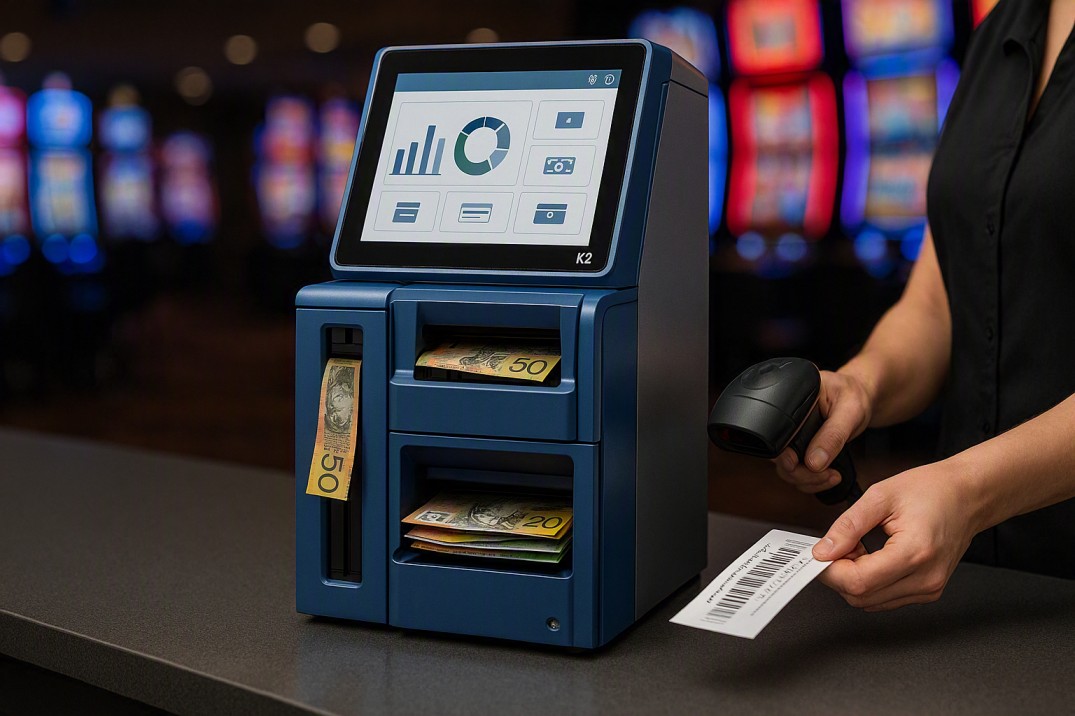
Notes recycler, cash recycler, and money recycler all refer to the same equipment category. This guide uses these terms interchangeably. The Cashcom K2 Cash Recycler is the specific model covered in this post and is the only recycler in the Cashcom range with optional TITO integration. |
| Quick Answer
For Australian gaming venues — clubs, pubs with gaming machines, and casinos — a notes recycler needs to do more than count and recycle cash. It needs to: • Accept and process TITO vouchers: gaming machines issue cash-out tickets (TITO) that patrons redeem for cash. A recycler with TITO integration handles this redemption automatically, without manual cashier processing. • Carry a full four-layer detection stack: UV + MG + IR + CIS. Gaming venues process high note volumes from the public — the highest-risk environment for counterfeit exposure outside of bank branches. • Maintain a per-employee, per-transaction audit trail: PIN-based accountability is a regulatory expectation in licensed gaming environments, not just a convenience feature. • Handle extended operating hours reliably: clubs and casinos trade well beyond normal retail hours; the machine needs to perform under continuous, sustained use. The Cashcom K2 Cash Recycler with optional TITO module covers all four requirements. It is the only machine in the Cashcom range with TITO integration. |
Why Gaming Venues Have Different Cash Handling Requirements
A licensed gaming venue in Australia — whether it is a registered club, a hotel with gaming machines, or a casino — operates a cash handling environment that differs from retail or hospitality in three important ways.
First, the volume. Gaming venues process significantly higher note volumes than most retail operations, concentrated in bursts around peak gaming periods. A busy club can process thousands of notes in a single evening session — a volume that makes manual cash handling both slow and error-prone.
Second, the regulatory context. Licensed gaming venues in Australia operate under state-based gaming authority oversight — ILGA in NSW, VGCCC in Victoria, and equivalent bodies in other states. These regulators have specific expectations around cash transaction records, audit trails, and accountability for cash handling staff. A notes recycler that does not produce a per-employee, per-transaction log does not meet this standard.
Third, the TITO workflow. Most modern Australian gaming machines operate on a Ticket-In Ticket-Out (TITO) system — players insert cash, play, and receive a printed voucher for their remaining credits rather than a coin payout. Redeeming those vouchers for cash is a core cashier function in every gaming venue, and a notes recycler with TITO integration automates it.
| A Day in the Life
It is Friday at 9:15 pm at a busy licensed club in Western Sydney. The gaming floor is at capacity across 30 machines. A patron approaches the cashier desk with a TITO voucher showing $127.50. The cashier scans the voucher at the K2 Cash Recycler’s integrated reader. The machine validates the voucher, counts out $127.50 in the optimal denomination mix from its internal cassettes — one $100 note, one $20, one $5, and two $1 coins — and records the transaction against the cashier’s PIN and the voucher’s unique barcode. The patron receives their cash in under 15 seconds. The cashier never manually counts notes. The transaction is logged and reconciled automatically. Across an evening session with 200 TITO redemptions, that 15-second automated process — versus 45–60 seconds of manual counting per redemption — represents roughly 2.5 hours of cashier time returned to the floor. |
What Is TITO and How Does a Notes Recycler Fit In?
TITO — Ticket-In Ticket-Out — is the system that replaced coin-based payouts in Australian gaming machines. Instead of coins falling into a tray, a gaming machine prints a thermal voucher showing the player’s credit balance as a dollar value. The player takes the voucher to a cashier or a self-service ticket redemption unit (TRU) to receive cash.
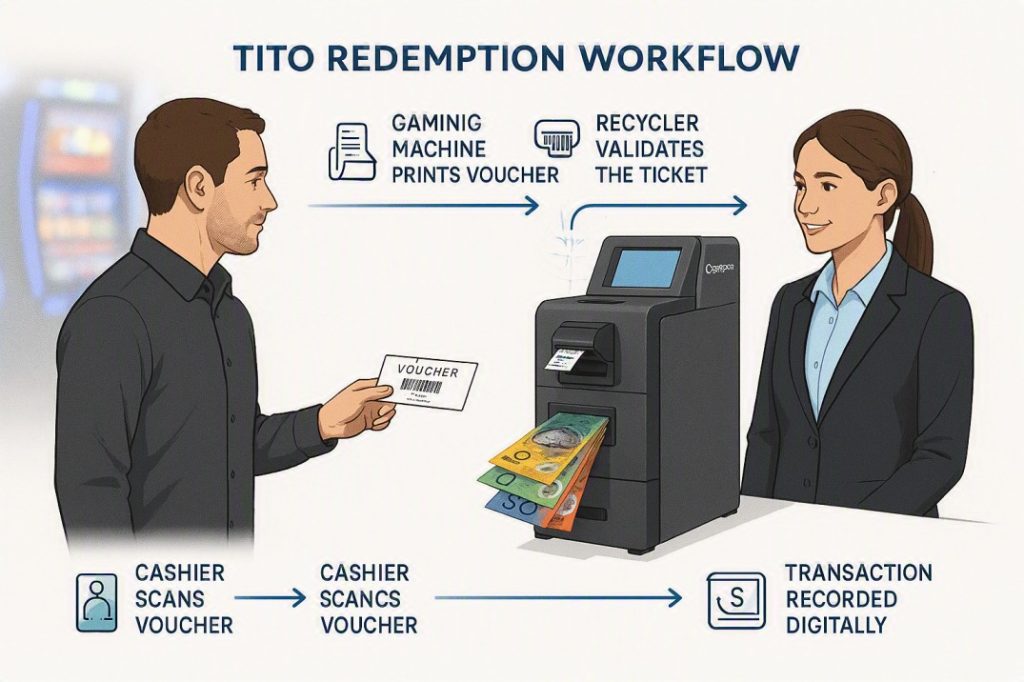
A notes recycler with TITO integration sits at the cashier desk and acts as both the cash storage and dispensing point for voucher redemptions. The cashier scans the TITO voucher’s barcode, the recycler validates it against the gaming system’s voucher database, and dispenses the cash value from its denomination cassettes — logging the transaction against the operator’s PIN.
| TITO Stage | What Happens | Recycler’s Role |
| Patron inserts cash | Player feeds banknotes into the gaming machine’s bill acceptor | Recycler manages the venue’s cash float; notes ultimately cycle through the recycler |
| Gaming machine issues voucher | When the patron cashes out, the gaming machine prints a TITO ticket (barcode) showing the credit value | No direct recycler involvement at this stage |
| Patron redeems voucher | Patron takes the TITO ticket to the cashier desk or a ticket redemption unit (TRU) | With TITO integration, the recycler accepts the voucher, validates it, and dispenses the cash value — automatically |
| Cash dispensed | Patron receives cash for the value on the voucher | Recycler counts out the denomination mix and dispenses from its internal cassettes; transaction logged per operator |
| Audit and settlement | Venue reconciles TITO voucher totals against gaming machine records | Recycler’s transaction log provides the cash-out record per voucher, per operator, and per session for reconciliation |
What “TITO Integration” Actually Means in Practice
TITO integration on a notes recycler is not a universal standard — it is a specific hardware or software connection between the recycler and the venue’s gaming management system (GMS). Before purchasing a recycler for a gaming venue, confirm:
- Protocol compatibility: the recycler’s TITO module must support the protocol used by your gaming management system. Common protocols include SAS (Slot Accounting System) and G2S (Game to System). Confirm compatibility with your GMS vendor before ordering.
- Voucher validation: the recycler should validate TITO vouchers against the GMS in real time — not just read the barcode value. A voucher that has already been redeemed or has expired should be rejected, not paid out.
- Settlement reporting: the recycler’s TITO transaction log should produce a settlement report compatible with your venue’s end-of-session gaming reconciliation process.
Contact the Cashcom team on 0451 353 676 to confirm K2 TITO compatibility with your specific gaming management system before purchasing.
What a Notes Recycler for a Gaming Venue Must Have
Beyond TITO, gaming venues require a notes recycler that meets a higher standard across several dimensions than a typical retail or hospitality machine. The requirements table below maps each requirement to its gaming-specific rationale and the K2’s coverage.
| Requirement | Why It Matters in Gaming | K2 Coverage |
| TITO (Ticket-In Ticket-Out) integration | Gaming machines issue cash-out tickets; recycler must accept and process TITO vouchers alongside cash notes | Optional TITO module |
| Full UV + MG + IR + CIS detection | High cash throughput increases counterfeit risk exposure; 4-method detection is the minimum standard | Standard |
| PIN-based per-employee audit trail | Regulatory requirement in licensed gaming environments; every cash transaction must be attributable to an operator | Standard |
| Multi-currency capability | Tourist and international patron environments handle foreign currency notes alongside AUD | Up to 7 currencies |
| High hopper capacity (1,000+ notes) | Clubs and casinos process large note volumes during peak periods; frequent reloads create service interruptions | 1,000-note hopper |
| LAN connectivity for central reporting | Gaming regulators may require centralised cash transaction records accessible by venue management | Standard LAN |
| Denomination-to-fitness sorting | Unfit notes must be separated from circulation; gaming venues handle high proportions of heavily circulated notes | Single-pass sorting |
| All-day continuous operation rating | Clubs and casinos operate across extended trading hours; machine must perform reliably under sustained use | Commercial-grade build |
Counterfeit Detection in a Gaming Environment
Gaming venues face a specific counterfeit risk profile that differs from retail. Two factors drive this:
- High anonymous cash volume: gaming patrons often pay in cash without the kind of staff scrutiny that a retail transaction involves. A busy cashier processing TITO redemptions and cash purchases simultaneously under time pressure is more vulnerable to accepting a sophisticated counterfeit than a teller at a bank branch.
- Worn note concentration: gaming venues recirculate notes heavily. Notes that have been through a machine’s bill acceptor multiple times accumulate wear faster than notes in general retail circulation, increasing the proportion of borderline reads on older notes.
For these reasons, UV-only detection is not appropriate for gaming venue use. The minimum standard is UV plus MG plus IR — and for venues processing high volumes, CIS detection adds a full-image verification layer that catches sophisticated counterfeits that the other three methods alone can miss. The Cashcom K2 runs all four simultaneously as standard.
Audit Trail Requirements in Licensed Gaming Venues
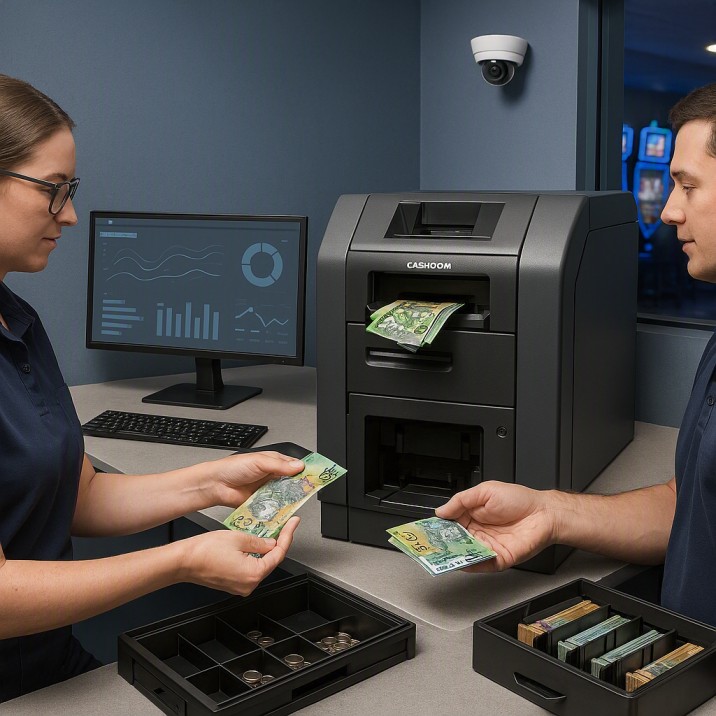
Australian gaming regulators require licensed venues to maintain records of cash transactions sufficient to support both internal reconciliation and regulatory audit. In practice, this means:
- Every cash-in and cash-out transaction must be attributable to a specific operator — not just a shift or a session.
- TITO voucher redemptions must be recorded against the voucher’s unique barcode, the cash amount paid, the time of redemption, and the operator who processed it.
- Session totals must reconcile against gaming machine electronic meters and the venue’s gaming management system.
- Records must be retained in a format accessible to both venue management and, on request, the relevant gaming authority.
The Cashcom K2’s PIN-based per-employee audit trail covers the operational layer of these requirements — every transaction is logged against an individual operator PIN, timestamped, and exportable via LAN. For venues with specific regulatory reporting requirements, confirm the K2’s output format against your GMS and reporting obligations before purchasing.
| ⚠️ Important: Regulatory Compliance Is Venue-Specific
Cash handling requirements for licensed gaming venues vary by state and venue type (registered club, hotel, casino). The requirements described in this guide reflect general industry standards and common regulatory expectations — they are not legal advice and do not substitute for review of your venue’s specific licence conditions and the requirements of your state gaming authority. Confirm your venue’s specific cash handling, audit trail, and reporting requirements with your gaming operations manager or compliance officer before purchasing any cash handling equipment. |
Multi-Currency Capability: Relevant for Larger Gaming Venues
Larger gaming venues — particularly those in tourist-heavy areas, near international airports, or operating casino floors — regularly receive foreign currency notes from international patrons. A notes recycler that handles AUD only creates a manual exception process for every non-AUD note received.
The Cashcom K2 handles up to 7 currencies simultaneously. For most suburban clubs and regional pubs, this is a non-issue — AUD is the only currency in play. For Crown-type casino environments, city clubs with high international patron volumes, or gaming venues near airports, the multi-currency capability is a meaningful operational feature rather than a specification detail.
The Cashcom K2 Cash Recycler — Gaming Venue Specification
| Cashcom K2 Cash Recycler
📌 The only recycler in the Cashcom range — with optional TITO integration for gaming venue environments Detection: Full UV + MG + IR + CIS (4-method simultaneous) Speed: 1,000 notes per minute (value counting) Hopper: 1,000-note capacity Sorting: Denomination-to-fitness sorting in a single pass Currency: Up to 7 currencies handled simultaneously TITO: Optional TITO (Ticket-In Ticket-Out) integration module Audit: PIN-based, per-employee audit trail Connectivity: LAN connectivity for central reporting and remote management Verdict: The K2 is built for exactly the cash handling environment that gaming venues operate in — high note volume, extended hours, multiple operators, regulatory audit requirements, and the unique TITO voucher redemption workflow that licensed clubs and casinos manage daily. No other machine in the Cashcom range provides TITO integration; the K2 is the correct and only choice for gaming environments requiring it. View product → K2 Cash Recycler Sorter Machine |

Signs Your Gaming Venue Needs a Notes Recycler with TITO Integration
- Your cashier desk processes more than 50 TITO voucher redemptions per session — manual cash counting is creating queue time and service pressure.
- You have experienced TITO redemption errors — incorrect cash amounts paid out, redeemed vouchers accepted a second time, or disputes over payout amounts.
- Your current cash handling equipment does not produce a per-employee transaction log — a compliance gap in a licensed gaming environment.
- Your venue processes high note volumes across extended trading hours and your current machine was not designed for continuous operation at that volume.
- You handle foreign currency notes from international patrons and currently process them as a manual exception.
- Your gaming operations manager or compliance officer has flagged cash handling audit trail gaps in a regulatory review.
| 💡 Quick Calculation
A gaming venue processing 200 TITO voucher redemptions per evening session at an average of 45 seconds per manual redemption spends approximately 90 minutes of cashier time on redemptions alone, per session. At 5 sessions per week, that is 7.5 hours of cashier time weekly. At the K2’s automated processing time of approximately 15 seconds per redemption, the same 200 redemptions take 50 minutes — returning 40 minutes per session, or over 3 hours per week, to the floor. Across a full year of operation, that is over 150 hours of cashier time recovered from a single operational change. |
| ⚠️ Our Honest Assessment
A notes recycler with TITO integration is a significant investment, and it is not the right equipment for every licensed venue. A small pub with 5 gaming machines and modest TITO redemption volume may find that a quality cash counter and a standard TITO terminal are a more cost-effective combination than an integrated recycler. The K2 earns its place in gaming environments where TITO redemption volume is high, where cashier time is genuinely constrained during peak sessions, and where the regulatory audit trail requirement makes per-employee transaction logging a necessity rather than a convenience. If your venue sits in that description, the K2 is the right machine. If it does not, contact the Cashcom team — we will tell you honestly whether a simpler solution fits better. |
Frequently Asked Questions
| Question | Answer |
| What is TITO integration on a notes recycler? | TITO (Ticket-In Ticket-Out) integration means the notes recycler can accept, validate, and process gaming machine cash-out vouchers. When a patron presents a TITO ticket at the cashier desk, the recycler reads the voucher’s barcode, validates it against the gaming management system, and dispenses the cash value from its internal cassettes — automatically, with the transaction logged against the operator’s PIN. |
| Does the Cashcom K2 work with all gaming management systems? | The K2’s TITO module supports integration with major gaming management system protocols. Compatibility depends on the specific GMS used in your venue. Contact the Cashcom team on 0451 353 676 to confirm compatibility with your system before purchasing. |
| What counterfeit detection standard should a gaming venue notes recycler have? | At minimum, UV plus MG plus IR detection running simultaneously. For gaming venues processing high note volumes, CIS (Contact Image Sensor) detection adds a full-image verification layer that is strongly recommended. The Cashcom K2 runs all four detection methods simultaneously as standard. |
| Is a per-employee audit trail required for gaming venues in Australia? | Australian gaming regulators generally require cash transactions to be attributable to specific operators. The K2’s PIN-based per-employee audit trail meets this operational requirement. Confirm your venue’s specific regulatory obligations with your compliance officer or state gaming authority. |
| Can a notes recycler handle both cash and TITO vouchers? | Yes — with TITO integration, the K2 handles both incoming cash notes and incoming TITO vouchers in a single workflow. Cash is authenticated, sorted, and stored in the denomination cassettes as normal. TITO vouchers are validated against the GMS and the cash value is dispensed from the cassettes. |
| What is the difference between a notes recycler and a cash counter for a gaming venue? | A cash counter authenticates and counts notes, then outputs them to a stacker — it does not store or dispense notes, and it does not handle TITO vouchers. A notes recycler stores authenticated notes and dispenses them on demand, with TITO integration for voucher redemption. For gaming venues with meaningful TITO redemption volume, the recycler is the operationally correct choice. |
| Does the Cashcom K2 handle foreign currency notes? | Yes — the K2 handles up to 7 currencies simultaneously, making it suitable for gaming venues that regularly receive non-AUD notes from international patrons. |
Talk to Cashcom About the K2 for Your Gaming Venue
Cashcom has supplied cash handling equipment to Australian gaming venues since 2015. If you are evaluating a notes recycler with TITO integration for your club, pub, or casino — or want to confirm K2 compatibility with your gaming management system — contact the team for a no-obligation discussion.
Call: 0451 353 676 | Email: sales@cashcom.com.au | Web: cashcom.com.au
Also see: Cash Recycler Machine Australia: Complete Buyer’s Guide 2026 — for a full overview of recycler features, specifications, and buying considerations before making a decision.
About the Author
This article was prepared by the Cashcom Team, Australian Cash Handling Specialists since 2015. Cashcom supplies and services cash counting, sorting and recycling equipment for retail, hospitality, banking, gaming and cash-in-transit businesses across Australia.
Get in touch: U20, 22-24 Princes Road East, Auburn, 2144 | 0451 353 676 | sales@cashcom.com.au | cashcom.com.au