
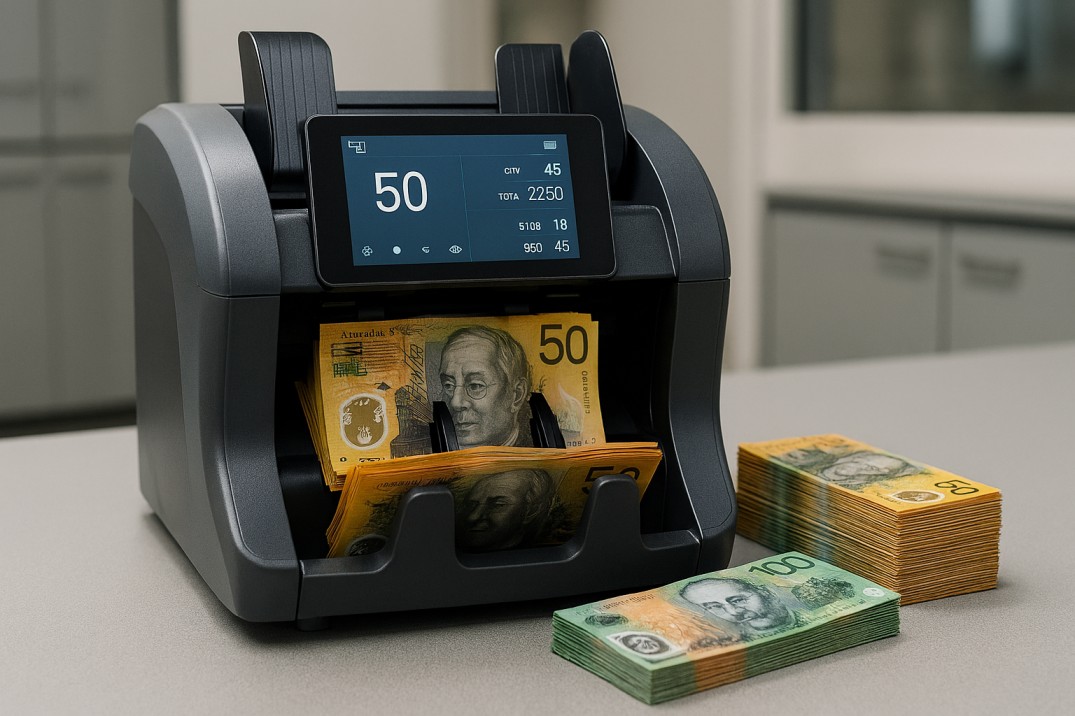
Counting notes by hand at the end of a trading day is one of the most persistently inefficient tasks in any cash-handling business. It is slow — a trained person counting carefully processes 200–300 notes per minute at best. It is error-prone — fatigue, distraction, and interrupted counts create miscounts that require recounts. And it provides no counterfeit protection — a fake $50 or $100 note that passes a manual check goes straight into the banking deposit.
A professional notes counting machine eliminates all three problems simultaneously. Notes are processed at 720–1,500 per minute depending on model, authentication runs against all four detection methods on every note, and the entire process is completed before a manual count of the same stack would be halfway finished.
What Is a Notes Counting Machine?
A notes counting machine — also called a note counter machine, cash counting machine, money counting machine, or cash counter — is an automated device that processes a stack of banknotes through a sensor array, counting the quantity and total value while simultaneously authenticating each note for counterfeits and physical damage.
The process is simple in practice: load a stack of notes into the hopper, press start, and within seconds you have a complete count. On a professional notes counting machine, that count includes the total value across all denominations (mixed value counting), a breakdown by denomination, any suspect notes separated into a reject pocket, the serial number of every note logged, and the results exportable via USB or LAN to your accounting or reporting system.
What separates a professional notes counting machine from a basic consumer counter is the detection capability. Consumer machines use UV only — a single detection method that was adequate a decade ago but is insufficient for Australian polymer notes in 2026. Professional machines combine Dual CIS colour imaging, magnetic detection, infrared analysis, and UV in a simultaneous four-method check that provides reliable authentication for every note in every count.
How a Notes Counting Machine Works
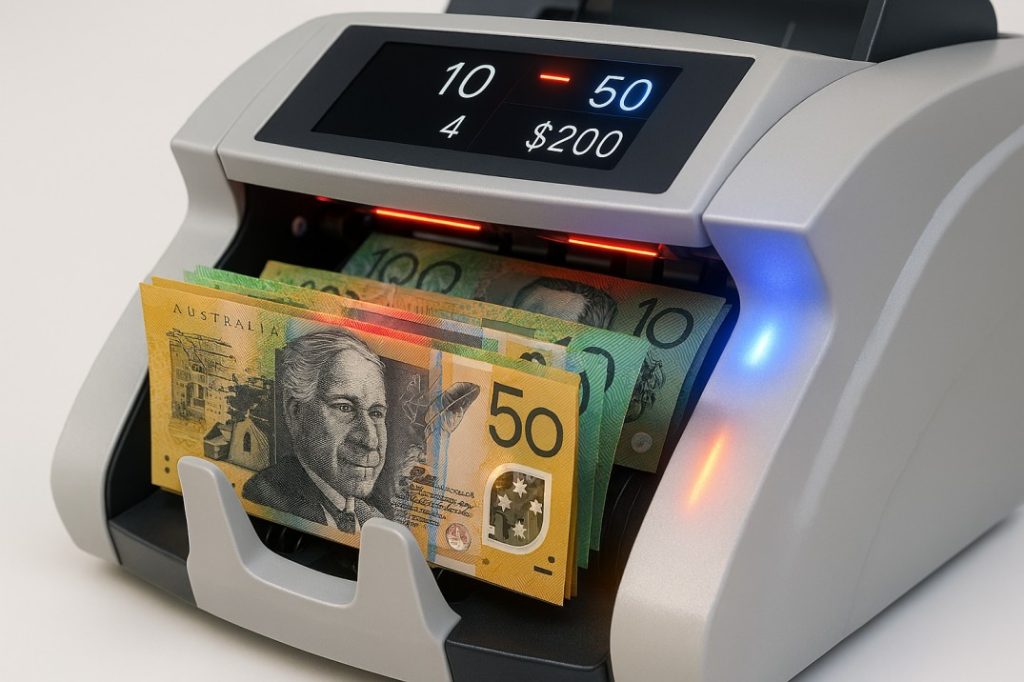
Understanding how a notes counting machine processes each note helps explain why the specifications matter and what the numbers on the spec sheet actually mean in practice.
Step 1 — Note Feeding
Notes are loaded into the input hopper — a tray that holds the note stack while the machine processes them one at a time. The hopper capacity (typically 500–1,000 notes on professional machines) determines how many notes can be processed without stopping to reload. A feed mechanism separates individual notes from the stack and draws them through the machine at the rated counting speed.
Step 2 — Sensor Array Authentication
As each note passes through the machine’s sensor zone, four detection checks run simultaneously in under 30 milliseconds:
- UV check: Ultraviolet sensors verify the UV-fluorescent security markings on the note. Genuine Australian polymer notes have specific UV patterns unique to each denomination.
- MG check: Magnetic sensors read the magnetic ink patterns printed on genuine notes. Each denomination has a unique magnetic signature that commercial counterfeit inks cannot replicate reliably.
- IR check: Infrared sensors measure the IR absorption profile of the note’s inks — a chemical property of genuine security inks that differs by denomination and cannot be replicated by standard printing.
- CIS imaging: Colour Image Sensors capture full-colour images of both note faces and compare them against a genuine note database in real time. Dual CIS scans both faces simultaneously for maximum coverage.
Step 3 — Denomination Identification
The combined sensor data identifies the denomination of each note — the machine does not require notes to be pre-sorted. This is mixed value counting: load a random stack of $5, $20, $50, and $100 notes together, and the machine identifies each denomination as it passes and maintains separate counts and totals.
Step 4 — Routing
Authenticated notes in good condition are routed to the output stacker. Notes that fail authentication go to the dedicated reject pocket — physically separated from the counted stack so they can be identified and examined. On machines with denomination sorting (H210, LS-200, LS-300), notes are also routed to separate output pockets by denomination during this step.
Step 5 — Output and Logging
The screen displays the count results — total value, denomination breakdown, and number of rejected notes. Serial numbers are logged for every note processed. Results can be exported via USB, printed, or transmitted via LAN to connected systems. The entire process for a 500-note stack takes under 45 seconds on a machine running at 720 notes per minute.
Types of Notes Counting Machines
The notes counting machine market covers several distinct types of equipment, and knowing which type you need is the first buying decision to make.
Notes Counter (Count Only)
Counts and authenticates notes, provides a total value and denomination breakdown on screen, and routes all notes to a single output stack. No physical denomination sorting. The right choice for businesses that need fast, accurate end-of-day reconciliation and do not need denomination-separated output. The H110 is the Cashcom machine in this category.
Notes Sorter (Count + Physical Denomination Sorting)
Does everything a counter does, plus physically routes notes into separate output pockets by denomination, orientation, and fitness condition during the count. One pass produces a counted, authenticated, denomination-sorted output ready for banking preparation. The right choice for businesses that currently sort notes manually after counting. The H210, LS-200, and LS-300 are the Cashcom machines in this category.
Multi-Currency Notes Counter
Counts and authenticates notes across multiple currencies — up to 60 on the H-880 and H-890 — with full 4-method detection for every supported currency. The right choice for tourism retail, duty-free, hospitality near international precincts, and currency exchange operations. The H-880 and H-890 are the Cashcom machines in this category.
Industrial Notes Counting Machine
Designed for all-day continuous operation at sustained high throughput — 1,200–1,500 notes per minute — with deep detection capability (18-channel MG, 21-channel ultrasonic) and remote management. The right choice for banks, CIT operations, large retail, and gaming venues that process thousands of notes across multiple shifts. The LS-300 and Newton-3-F are the Cashcom machines in this category.
Cash Recycler with Notes Counting
Combines notes counting with cash recycling — authenticated notes are stored and can be dispensed on demand as change or float. The right choice for operations that need automated float management as well as counting. The K2 Cash Recycler is the Cashcom machine in this category.
| Business Type | Recommended Machine Type |
| Single-till small business | Notes counter — H110 |
| Multi-till retail needing sorted output | Notes sorter — H210 or LS-200 |
| Tourism retail, multi-currency | Multi-currency counter — H-880 or H-890 |
| Bank, CIT, all-day industrial use | Industrial counter — LS-300 or Newton-3-F |
| Club, gaming, automated float management | Cash recycler — K2 |
Key Features Explained — What the Specifications Actually Mean
Counting Speed
Measured in notes per minute. This is the most visible spec and the one most buyers focus on — often incorrectly. Here is the practical reality: at 720 notes per minute, a 500-note stack is processed in under 45 seconds. At 1,500 notes per minute, it takes under 20 seconds. For most businesses counting one or two tills per day, both speeds are far faster than the problem. Speed becomes a genuine operational factor when you are processing 3,000+ notes per day across multiple tills in high-pressure time windows.
Mixed Value Counting
The ability to count notes of different denominations in a single unsorted pass. Without this, you must pre-sort notes by denomination before counting — typically 10–20 minutes of manual sorting per till. With mixed value counting, load the till’s notes unsorted and receive a complete denomination breakdown and total value automatically. Every professional Cashcom notes counting machine supports mixed value counting.
Detection Methods: Dual CIS + UV + MG + IR
The combination that matters. Dual CIS (colour image sensor) captures full-colour images of both note faces for comparison against genuine note references. UV detects ultraviolet security markings. MG (magnetic) reads magnetic ink patterns. IR (infrared) checks the ink’s chemical absorption profile. All four running simultaneously provides reliable authentication for Australian polymer notes in 2026. UV-only detection is not adequate.
Hopper Capacity
How many notes the machine holds in its input tray. 500 notes (H110, H210) is appropriate for most small to medium businesses. 600 notes (LS-200) suits higher-volume operations. 1,000 notes (K2) is the largest in the Cashcom range, designed for high-volume gaming and retail operations where reloading frequently interrupts workflow.
Fitness Detection
The ability to identify and separate notes that are worn, soiled, torn, or otherwise unfit for re-circulation. Categories include soil, tape, graffiti, holes, tears, dog-ears, missing edges, and double-fed notes. Notes that fail fitness checks are routed to the reject pocket. For businesses preparing banking deposits, fitness sorting ensures that bundled notes meet the bank’s acceptable condition standards.
Serial Number Logging
The machine reads the unique serial number printed on each note during processing and creates an exportable log. For businesses that accept large volumes of $50 and $100 notes, serial number logs provide an audit trail that supports counterfeit investigations and disputed transaction resolution.
LAN Connectivity
Allows count data to be exported directly from the machine to networked accounting or reporting systems. For multi-location businesses, LAN-connected machines allow centralised reporting of daily cash totals without manual data entry. The LS-200 and LS-300 have LAN connectivity as standard. The H110 includes a LAN port.
The Cashcom Notes Counting Machine Range — Reviewed
Every notes counting machine in the Cashcom range is configured specifically for Australian polymer notes. Here is an honest review of each machine and who it is designed for.
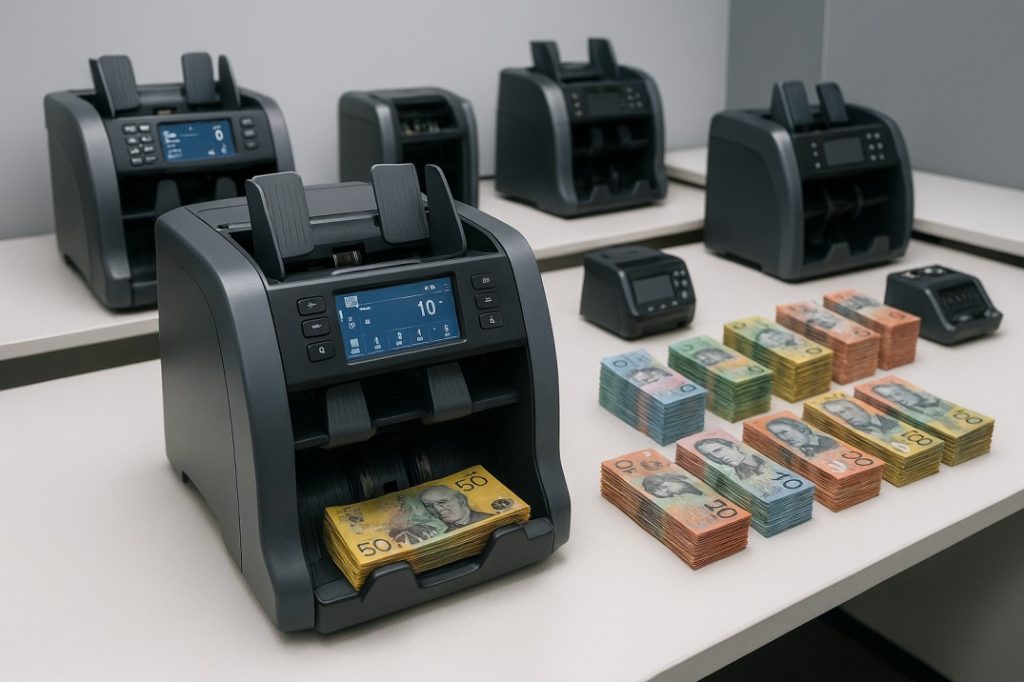
H110 Cash Counting Machine | Best for: Small–medium business, 1–3 tills |

The H110 is the benchmark professional notes counting machine for Australian small and medium businesses. Bank-grade Dual CIS detection at an accessible price. Processes 500 notes in under 45 seconds. Serial number logging provides an audit trail that manual counting cannot match. The starting point for any business that counts cash daily. • Counting Speed: 720 notes/min • Detection: Dual CIS + UV + MG + IR — bank-grade • Mixed Value: Auto denomination recognition — AUD and major currencies • Fitness Detection: 12 types including soil, tape, watermark, hole, dog-ear • Serial Numbers: Full logging, data analysis, statistical reports • Hopper: 500 notes | Stacker: 200 | Reject: 100 • Connectivity: LAN + 2x USB + Serial — optional printer • Compliance: CE, CB, FCC certified View Product: https://www.cashcom.com.au/product/h110-cash-counting-machine/ |
H210 Money Counter and Sorter Machine | Best for: Denomination sorting + detection in one pass |

The H210 adds physical denomination sorting to counting — one pass delivers sorted, authenticated output ready for banking. For businesses that currently sort notes by hand after counting, the H210 eliminates that step entirely. 900 notes per minute counting, 750 notes per minute sorting. • Counting Speed: 900 notes/min • Sorting Speed: 750 notes/min • Output: 3 pockets: 2 sorted exits + 1 rejection outlet • Detection: Double-face counterfeit identification • Damage Detection: Dirt, tape, dog-ear, crack, hole, dimension, double notes • Serial Numbers: Real-time ID — queryable by serial, operator, batch • Hopper: 500 notes | 2 sorted exits + 1 rejection outlet View Product: https://www.cashcom.com.au/product/h210/ |
LS-200 Note Counter Machine | Best for: Multi-till retail, 1,200 notes/min with 18-channel MG |

The LS-200 is the speed step-up for businesses that have outgrown the H110 or H210. At 1,200 notes/min in value counting mode, it processes 600 notes in under 30 seconds. The 18-channel magnetic system scans the full note width — catching magnetic ink anomalies that narrower sensors miss. • Counting Speed: 1,500 notes/min (piece) | 1,200 notes/min (value + authentication) • Detection: Dual CIS + UV + MG 18-channel + IR + Ultrasonic 21-channel (F version) • Hopper: 600 notes | Stacker: 200 | Reject: 100 • Sorting: Denomination, face, orientation — real-time serial OCR • OS: Linux — stable for continuous daily use • Connectivity: LAN, USB, RS-232 • Display: 4.3-inch wide touch screen View Product: https://www.cashcom.com.au/product/ls-200-note-counter/ |
LS-300 Note Counter Machine | Best for: All-day continuous operation, banks, large retail, CIT |

The LS-300 is the flagship notes counting machine for operations that run the machine all day, not just end-of-session. The dust-free vertical path eliminates the progressive jam risk of horizontal-path machines under continuous use. Remote upgrade keeps detection current as new AUD note series are issued — no technician visit required. • Value Count Speed: 1,200 notes/min (value + authentication) • Detection: Dual CIS + UV + MG 18-channel + IR + Ultrasonic 21-channel • Key Feature: Dust-free vertical path — all-day jam-resistant continuous operation • Remote Upgrade: Currency database updated via LAN — no service visit required • Currency: 48 currencies (20 auto-recognition) • Display: 4.3-inch touch screen + stacker side LED • Connectivity: LAN, USB, RS-232 — real-time monitoring + remote management View Product: https://www.cashcom.com.au/product/ls-300-note-counter/ |
H-880 / H-890 Note Counting Machine | Best for: 60-currency coverage, tourism, duty-free, ECB-certified |

For businesses that regularly handle foreign currencies alongside AUD — tourism retail, duty-free, airport hospitality, currency exchange — the H-880 and H-890 provide full 4-method detection across all 60 supported currencies. 100% ECB certification confirms independently verified detection accuracy. • Detection: CIS Image + Magnetic + Infrared + UV — full 4-method • Currencies: Up to 60 currencies including AUD, USD, EUR, GBP, JPY, SGD, AED • Certification: 100% ECB (European Central Bank) pass rate • Serial Numbers: Real-time OCR reading across all currencies • Display: Large TFT touch panel • Connectivity: RS-232, USB, SD card View Product: https://www.cashcom.com.au/product/h-880/ |
Newton-3-F Note Counter Machine | Best for: 24/7 continuous operation, banks, CIT, casinos |

The Newton-3-F is the notes counting machine for operations that run continuously — not just during business hours. Dual-sided IR and dual-sided CIS scan both faces of every note simultaneously. The in-screen note image display is unique in the Cashcom range — operators can visually verify any flagged note without removing it from the processing flow. • Counting Speed: 1,500 notes/min (piece) | 1,200 notes/min (all modes simultaneously) • Detection: UV + IR two-sided + Magnetic + Dual CIS both faces + Dimension + Ultrasonic • Special Feature: Scanned note image displayed on 4.3-inch colour screen for visual verification • Duty Cycle: Designed for 24/7/365 continuous operation • OS: Linux • Dimensions: 312mm × 340mm × 340mm | Weight: ~11kg View Product: https://www.cashcom.com.au/product/newton-3-f/ |
Full Specification Comparison — All Cashcom Notes Counting Machines
| Specification | H110 | H210 | LS-200 | LS-300 | H-880/890 | Newton-3-F |
| Type | Counter | Sorter | Hi-Speed | Industrial | Multi-FX | 24/7 Ind. |
| Speed (value) | 720/min | 900/min | 1,200/min | 1,200/min | High | 1,200/min |
| Mixed Value Count | Yes | Yes | Yes | Yes | Yes | Yes |
| Denomination Sort | No | Yes | Yes | Yes | No | Yes |
| Fitness Sort | Yes | Yes | Yes (F ver) | Yes | No | Yes |
| Dual CIS | Yes | Yes | Yes | Yes | Yes | Yes both faces |
| 18-ch MG | No | No | Yes | Yes | No | Yes |
| Ultrasonic | No | No | Yes (21ch) | Yes (21ch) | No | Yes |
| Serial Numbers | Yes | Yes | Yes | Yes | Yes | Yes |
| LAN | Yes | No | Yes | Yes | No | Yes |
| Remote Upgrade | No | No | No | Yes | No | No |
| Touch Screen | No | No | Yes | Yes | Yes | Yes |
| Hopper | 500 notes | 500 notes | 600 notes | N/A | N/A | N/A |
| Best Volume/Day | <3,000 | <5,000 | 3k–10k | 10,000+ | Multi-FX | 24/7 |
Quick Matcher — Find Your Notes Counting Machine in 60 Seconds
| Your Situation | Best Cashcom Machine |
| Single till, café or small retail, daily count | H110 — bank-grade detection, compact, LAN |
| 2–3 tills, need denomination-sorted output | H210 — counts + sorts in one pass |
| Multi-currency, tourism, duty-free, international | H-880 or H-890 — 60 currencies, ECB certified |
| 3–5 tills, 3,000–10,000 notes/day, LAN reporting | LS-200 — 1,500/min, 18-channel MG |
| All-day continuous, bank, large retail, CIT | LS-300 — dust-free, remote upgrade |
| Gaming, club, automated float management | K2 Cash Recycler — 1,000-note hopper, dispensing |
| 24/7 bank or CIT cash centre | Newton-3-F — dual-sided sensors, 24/7 spec |
| Growing business, not sure yet | H110 — clear upgrade path to any model above |
| Notes + coins, complete daily reconciliation | H110 or H210 + Con200 Coin Sorter — full solution |
Notes Counting Machines and Australian Polymer Banknotes
Australian banknotes are printed on polymer substrate — biaxially oriented polypropylene film — rather than the paper used in most other countries. This material difference has direct implications for notes counting machine purchasing decisions in Australia.
Why AUD Configuration Matters
Detection parameters for UV fluorescence, magnetic ink patterns, and infrared absorption are all calibrated differently for polymer notes versus paper notes. A notes counting machine calibrated for USD or EUR paper notes will produce unreliable authentication results for AUD polymer notes — either missing counterfeits or generating excessive false-positive rejects. All Cashcom notes counting machines are supplied configured for Australian currency.
The 2026 Counterfeit Landscape
Australian polymer notes are among the most counterfeit-resistant in the world — but not immune. Reserve Bank data consistently shows $50 and $100 notes as the most commonly counterfeited denominations. In 2026, high-quality counterfeits can pass UV-only detection reliably. Multi-method detection combining UV, MG, IR, and CIS imaging is the reliable standard for authentication of high-value Australian polymer notes.
Note Updates and Currency Database Currency
Note Printing Australia periodically updates note designs and security features. When a new note series is issued, notes counting machines may need updated detection databases to correctly authenticate the new design. The LS-300’s remote upgrade capability handles this automatically via LAN. Other models are updated via USB when updates are released. Cashcom notifies customers of relevant updates for machines in their range.
Frequently Asked Questions
| Q: What is a notes counting machine?
A notes counting machine — also called a note counter machine, cash counting machine, or money counting machine — is an automated device that processes a stack of banknotes, counting the quantity and total value of each denomination while simultaneously authenticating every note for counterfeits and physical damage. Professional notes counting machines run four detection methods simultaneously (UV, magnetic, infrared, and CIS colour imaging) and complete a 500-note count in under 45 seconds. |
| Q: What is the best notes counting machine for a small business in Australia?
The Cashcom H110 Cash Counting Machine is the recommended notes counting machine for most Australian small businesses. It uses Dual CIS colour imaging combined with UV, magnetic, and infrared detection — bank-grade authentication capability — at 720 notes per minute. It includes LAN connectivity, serial number logging, and 12-type fitness detection. For businesses that also need denomination-sorted output, the H210 adds this capability. Call Cashcom on 0451 353 676 for a direct recommendation based on your daily volume. |
| Q: How does a notes counting machine detect fake Australian notes?
Professional notes counting machines detect counterfeits using four methods simultaneously: UV (checks ultraviolet security markings), MG (reads magnetic ink patterns unique to each denomination), IR (measures the infrared absorption of security inks), and CIS (captures full-colour images of both note faces and compares them against genuine note references). Counterfeit notes typically fail one or more of these checks and are automatically routed to the machine’s reject pocket, separated from the authenticated stack. |
| Q: What is mixed value counting in a notes counting machine?
Mixed value counting is the ability to count and identify notes of different denominations in a single unsorted pass. Without this feature, notes must be pre-sorted by denomination before counting. With mixed value counting, load a stack of unsorted $5, $20, $50, and $100 notes together and the machine identifies each denomination automatically as it passes through, providing a complete denomination breakdown and total value. All Cashcom professional notes counting machines support mixed value counting. |
| Q: What is the difference between a notes counter and a notes sorter?
A notes counter counts and authenticates notes, providing a denomination breakdown and total value on screen — all notes end up in a single output stack. A notes sorter does everything a counter does plus physically routes notes into separate output pockets by denomination, orientation, and fitness condition during the count. If you currently sort notes by hand after counting, a notes sorter eliminates that step. The Cashcom H210, LS-200, and LS-300 are notes sorters. |
| Q: How fast does a professional notes counting machine process notes?
Professional notes counting machines in the Cashcom range process notes at 720–1,500 notes per minute depending on model. In practice: the H110 at 720 notes/min processes 500 notes in under 45 seconds. The LS-200 at 1,200 notes/min (in value counting mode) processes 600 notes in under 30 seconds. For most small and medium businesses, any machine above 700 notes/min is faster than the bottleneck — speed becomes a material factor for businesses counting 3,000+ notes per day. |
| Q: Do notes counting machines work with Australian polymer banknotes?
Professional notes counting machines purchased from Cashcom are configured specifically for Australian polymer banknotes. They are calibrated for the UV fluorescence, magnetic ink patterns, infrared absorption profiles, and CIS reference images of Australian $5, $10, $20, $50, and $100 polymer denominations. This is an important distinction from imported machines that may be configured for paper-based currencies — AUD configuration is not automatic and must be confirmed before purchase. |
| Q: Where can I buy a notes counting machine in Australia?
Cashcom supplies professional notes counting machines to Australian businesses from our base in Haberfield, NSW. Our range covers every business size — from the H110 for small retail to the LS-300 for banks and CIT operations. We ship to all states and territories. Browse the full range at cashcom.com.au/products/, call 0451 353 676, or email sales@cashcom.com.au. Monday to Friday, 9am–6pm. |
The Right Notes Counting Machine for Your Business
The notes counting machine market in Australia in 2026 covers a wide range — from entry-level professional machines for small business to industrial 24/7 equipment for banks and CIT operators. The right choice is not about buying the most capable machine available. It is about matching the machine’s capability to your actual daily operation.
For most Australian small and medium businesses — a café, restaurant, retail store, or small club with 1–4 tills — the H110 provides everything needed: bank-grade Dual CIS detection, mixed value counting, serial number logging, LAN connectivity, and 720 notes per minute in a compact machine that takes two minutes to learn. The step up to the H210 is for businesses that need denomination-sorted output. The LS-200 is for businesses where counting speed across multiple tills is a genuine bottleneck.
For banks, large retail, CIT operations, and gaming venues — where the notes counting machine runs continuously, detection must be maximised, and remote management matters — the LS-300 and Newton-3-F are the appropriate tools. For businesses needing the full cash recycling cycle including automated dispensing, the K2 Cash Recycler addresses requirements a standard notes counting machine cannot.
To find the right notes counting machine for your business, call Cashcom on 0451 353 676, email sales@cashcom.com.au, or browse the full range at cashcom.com.au/products. Monday to Friday, 9am–6pm.