
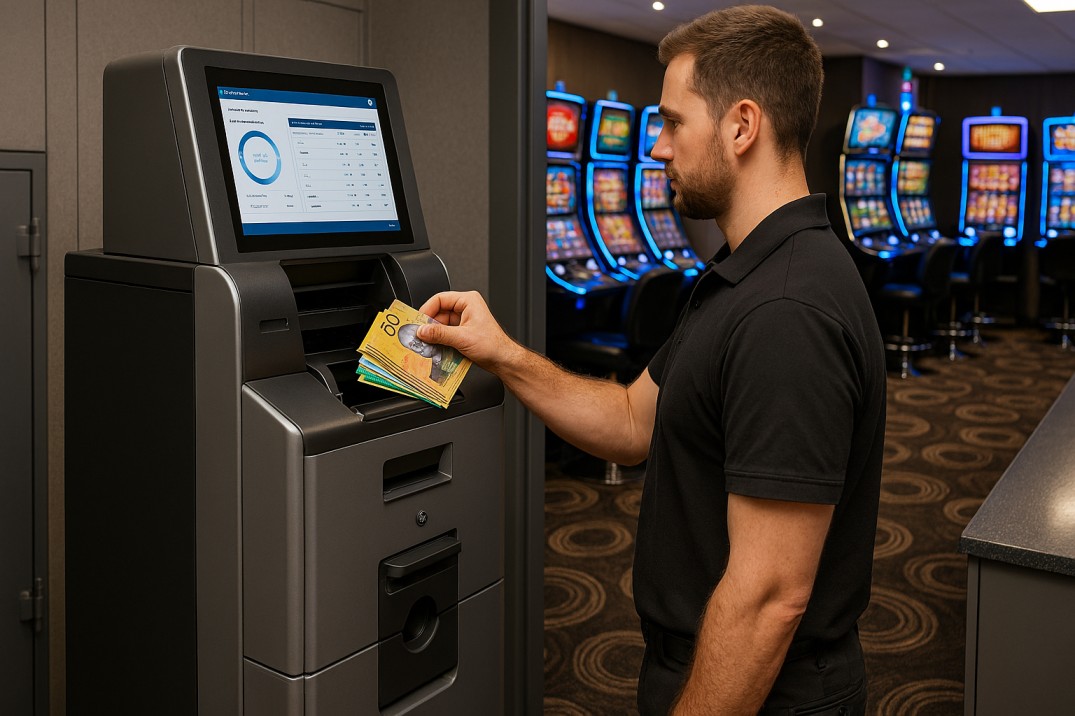
Licensed clubs and gaming venues in Australia operate with a cash handling complexity that most other businesses simply do not face. Gaming machine collections happen continuously throughout the day. Bar and bistro cashiers need float replenishment across multiple shifts. Membership and TAB transactions add additional cash streams. Staff rotate across positions on rosters that span from 10am to midnight. And the accountability requirements — both internal governance and regulatory compliance — demand a complete audit trail for every cash movement.
A standard money counter handles the end-of-day counting problem. A cash recycler machine handles the full operational cash management challenge — collecting from gaming points, making change available on demand, maintaining denomination inventory, and logging every transaction against an employee identifier throughout the entire trading day.
This guide identifies what clubs and gaming venues specifically need from a cash recycler machine, covers the key buying criteria in detail, and explains why the Cashcom K2 Cash Recycler Sorter Machine is the recommended solution for Australian gaming environments in 2026.
| 💡 Quick answer:
The best cash recycler machine for Australian clubs and gaming venues is the Cashcom K2 Cash Recycler Sorter Machine. Its 1,000-note hopper handles full floor collection runs without reloading, full 4-method detection meets the authentication standard for Australian polymer notes, and the optional TITO integration processes gaming tickets alongside cash in a single unit. Call 0451 353 676 to discuss deployment for your venue. |
Why Clubs and Gaming Venues Have Unique Cash Handling Requirements
The cash management challenge in a licensed club or gaming venue is fundamentally different from retail, hospitality, or most other commercial cash environments. Understanding these differences is the starting point for choosing the right equipment.
Multiple Simultaneous Cash Streams
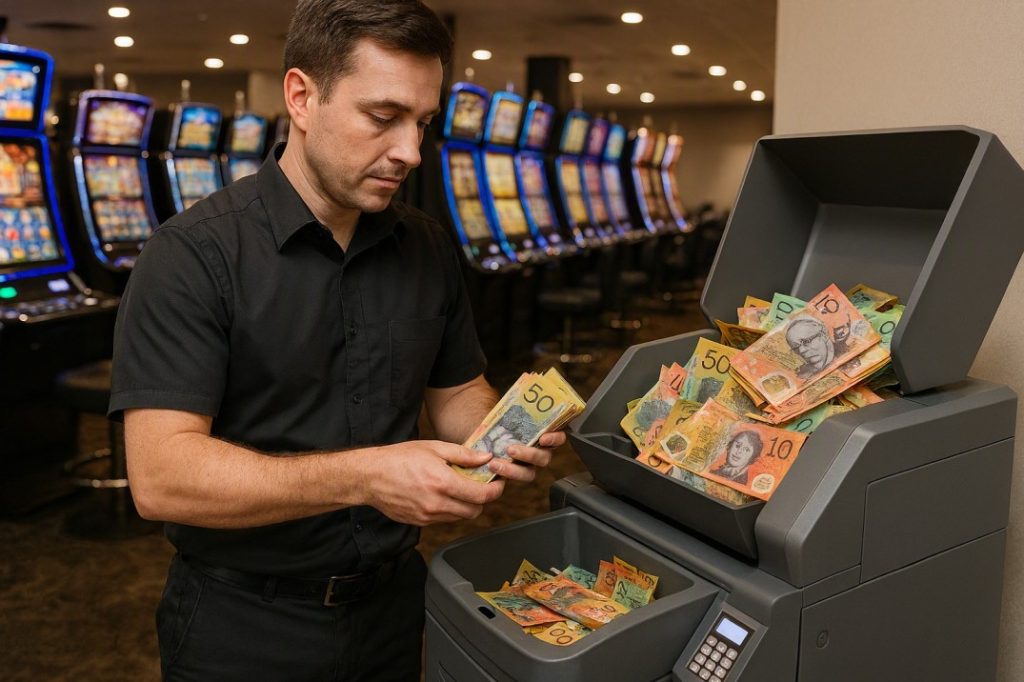
A typical licensed club generates cash from electronic gaming machines (EGMs), the bar, the bistro, the TAB, vending, and possibly events and membership payments — all running simultaneously throughout the trading day. Each stream has different denomination patterns, different collection timing, and different accountability requirements. Managing all of these through a single cash recycler machine with clear separation by source is a core operational need.
High $50 and $100 Note Volumes
Gaming environments see disproportionately high volumes of $50 and $100 notes — players typically feed machines with larger denominations. This has two cash handling implications. First, the authentication capability of the cash recycler machine must be genuinely reliable for these denominations — UV-only detection is not adequate for Australian polymer $50 and $100 notes in 2026. Second, the machine’s change dispensing capability must handle a range of smaller denominations for bar and bistro change requirements.
TITO Ticket Processing
Modern EGMs in Australian clubs and gaming venues use Ticket-In, Ticket-Out (TITO) technology — players cash out credits as a printed ticket rather than coins or notes. These tickets are redeemed at ticket redemption terminals or the cashier cage. A cash recycler machine that also processes TITO tickets eliminates a separate processing step and consolidates cash and ticket accounting in a single system.
Staff Rotation and Accountability
A club operating from 10am to midnight with multiple shifts, relief staff, and rotating gaming floor attendants has a significantly larger group of staff accessing cash than a typical retail operation. Per-employee transaction logging — every deposit and withdrawal attributed to an individual PIN — is not a convenience feature in this environment. It is a governance and compliance requirement. The audit trail from a professional cash recycler machine is the documentary evidence that internal cash handling was conducted correctly.
Regulatory Environment
Licensed clubs and gaming venues in Australia operate under state-based gaming regulation that includes cash handling requirements. The detailed transaction logs produced by a professional cash recycler machine support compliance with AML/CTF obligations and internal audit requirements. While a cash recycler machine is not itself a compliance solution, its transaction records are a valuable component of a compliant cash management framework.
What to Look for in a Cash Recycler Machine for Clubs and Gaming Venues
-
TITO Ticket Integration
This is the most gaming-specific feature to check. A cash recycler machine with TITO integration processes both cash notes and gaming tickets, allowing gaming floor staff to handle all cash and ticket transactions at a single machine. Without TITO integration, clubs run two separate systems — a cash recycler for notes and a separate ticket validator — creating additional workflow steps and two separate reconciliation records.
Not all cash recycler machines support TITO, and those that do may require specific configuration for your gaming system. Always confirm TITO compatibility with your gaming platform before purchasing.
-
Hopper Capacity
Gaming floor collection runs generate large note volumes from many EGMs in quick succession. A machine with a 500-note hopper requires reloading mid-collection for most floor runs. A 1,000-note hopper — as on the Cashcom K2 — handles a full floor collection from a medium-sized gaming floor in a single load. This is a practical operational differentiator that directly affects how much staff time the cash recycler machine consumes per collection run.
-
Detection Reliability for $50 and $100 Notes
Given the high proportion of $50 and $100 notes in gaming environments, the authentication capability of the cash recycler machine must reliably detect counterfeits in these denominations. In 2026, UV-only detection is not sufficient. Look for machines with combined UV, magnetic (MG), infrared (IR), and CIS colour image detection. The K2 Cash Recycler uses all four methods simultaneously.
-
Per-Employee Access Control and Audit Trail
Individual PIN access with transaction-level logging is essential in a multi-staff gaming environment. Every deposit and withdrawal should be attributed to a specific employee identifier with timestamp and denomination detail. This is the foundation of cash accountability in a regulated gaming operation.
-
Multi-Currency Support
Gaming venues in tourist areas or near major international hotels may encounter foreign currency notes. A cash recycler machine with multi-currency detection handles these without a separate processing step. The K2 supports up to 7 currencies simultaneously with auto-detect.
-
Fitness Sorting
EGMs recirculate notes heavily — the same notes pass through gaming machines many times before being banked. This means gaming environments see a higher proportion of worn, folded, and slightly damaged notes than most other cash businesses. A cash recycler machine with fitness sorting separates unfit notes from fit ones automatically, ensuring only notes in acceptable condition are stored for re-dispensing as change.
The Cashcom K2 Cash Recycler Sorter Machine — Best for Australian Clubs
Having supplied cash handling equipment to Australian clubs, gaming venues, entertainment operations, and CIT operators since 2015, the K2 Cash Recycler Sorter Machine is Cashcom’s recommended cash recycler machine for the gaming and club environment. Here is why it specifically addresses the requirements of this sector.
| Specification | K2 Cash Recycler Details |
| Counting Speed | 1,000 notes per minute (value counting) |
| Fitness Sort Speed | 800 notes per minute |
| Hopper Capacity | 1,000 notes — handles full floor collection runs without reloading |
| Stacker Capacity | 200 notes |
| Reject Pocket | 100 notes — automatic separation of suspect and damaged notes |
| Detection | UV + Magnetic + Infrared + CIS — full 4-method simultaneously |
| Sorting | Denomination, orientation, facing, fitness — all in one pass |
| Currency Support | Up to 7 currencies simultaneously with auto-detect |
| TITO Integration | Optional — barcode and gaming ticket detection |
| Display | 4.3-inch touch screen — intuitive for multi-staff gaming environments |
| AUD Configuration | Fully configured for Australian polymer notes ($5–$100) |
| Design | Compact — fits standard cash room and cage environments |
| Best For | Licensed clubs, gaming venues, entertainment, large hospitality |
Why the 1,000-Note Hopper Matters for Gaming Floors
Consider a club with 60 EGMs. A typical full-floor collection run covers every machine and produces 600–900 notes on a moderate trading day, up to 1,200–1,500 notes on a busy Friday or Saturday night. With a 500-note machine, that run requires at least one mid-collection stop to reload — the gaming attendant pauses, clears the machine, reloads, and continues. With the K2’s 1,000-note hopper, the full moderate-day collection fits in a single load. The Friday night collection requires one reload at most rather than two or three.
Over a week of trading, the cumulative time saving from fewer reloads is significant. More importantly, fewer stops during collection means the attendant’s attention is on the floor rather than on managing the machine — a meaningful operational and security benefit.
Why TITO Integration Matters
Without TITO integration, a club’s gaming cashier runs two separate processes at the end of each shift: cash notes through the cash recycler, gaming tickets through the ticket validator. Two machines, two logs, two reconciliation records that need to be reconciled against each other.
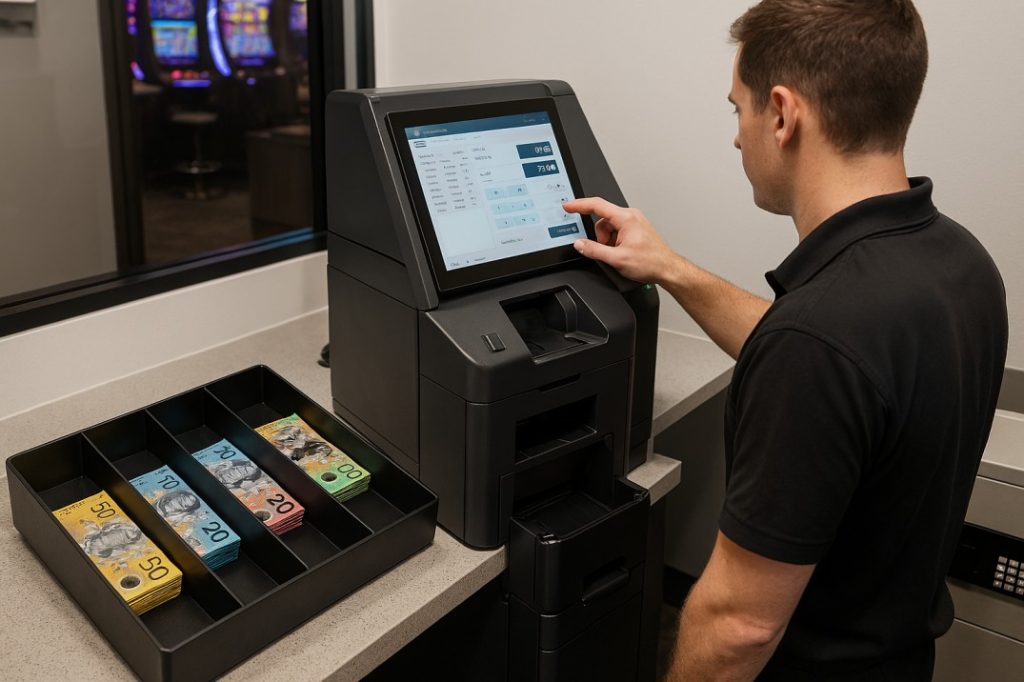
With the K2’s optional TITO integration, cash notes and gaming tickets are processed in the same workflow. The K2 reads the ticket’s barcode, validates the value, and records the transaction in the same log as cash deposits. End-of-shift reconciliation is a single report rather than two separate records.
Why 4-Method Detection Matters for Gaming
Gaming venues process a disproportionately high volume of $50 and $100 notes. These are also the denominations with the highest counterfeit risk in Australia. A cash recycler machine that only uses UV detection would not provide reliable protection for these denominations in 2026. The K2’s combination of UV, magnetic, infrared, and CIS detection provides reliable authentication across all AUD denominations, including the high-value notes that dominate gaming floor collections.
Comparing Cash Recycler Options for Australian Gaming Venues
The Australian market for cash recycler machines in gaming and club environments has several options at different price and capability points. Here is an honest comparison:
| Feature | K2 (Cashcom) | Standard Counter | Basic Recycler |
| Note dispensing | ✅ | ❌ | ✅ |
| Hopper capacity | 1,000 notes | 500–600 notes | 400–500 notes |
| Detection | Full 4-method | Full 4-method | UV only |
| TITO integration | Optional | ❌ | ❌ |
| Fitness sorting | ✅ | ✅ | ❌ |
| Multi-currency | 7 currencies | Up to 20 | 1–2 currencies |
| Per-employee logging | ✅ | ✅ | ⚠️ |
| Touch screen | ✅ | ✅ | ❌ |
| AUD polymer config | ✅ | ✅ | Verify |
| Australian supplier | ✅ | ✅ | Varies |
| Best for gaming | ✅ | Counting only | Limited |
The comparison highlights two critical gaps in alternatives for gaming venues: TITO integration and hopper capacity. These are not minor convenience features — they are the specifications that determine whether a cash recycler machine genuinely improves the gaming cash management workflow or simply replaces one manual step with a marginally faster one.
How the K2 Cash Recycler Fits Into a Club’s Cash Management Workflow
Here is a practical breakdown of how the K2 Cash Recycler integrates into a typical licensed club’s daily cash operations:
Opening — Float Preparation
The cash manager opens for the day and reviews the K2’s current note inventory on the touch screen. For each bar and bistro cashier opening their station, the K2 dispenses the required opening float — the cashier logs in with their PIN, requests their denomination requirements, and the machine dispenses the exact notes. The opening float transaction is logged automatically. No manual counting of float packets.
Trading — Gaming Machine Collections
Gaming floor attendants collect notes from EGMs throughout the day. Each collection run deposits into the K2 — the attendant logs in with their PIN and deposits the collected notes. The machine authenticates each note, sorts by denomination and fitness, and updates its internal inventory. The transaction is logged against the attendant’s PIN. Fit notes are stored for re-dispensing. Unfit notes and any counterfeits go to the reject pocket.
Trading — Change Requests and Float Top-Ups
Bar and bistro cashiers running low on a denomination log in with their PIN and request specific denominations. The K2 dispenses the requested notes — a transaction logged against their PIN. No supervisor involvement required for routine change requests within authorised limits. Supervisors can set denomination withdrawal limits per employee level if required.
Shift Change — Per-Shift Reconciliation
At the end of each shift, the cash manager prints or views a per-shift transaction report from the K2. The report shows every deposit and withdrawal during the shift, broken down by employee, denomination, and time. Any discrepancy between what staff reported depositing and what the machine received is immediately visible. This replaces the manual shift-change process where cash is physically counted and transferred.
Close — End-of-Day Reporting
At close of trading, the K2 provides a full-day transaction summary — total deposits by employee, total withdrawals by employee, denomination inventory, rejected note count, and a running balance. The cash manager verifies the K2’s noted inventory against expected totals. Banking preparation is largely complete — fit notes are already sorted and authenticated. Unfit notes are in the reject pocket ready for separate banking or destruction.
Return on Investment: K2 Cash Recycler for Australian Clubs
The ROI case for a cash recycler machine in a licensed club or gaming venue is among the strongest of any commercial setting. Here is a realistic calculation:
Staff Time Saving
If the K2 reduces the time a gaming cashier spends on float runs and collection processing by 90 minutes per shift, across two shifts per day, 300 operating days per year — at a fully loaded staff cost of $32 per hour — that is $28,800 in recovered staff time per year. Larger venues with more gaming floors and more staff will see proportionally greater savings.
Shrinkage Reduction
Internal cash shrinkage is a known risk in any multi-staff cash environment. In gaming venues with rotating staff across gaming floors, bars, and cage operations, the per-employee transaction logging of the K2 creates accountability that substantially reduces unexplained cash discrepancies. Clubs that have implemented cash recycler machines consistently report a measurable reduction in till shortfalls and float discrepancies within the first operating quarter.
Compliance Value
The detailed transaction logs produced by the K2 support gaming venue AML/CTF cash handling obligations. While the machine is not itself a compliance solution, the audit trail it produces reduces the manual record-keeping burden associated with cash transaction documentation. For larger clubs subject to enhanced AML/CTF program requirements, this documentation value is material.
| Conservative calculation for a medium-sized club:
Staff time saving: $28,800/year. Shrinkage reduction (even 0.1% of $2M annual cash throughput): $2,000/year. Combined: $30,800/year in recoverable value. At this rate, the K2’s investment is typically recovered within 18–24 months. For larger clubs with higher cash volumes, the payback period is shorter. Contact Cashcom on 0451 353 676 to build a site-specific ROI calculation for your venue. |
Frequently Asked Questions
| Q: What is the best cash recycler machine for an Australian licensed club?
The Cashcom K2 Cash Recycler Sorter Machine is the recommended cash recycler for Australian licensed clubs and gaming venues. Its 1,000-note hopper handles full EGM floor collection runs without reloading, full 4-method detection (UV + MG + IR + CIS) reliably authenticates Australian polymer notes including high-value $50 and $100 denominations, and the optional TITO integration processes gaming tickets alongside cash. Call Cashcom on 0451 353 676 to discuss deployment for your specific venue. |
| Q: Does the K2 Cash Recycler support TITO for gaming machines?
Yes — TITO (Ticket-In, Ticket-Out) ticket detection is an optional add-on for the K2 Cash Recycler. For gaming venues processing both cash notes and EGM tickets, this option allows the K2 to handle both in a single unit with a combined transaction log. TITO must be specified and configured at time of order. Contact Cashcom to confirm compatibility with your specific gaming system before ordering. |
| Q: How many EGM notes can the K2 process in a single collection run?
The K2’s 1,000-note hopper is the largest in the Cashcom range. For a medium gaming floor with 40–60 EGMs, a typical moderate-day collection run produces 500–800 notes — this fits comfortably in a single K2 load. Busy Friday and Saturday collections from larger floors may require one reload. The K2’s 1,000-note capacity eliminates the multiple reload cycles that smaller-hopper machines require for high-volume gaming collections. |
| Q: Is the K2 compliant with Australian gaming cash handling requirements?
The K2 Cash Recycler produces detailed transaction logs — per employee, per denomination, with timestamps — that support gaming venue cash handling documentation requirements. While the machine is not itself a regulatory compliance instrument, its audit trail records support AML/CTF cash transaction documentation obligations. Clubs should confirm specific regulatory requirements with their state gaming authority and legal/compliance advisors. |
| Q: Can the K2 handle the high volume of $50 and $100 notes in gaming environments?
Yes. The K2 uses full 4-method detection — UV, magnetic, infrared, and CIS colour imaging — on every note simultaneously, including $50 and $100 denominations. This authentication combination is reliable for Australian polymer notes in 2026, including the high-value denominations most commonly used in gaming environments and most commonly targeted by counterfeiters. Counterfeit and damaged notes are automatically rejected to the reject pocket. |
| Q: How does the K2 Cash Recycler compare to just using a professional money counter for a gaming venue?
A professional money counter handles end-of-day reconciliation well but cannot dispense notes as change or float, does not create per-employee transaction logs for every cash movement throughout the day, and cannot process TITO gaming tickets. For a gaming venue with active float management needs across multiple shifts and multiple staff, a cash recycler machine like the K2 addresses the full operational cash management challenge. A money counter alone addresses only the reconciliation step. |
| Q: Where can I buy the K2 Cash Recycler in Australia?
Cashcom supplies the K2 Cash Recycler Sorter Machine to clubs and gaming venues across Australia from our base in Haberfield, NSW. We ship to all states and territories. View the K2 at cashcom.com.au/product/k2-cash-recycler/, call 0451 353 676, or email sales@cashcom.com.au. Available Monday to Friday, 9am–6pm. Our team can confirm TITO configuration and discuss deployment requirements for your specific venue. |
Australian licensed clubs and gaming venues have the most complex cash management requirements of any commercial setting outside banking. The combination of continuous EGM collections, active float distribution across multiple service points, multi-shift staff rotation, TITO ticket processing, and regulatory accountability requirements demands equipment specifically suited to this environment.
The K2 Cash Recycler Sorter Machine addresses every one of these requirements. The 1,000-note hopper eliminates the reloading bottleneck that slows floor collection runs. The 4-method detection provides reliable authentication for the high-value notes that dominate gaming cash flows. The optional TITO integration consolidates cash and ticket processing. And the per-employee transaction logging creates the audit trail that club governance and regulatory compliance require.
For clubs and gaming venues currently using a basic money counter or managing cash manually, the operational and accountability improvement from deploying a K2 is significant. For venues already using an older or lower-specification cash recycler machine, the K2 represents a meaningful step up in both hopper capacity and detection reliability.
To discuss the K2 Cash Recycler for your club or gaming venue, call Cashcom on 0451 353 676, email sales@cashcom.com.au, or view the full specification at cashcom.com.au/product/k2-cash-recycler/. Our team is available Monday to Friday, 9am–6pm and can discuss TITO configuration and deployment requirements for your specific venue.