
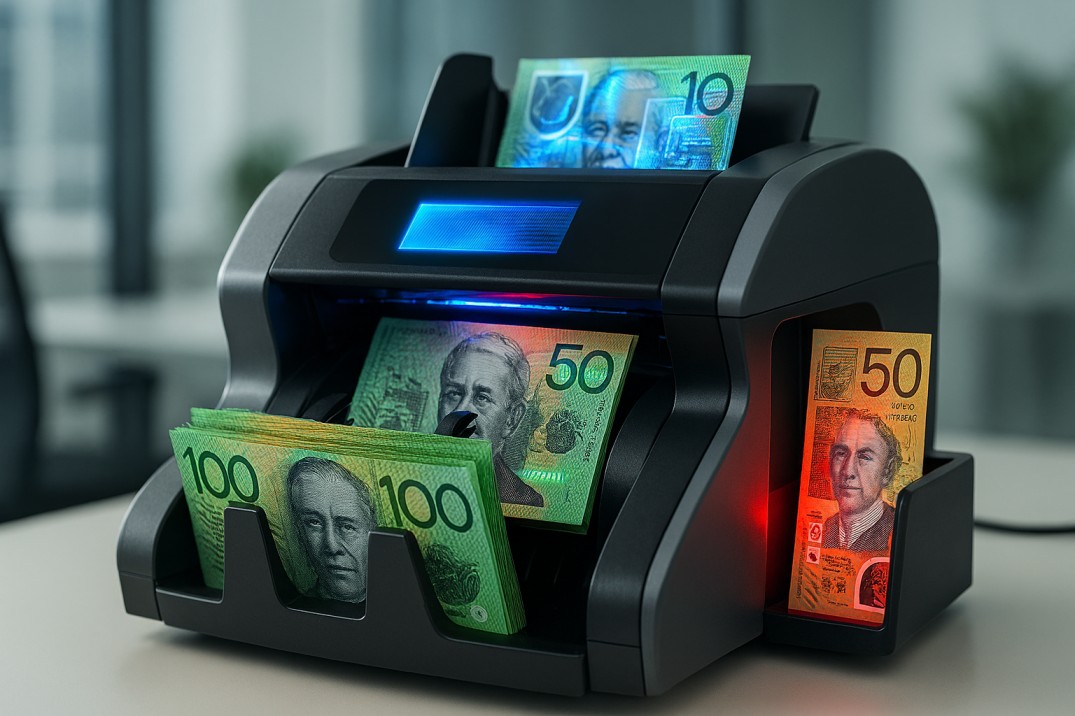
Every notes counting machine on the market claims to detect counterfeit notes. Most of them are telling the truth — but the quality of that detection varies enormously, and for Australian polymer banknotes in 2026, the difference between adequate and inadequate protection is not a minor technicality.
A fake $50 or $100 note accepted at the till costs your business the full face value. The bank does not compensate you. The police investigation, if it goes anywhere, rarely recovers the loss. The most likely scenario is that the counterfeit is found during deposit processing, removed from your account, and you carry the loss. For a busy café, restaurant, or retail store accepting hundreds of notes a week, the question is not whether it can happen — it is how many notes you process before one slips through.
This guide covers exactly what fake note detection means in a notes counting machine, why the detection method matters so much for Australian polymer notes specifically, and the best notes counting machines with fake note detection available in Australia in 2026.
| ⚠️ The key issue:
Many notes counting machines described as having ‘fake note detection’ use UV detection only. In 2026, UV-only detection can be defeated by high-quality counterfeit polymer notes. For reliable protection of Australian $50 and $100 notes, the minimum standard is UV + magnetic (MG) + infrared (IR). Dual CIS colour image detection is the gold standard. This guide explains why — and shows which machines meet the standard. |
Why Fake Note Detection Matters for Australian Businesses in 2026
Australian polymer banknotes are among the most sophisticated in the world. The combination of transparent windows, colour-shifting ink, raised print (intaglio), microprinting, and UV-fluorescent security elements makes them significantly more difficult to counterfeit than the paper currencies used in most other countries.
However, the counterfeiting technology available to criminals has advanced in parallel. Reserve Bank of Australia data consistently identifies $50 and $100 notes as the most targeted denominations. Sophisticated polymer counterfeit notes — printed on materials that replicate some of the visual characteristics of genuine polymer notes — can now pass UV-only detection reliably. This is the documented reality in the Australian market in 2026, not a speculative risk.
The Financial Exposure
Consider the practical financial exposure. A retail business processing 400 notes per day, five days per week, handles approximately 100,000 notes per year. If one note in every 50,000 is a sophisticated counterfeit that passes a UV-only machine — a conservative estimate based on Reserve Bank circulation data — that business accepts two fake notes per year at an average of $75 per note (weighted toward $50 notes). The machine that catches those notes costs nothing compared to the annual loss from missing them.
The Accountability Angle
Beyond direct financial loss, there is a staff accountability dimension. When a fake note is discovered in a bank deposit, it is removed from the deposit total. If your business cannot determine which transaction the note came from — and manual counting cannot provide this — there is no way to determine whether the acceptance was genuine or deliberate. A notes counting machine with serial number logging creates a complete per-note audit trail that manual counting cannot replicate.
Fake Note Detection Methods Explained: What Each One Does
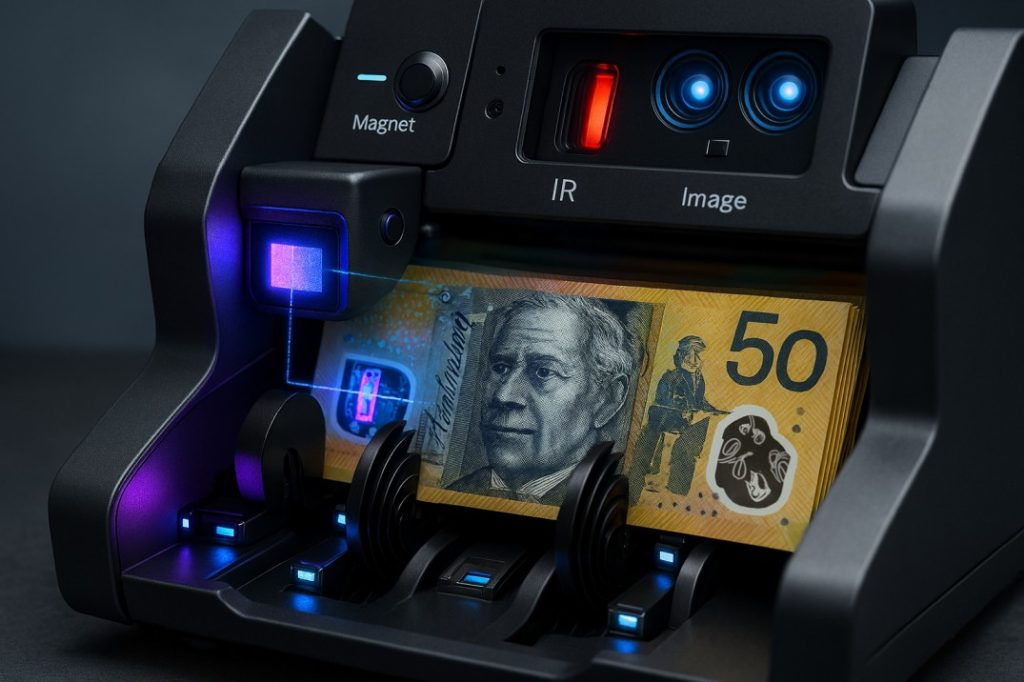
There are four main detection methods used in professional notes counting machines. Each targets different security features of genuine Australian polymer banknotes. Understanding what each method detects helps you assess whether a machine’s detection capability is adequate for your needs.
UV — Ultraviolet Detection
How it works: UV lamps at 365nm wavelength illuminate each note as it passes through the machine. Genuine Australian polymer notes contain UV-fluorescent inks and security fibres that glow in specific patterns under UV light. Counterfeit notes printed on standard materials typically either show no UV fluorescence, incorrect patterns, or excessive background fluorescence.
Reliability in 2026: Moderate. UV is the oldest anti-counterfeiting detection method, which means it is also the most understood and most targeted by sophisticated counterfeiters. High-quality polymer counterfeit notes can now replicate UV fluorescence patterns with increasing accuracy. UV detection remains a useful layer in a multi-method system but is not adequate as a standalone protection method for Australian $50 and $100 notes.
| UV-only machines are sold as ‘counterfeit detectors’ but provide only moderate protection in 2026. They were adequate a decade ago. They are not adequate now for high-value Australian polymer notes. |
MG — Magnetic Ink Detection
How it works: Genuine Australian banknotes are printed with magnetic ink in denomination-specific patterns. Magnetic sensors in the notes counting machine read these patterns as each note passes through, comparing them against stored reference profiles. The density, location, and pattern of magnetic ink varies by denomination and is extremely difficult to replicate without access to specialist magnetic ink formulations used by Note Printing Australia.
Reliability in 2026: High. Magnetic ink replication requires materials that are not commercially available. Most counterfeit notes fail magnetic detection, making MG one of the most reliable single-method checks. The LS-200 and LS-300 use 18-channel magnetic detection — scanning the full note width rather than just a central stripe — for maximum sensitivity. The H110, H210, K2, and other machines use standard MG detection, which is effective for the vast majority of counterfeits in Australian circulation.
IR — Infrared Detection
How it works: IR sensors measure how each note absorbs and transmits infrared light. The inks, substrate, and security elements used in genuine Australian polymer notes have specific IR absorption profiles that differ by denomination. Counterfeit notes printed with standard commercial inks fail to replicate these profiles — they show incorrect IR absorption patterns that trigger a detection flag.
Reliability in 2026: Very high. IR absorption profiles are determined by the chemical composition of security inks — a property that cannot be replicated by commercial printing. A note that looks identical to a genuine one under visible light can still fail IR detection because its ink chemistry is wrong. IR is one of the most reliable single-method checks for Australian polymer notes.
CIS — Colour Image Sensor (Dual CIS)
How it works: High-resolution colour cameras capture full-colour images of both sides of each note during transit. These images are compared in real time against a reference database of genuine note images for every denomination. Any note whose image profile deviates from the expected pattern — wrong colour distribution, missing security elements, incorrect microprint, wrong dimensions — is flagged and routed to the reject pocket.
Reliability in 2026: Highest. Dual CIS imaging is the most comprehensive detection method because it effectively compares the entire note against a genuine reference rather than checking individual properties. Dual CIS — scanning both faces simultaneously — doubles the data captured per note. This is the detection standard used in Reserve Bank and commercial banking equipment. All professional Cashcom notes counting machines use Dual CIS.
| Detection Method | Targets | Reliability for AUD | Can Be Defeated By |
| UV only | Fluorescent markings | ⚠️ Medium | UV-fluorescent material replication |
| MG (magnetic) | Magnetic ink patterns | ✅ High | Specialist magnetic inks (rare) |
| IR (infrared) | Ink chemical absorption | ✅ Very High | Specialist IR inks (very rare) |
| Dual CIS imaging | Full visual note profile | ✅ Highest | Near-perfect note reproduction |
| UV + MG + IR | Multiple properties combined | ✅ Very High | Multi-method simultaneous replication |
| UV + MG + IR + CIS | All known security features | ✅ Highest | Near impossible to replicate all |
Why Australian Polymer Notes Need Multi-Method Detection
Australian polymer notes have physical properties that make them behave differently from paper currencies under each detection method. Understanding these differences explains why the detection method matters for Australian notes specifically — not just generically.
The Polymer Substrate
Australian notes are printed on biaxially oriented polypropylene (BOPP) film rather than cotton-linen paper. This substrate is optically clear, has a specific infrared absorption profile, and accepts different ink formulations than paper. Counterfeit notes attempting to replicate polymer notes face a fundamental materials challenge: the inks that work on paper behave differently on polymer film, producing detectable deviations in IR and MG readings.
Why UV Alone Is Not Enough for Polymer Notes
Because the polymer substrate itself has different UV properties from paper, counterfeiters working with polymer-like materials have been able to produce notes with UV fluorescence patterns that pass UV-only detection. The magnetic and infrared properties of genuine AUD security inks — determined by Note Printing Australia’s specific ink formulations — are much harder to replicate because they depend on chemistry rather than visual appearance.
The 18-Channel MG Advantage for $50 and $100 Notes
Standard MG detection sensors cover a narrow stripe across the note’s width. For Australian $50 and $100 notes, denomination-specific magnetic ink is present across the full width of the note. An 18-channel magnetic system — as found in the LS-200 and LS-300 — covers the full note width, capturing magnetic ink data that narrower sensors miss. For businesses with particularly high volumes of high-value notes, the 18-channel system provides meaningfully greater protection depth.
Best Notes Counting Machines with Fake Note Detection in Australia (2026)
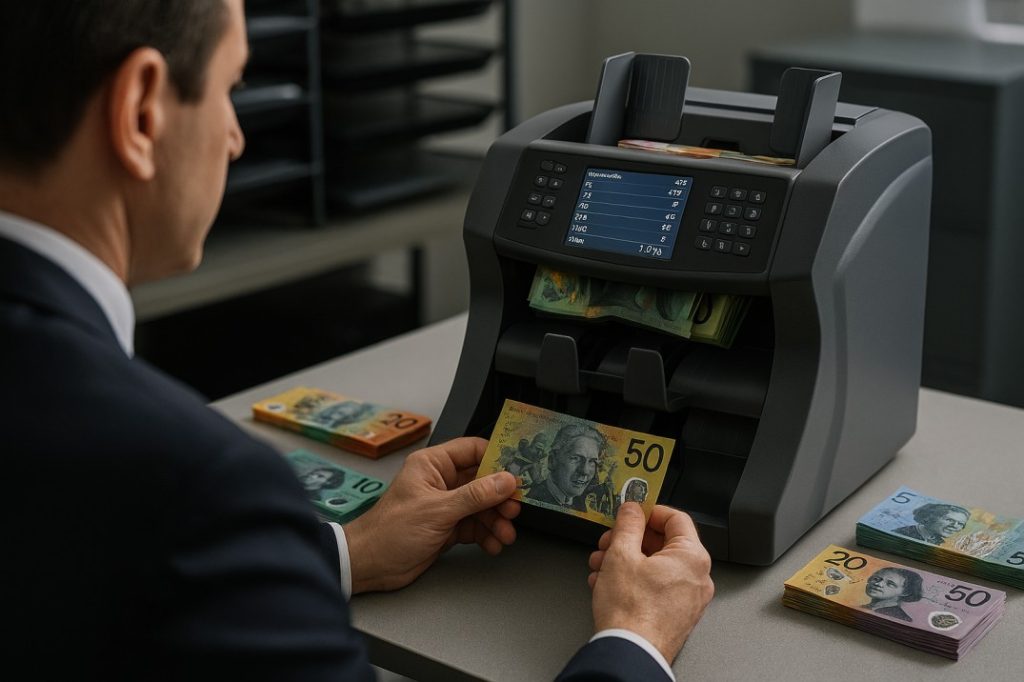
Every machine below uses multi-method detection — UV + MG + IR + CIS — as a minimum. This is the standard that provides reliable protection for Australian polymer notes. Here are the best options from Cashcom, ranked by detection depth and practical value for different business types.
Read More: Full Guide to Fake Note Detection Methods
Best Overall Detection: H110 for Small–Medium Business
| #1 for Most Businesses H110 Cash Counting Machine
🏪 Best fake note detection for small–medium Australian businesses Detection: Dual CIS + UV + MG + IR — full 4-method simultaneously Speed: 720 notes/min — detection runs simultaneously Hopper: 500 notes | Stacker: 200 | Reject: 100 Fitness Detection: 12 types including soil, tape, hole, watermark, dog-ear Serial Numbers: Full logging — audit trail for every note Connectivity: LAN + USB — data exportable to reporting systems Compliance: CE, CB, FCC certified Verdict: The H110 brings bank-grade Dual CIS detection to small and medium business use. The same detection standard used in Reserve Bank and commercial banking equipment. Four methods running simultaneously on every note at 720 notes/min. Counterfeit notes are routed to the reject pocket automatically with their serial numbers logged. The starting point for any Australian business wanting reliable fake note protection. View product → https://www.cashcom.com.au/product/h110-cash-counting-machine/ |
Best Detection + Sorting: H210 for Retail
| #2 Detection + Sorting H210 Money Counter and Sorter Machine
🔄 Best when you need fake note detection AND denomination sorting Detection: Double-face counterfeit identification — full dual-face authentication Speed: 900/min counting | 750/min sorting Output: 3 pockets: 2 sorted exits + 1 rejection outlet Damage Detection: Dirt, tape, dog-ear, crack, hole, double notes — multi-level Serial Numbers: Real-time ID — queryable by serial, operator, batch Verdict: The H210 adds denomination sorting to fake note detection. Counterfeit notes go to the rejection outlet while authenticated notes are simultaneously sorted by denomination. One pass delivers protection and sorted output. For retail businesses preparing denomination-specific banking bundles while maintaining counterfeit detection, this is the machine that does both simultaneously. View product → https://www.cashcom.com.au/product/h210/ |
Deepest Detection: LS-200 with 18-Channel MG
| #3 Maximum Detection LS-200 Note Counter Machine
⚡ Best fake note detection depth — 18-channel MG, 1,200 notes/min Detection: Dual CIS + UV + MG 18-channel + IR + Ultrasonic 21-channel (F version) Speed: 1,500/min (piece) | 1,200/min (value + detection) 18-Channel MG: Full note-width magnetic scanning — catches what narrower sensors miss Ultrasonic: 21-channel (F version) — physical anomaly detection Hopper: 600 notes | LAN connectivity Display: 4.3-inch touch screen Verdict: The LS-200’s 18-channel magnetic system is the key differentiator for detection depth. Standard machines scan a narrow magnetic stripe. The LS-200 scans the full note width with 18 independent sensors simultaneously — capturing magnetic ink patterns in the outer regions of $50 and $100 notes that narrower sensors miss. For businesses with particularly high volumes of high-value notes or where detection standards must be maximised, the LS-200 provides the deepest protection in the professional tier. View product → https://www.cashcom.com.au/product/ls-200-note-counter/ |
Industrial Detection: LS-300 for All-Day Operations
| #4 Industrial LS-300 Note Counter Machine
🏆 Best fake note detection for all-day industrial operation Detection: Dual CIS + UV + MG 18-channel + IR + Ultrasonic 21-channel Speed: 1,200/min (value + detection sustained) 18-Channel MG: Same full-width scanning as LS-200 Remote Upgrade: Detection databases updated via LAN — no service visit Dust-Free Design: All-day continuous operation without jam accumulation Display: 4.3-inch touch screen + stacker side LED Verdict: The LS-300 provides the same 18-channel MG and 21-channel ultrasonic detection as the LS-200, with the addition of remote detection database upgrade via LAN. When Note Printing Australia issues a new note series, the LS-300’s detection parameters update automatically without requiring a service visit. For operations where detection must remain current with zero scheduled maintenance interruption, this is the definitive professional notes counting machine. View product → https://www.cashcom.com.au/product/ls-300-note-counter/ |
Multi-Currency Detection: H-880 / H-890 for 60 Currencies
| #5 Multi-Currency H-880 / H-890 Note Counting Machine
🌍 Best fake note detection across 60 currencies — ECB certified Detection: CIS Image + MG + IR + UV — full 4-method across all 60 currencies Currencies: Up to 60 with full 4-method detection on every currency Certification: 100% ECB (European Central Bank) pass rate Serial Numbers: Real-time OCR reading across all supported currencies Display: Large TFT touch panel Verdict: For businesses that handle foreign notes alongside AUD regularly, the H-880 and H-890 provide full 4-method detection across 60 currencies simultaneously. The 100% ECB certification confirms the detection accuracy meets the most rigorous international verification standard. Fake note protection for AUD, USD, EUR, GBP, JPY, and 55 other currencies — in one machine. View product → https://www.cashcom.com.au/product/h-880/ |
What to Do When Your Notes Counting Machine Flags a Suspect Note
Having a machine that detects potential counterfeits is only half the process. Staff need to know what to do when a note is flagged — the procedure matters for your business’s protection and for any potential investigation.
- Remove the flagged note from the reject pocket. Do not mix it back with the counted stack or return it to the till.
- Examine the note manually. Check the clear window (it should be a genuine polymer window, not a cut-out hole), feel for raised print, tilt to check for colour-shifting ink, examine the serial number format.
- If the customer is still present, remain calm. Do not make accusations. Ask for an alternative payment method without explanation.
- Do not attempt to use or deposit the note. Knowingly using a counterfeit note is a criminal offence under the Crimes (Currency) Act 1981.
- Contact your bank and local police. Report the suspect note. Your machine’s serial number log will have recorded the serial number of the flagged note — valuable evidence.
- Submit the note to police or your bank. They will forward it to the Reserve Bank of Australia for analysis.
Frequently Asked Questions
| Q: Is UV detection enough for fake note detection in Australia in 2026?
No. UV-only detection was adequate a decade ago but is no longer sufficient for Australian $50 and $100 polymer notes in 2026. High-quality counterfeits can replicate UV fluorescence patterns with increasing accuracy. The minimum reliable standard for Australian polymer note authentication is UV combined with magnetic (MG) and infrared (IR) detection. Dual CIS colour image detection is the gold standard. Every professional Cashcom notes counting machine uses all four methods simultaneously. |
| Q: What is the best notes counting machine with fake note detection for a small business?
The Cashcom H110 is the best starting point for most Australian small businesses. Dual CIS + UV + MG + IR detection simultaneously on every note — the same authentication standard as banking equipment. 720 notes per minute with counterfeit notes automatically separated and serial numbers logged. Call Cashcom on 0451 353 676 for a direct recommendation based on your daily volume. |
| Q: What is Dual CIS detection and why is it better than UV-only?
Dual CIS (Dual Colour Image Sensor) captures high-resolution colour images of both faces of every note simultaneously during processing. These images are compared against a genuine note database in real time. UV detection only checks for fluorescent markings. Dual CIS compares the entire visual profile of the note — colour distribution, security element placement, microprint — against what a genuine note should look like for that denomination. Combined with MG and IR, Dual CIS provides authentication depth that UV-only machines cannot match. |
| Q: What is the 18-channel magnetic detection in the LS-200 and LS-300?
Standard magnetic detection uses 1–4 sensors covering a narrow stripe across the note’s width. The LS-200 and LS-300 use 18 independent magnetic sensors simultaneously covering the full note width. For Australian $50 and $100 notes, denomination-specific magnetic ink is present across the full note width — an 18-channel system captures this data where narrower sensors may miss edge-region ink patterns. For businesses with high volumes of high-value notes, 18-channel MG provides meaningfully greater detection reliability. |
| Q: Can notes counting machines detect all counterfeit Australian notes?
No detection system can guarantee 100% catch rates for all possible counterfeits — this is true of any technology, including banking equipment. What multi-method detection (UV + MG + IR + Dual CIS) provides is reliable protection against the full range of currently circulating Australian counterfeit notes. The combination makes replication of all detection signatures simultaneously extremely difficult. Single-method detection leaves gaps that sophisticated counterfeits can exploit. |
| Q: Does the notes counting machine’s fake note detection work on AUD polymer notes specifically?
Yes — provided the machine is configured for AUD. All Cashcom notes counting machines are supplied configured for Australian polymer note denominations. The UV, MG, IR, and CIS detection parameters are calibrated specifically for AUD polymer notes, not generic paper-currency parameters. This is an important distinction from imported machines that may be calibrated for paper-based currencies and provide unreliable results for AUD polymer notes. |
| Q: What happens to a detected counterfeit in a notes counting machine?
The machine routes any note failing authentication to the dedicated reject pocket — physically separating it from the counted stack before the count is complete. The serial number of the rejected note is logged automatically. You end the count with an authenticated stack and the suspect note isolated in the reject pocket for examination. The machine never mixes authenticated and rejected notes in the same output. |
Detection Method Determines Your Real Protection
The label ‘fake note detection’ on a notes counting machine is not a reliable indicator of protection quality. The detection method is what matters — and the gap between UV-only detection and professional multi-method detection is significant for Australian businesses accepting $50 and $100 polymer notes in 2026.
Every Cashcom professional notes counting machine uses Dual CIS + UV + MG + IR detection simultaneously. This is the combination that provides reliable protection against the counterfeits currently circulating in the Australian market. For businesses requiring the deepest available detection — high $50/$100 volumes, financial institutions, or all-day continuous operation — the LS-200 and LS-300 add 18-channel magnetic scanning and 21-channel ultrasonic to the standard four-method base.
The right machine depends on your volume, whether you need denomination sorting alongside detection, and whether all-day continuous operation or remote management are requirements for your operation. For most Australian small and medium businesses, the H110 provides everything needed at the right price point.
To discuss the right notes counting machine with fake note detection for your business, call Cashcom on 0451 353 676, email sales@cashcom.com.au, or browse the full range at cashcom.com.au/products. Monday to Friday, 9am–6pm.