
By the Cashcom Team | Australian Cash Handling Specialists since 2015 | Updated 2026
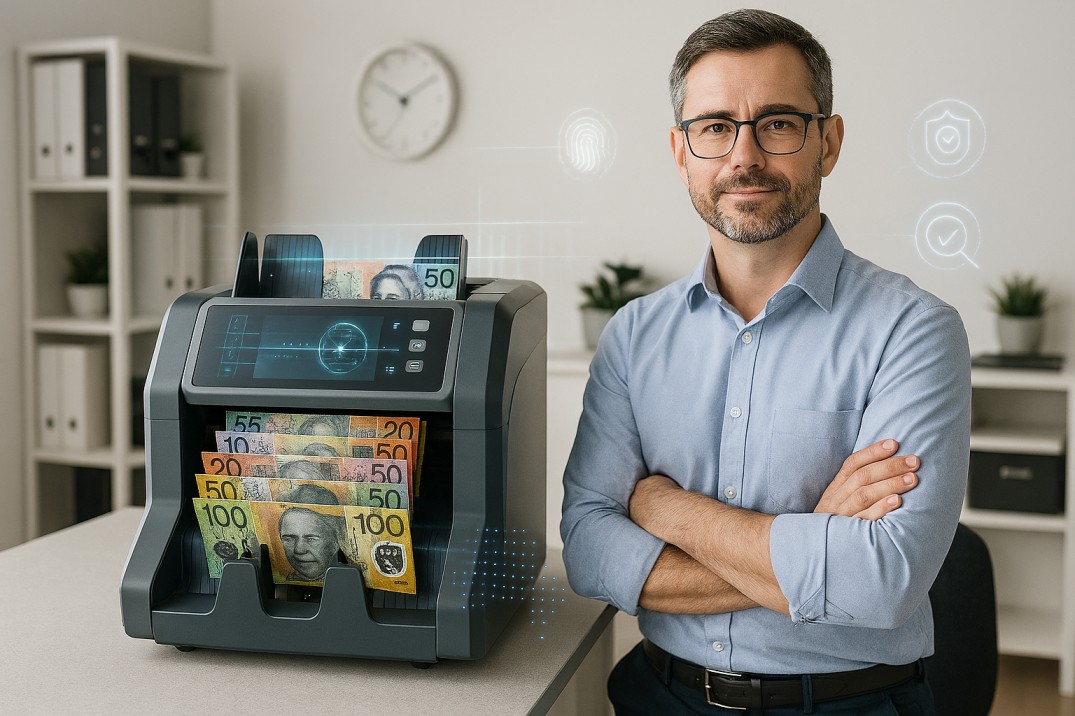
If your business handles cash regularly, a money counting machine is one of the most straightforward operational investments you can make. Done right, it eliminates the slow, error-prone manual count at end of day, catches counterfeit notes before they reach your bank, and gives you an accurate denomination-level record of every counting session.
Done wrong — buying on price alone, or choosing a machine not configured for Australian polymer notes — and you end up with equipment that underperforms, produces inaccurate results, or fails within 18 months of daily use.
This guide is the complete buying reference for any Australian business researching a money counting machine in 2026. It covers the types of machines available, the features that actually matter, what to ignore, and a direct recommendation for each business size and use case.
| Bottom line upfront: For most Australian small-to-medium businesses, the Cashcom H110 Cash Counting Machine is the right starting point — bank-grade Dual CIS detection, 720 notes per minute, mixed value counting, serial number logging, and LAN connectivity at a price accessible to any business counting cash daily. For higher volumes or denomination sorting requirements, the H210, LS-200, or LS-300 step up clearly. Read on for the full framework. |
What Is a Money Counting Machine?
A money counting machine — also called a cash counting machine, notes counting machine, or money counter machine — is an automated device that counts and authenticates banknotes at speed. Notes go in, and the machine returns a total note count, denomination breakdown, and total value, while simultaneously checking every note for counterfeits and physical fitness.
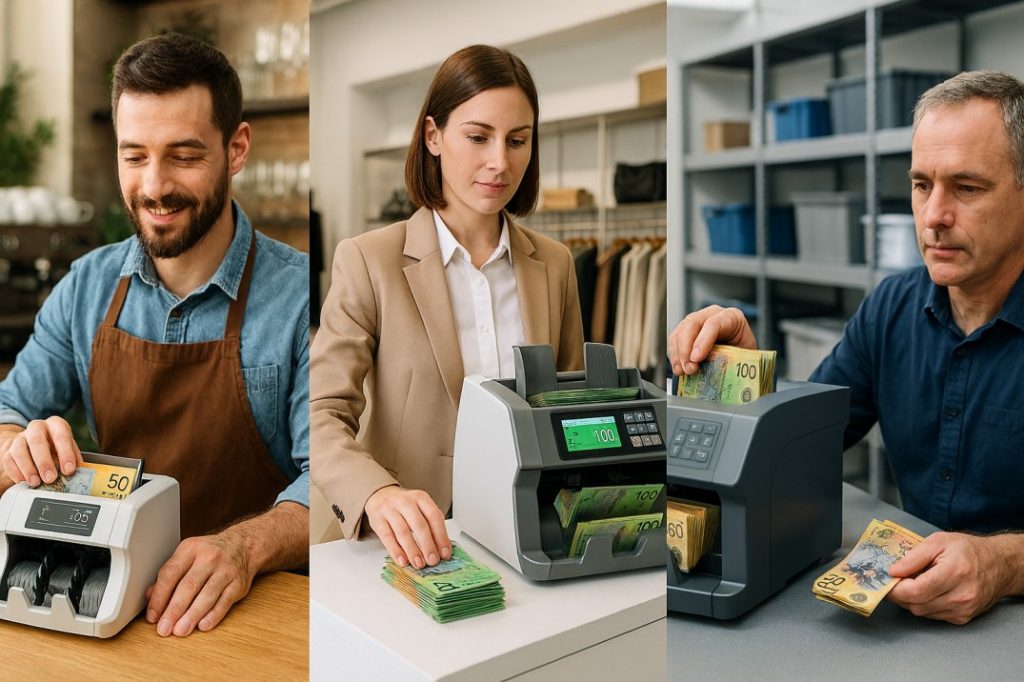
In Australia, money counting machines are used by businesses ranging from single-till cafés to multi-lane supermarkets, banks, licensed clubs, gaming venues, and cash-in-transit operators. The core function is the same across the range — the differences lie in counting speed, detection depth, sorting capability, and hopper capacity.
The terms money counting machine, cash counting machine, and notes counting machine are used interchangeably throughout the Australian market. They describe the same category of equipment. When comparing machines, focus on the specifications rather than the label used.
Types of Money Counting Machine Available in Australia
Understanding the four main categories of money counting machine prevents the most common buying mistake — purchasing either more capability than you need, or less.
Basic Note Counters
The entry point for money counting machines. These count notes at speed and return a total count. Most include UV counterfeit detection. Price points are accessible, and they suit very low-volume operations where the primary need is speed rather than security depth.
The important limitation: UV-only detection is not adequate for Australian polymer $50 and $100 notes in 2026. Sophisticated counterfeit polymer notes can pass UV checks reliably. For any business regularly handling $50 and $100 denominations, a basic UV-only machine does not provide reliable protection.
Best for: Operations under 100 notes per day, mostly small denominations.
Professional Note Counters with Multi-Method Detection
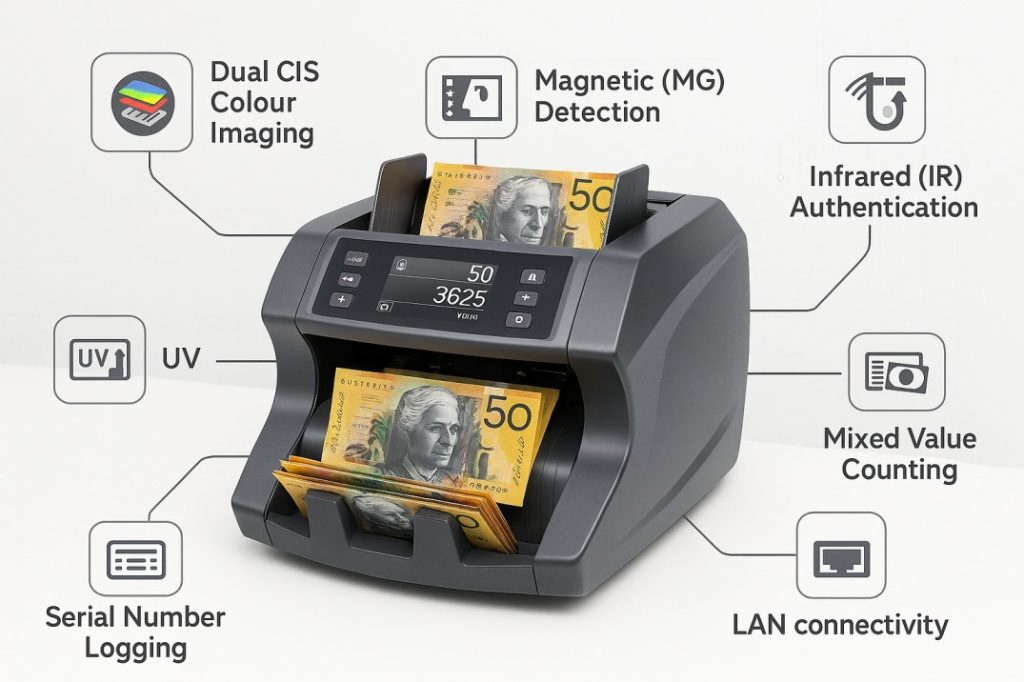
This is the correct category for most Australian businesses in 2026. These machines combine UV, magnetic (MG), and infrared (IR) detection simultaneously on every note — the minimum standard for reliable authentication of Australian polymer banknotes. The best machines in this category add Dual CIS colour image sensing, which scans both faces of every note and compares the result against a genuine note reference database in real time.
The difference between a UV-only machine and a multi-method professional counter is not marginal. It is the difference between protection that can be beaten and protection that matches the current standard for Australian polymer notes.
Best for: Most small-to-medium Australian businesses — retail, hospitality, cafés, service counters.
Money Counter and Sorter Machines
These machines count and authenticate notes, and physically sort them by denomination in the same pass — routing $10s, $20s, $50s, and $100s into separate output pockets. For businesses currently spending 15–20 minutes manually sorting notes after counting, a money counter and sorter eliminates that step entirely.
The H210 Money Counter and Sorter Machine is Cashcom’s recommendation for businesses with daily denomination sorting requirements.
Best for: Medium-volume businesses preparing denomination-specific banking bundles daily.
High-Speed Professional Counters
Running at 1,200–1,500 notes per minute with large hoppers and advanced detection depth, these machines are built for continuous, high-volume operation. The LS-200 (1,500 notes/min, 18-channel magnetic detection) and LS-300 (1,200 notes/min value counting, all-day vertical path design, remote management) represent the professional tier of money counting machines for Australian businesses.
Best for: Multiple-till retail, banks, large hospitality groups, CIT operators.
What Features Actually Matter When Buying a Money Counting Machine
The specifications on money counting machine product pages cover a lot of ground. Here is an honest assessment of what to prioritise and what you can safely deprioritise at each business scale.
Counterfeit Detection — Non-Negotiable
In 2026, the minimum standard for reliable counterfeit protection in any Australian business handling $50 and $100 notes is UV + MG + IR detection simultaneously. UV alone is the old standard — it is standard on consumer-grade machines and is not adequate for the quality of counterfeit polymer notes circulating in Australia today.
Dual CIS colour image sensing is the current gold standard. It adds full-colour imaging of both note faces on every pass, comparing against a genuine note database in real time. Every machine in the Cashcom range uses multi-method detection. If a money counting machine is described only as having ‘UV detection’, treat it as a consumer unit — not suitable as your primary counterfeit protection.
| Detection method quick reference: UV — baseline, present on all machines | MG — reads magnetic ink unique to genuine AUD notes | IR — checks infrared absorption profile | Dual CIS — full-colour imaging of both faces simultaneously. Minimum required for AUD business use: UV + MG + IR. |
Mixed Value Counting
Without mixed value counting, notes must be pre-sorted by denomination before the machine can count them — adding 10–20 minutes of manual preparation per till. With mixed value counting, you load an unsorted stack and receive a denomination breakdown and total value automatically. This is a fundamental feature for any business-grade money counting machine. Confirm it is present before purchasing.
Counting Speed — Match to Your Volume
| Daily Note Volume | Recommended Speed |
| Under 500 notes/day | 600–800 notes/min |
| 500–2,000 notes/day | 800–1,200 notes/min |
| 2,000+ notes/day | 1,200–1,500 notes/min |
The difference between 720 notes/min and 1,500 notes/min is a 25-second difference for a 500-note till. For a single-till business, this is not a meaningful operational factor. Do not pay for industrial speed if your daily count is below 1,000 notes — allocate that budget to detection depth instead.
Hopper and Stacker Capacity
The hopper is where you load notes before counting; the stacker is where counted notes are received. A larger hopper means fewer interruptions during a counting run.
For a single-till small business ending the day with 200–400 notes, a 500-note hopper is correctly sized — the H110 processes the full till in a single load. For high-volume operations counting 3+ tills, the K2’s 1,000-note hopper eliminates reloading interruptions.
Serial Number Logging
Most professional money counting machines log the serial number of every note processed. This creates an audit trail — useful when a dispute arises after the fact or when a flagged note needs to be traced. For a small business, serial number logging is a useful insurance feature rather than a daily operational requirement. The H110 includes full serial number logging and statistical reporting as standard.
LAN Connectivity
LAN connectivity allows count data to be exported to networked systems — accounting software, reporting dashboards, central management platforms. For a single-till business, manually recording totals from the machine screen adds seconds. LAN becomes genuinely valuable as the business grows to multiple tills or locations. Look for it as a standard inclusion rather than a paid add-on.
AUD Polymer Note Configuration
Australian banknotes are printed on polymer substrate — biaxially oriented polypropylene — rather than the cotton-linen paper used in most other currencies. Polymer notes have fundamentally different physical properties that affect how authentication sensors interact with them. A money counting machine calibrated for paper currencies will produce unreliable authentication results on Australian polymer notes.
Always confirm explicit AUD polymer note configuration before purchasing. All Cashcom money counting machines are configured for the Australian market.
Which Money Counting Machine Is Right for Your Business
Use this framework to identify the right machine for your situation:
Single-till small business — café, boutique, restaurant, service counter
The Cashcom H110 Cash Counting Machine is the correct choice. Bank-grade Dual CIS detection, 720 notes per minute, 500-note hopper, mixed value counting, serial number logging, and LAN connectivity. The H110 processes a typical small business till in under 45 seconds and provides the detection standard needed for Australian polymer $50 and $100 notes. It is not an over-specced machine — it is correctly specced for daily single-till use.
Medium retail or hospitality with denomination sorting requirements
The H210 Money Counter and Sorter Machine adds physical denomination sorting to the H110’s detection capability. If your daily workflow currently involves sorting notes by denomination before banking, the H210 eliminates that step in the same pass as counting. The time saving for a business sorting 400–800 notes per day is 15–25 minutes every trading day.
High-volume operation — multiple tills, professional cash room
The LS-200 at 1,500 notes per minute with 18-channel magnetic detection handles significantly higher daily volumes without reloading. The 18-channel MG system provides greater authentication depth for businesses processing large volumes of $50 and $100 notes daily — the denominations that carry the highest counterfeit risk.
All-day continuous operation — bank, large retail chain, CIT
The LS-300 is built for environments where the money counting machine runs for extended periods throughout the trading day. The vertical path design processes notes from top to bottom, allowing fine particles to fall clear rather than accumulating on sensors — the engineering choice that distinguishes a machine designed for continuous professional use from one designed for session-based daily use. LAN connectivity and remote management capability make the LS-300 suitable for multi-site operations.
High-volume with gaming or TITO requirements
The K2 Cash Recycler Sorter Machine — while primarily a cash recycler — can serve as a high-volume counting and sorting machine for operations also requiring dispensing capability. The 1,000-note hopper is the largest in the Cashcom range. For pure counting requirements without dispensing, the LS-series is the more appropriate choice.
| Quick match: Single till → H110 | Denomination sorting needed → H210 | Multiple tills, speed matters → LS-200 | All-day continuous use → LS-300 | Full cash recycling with dispensing → K2 |
Money Counting Machine vs Cash Counting Machine vs Notes Counting Machine: Is There a Difference?
This is one of the most common questions from first-time buyers. The short answer: no, there is no meaningful difference. Money counting machine, cash counting machine, and notes counting machine all describe the same category of equipment — automated devices that count and authenticate banknotes.
| Term | What It Means |
| Money counting machine | Counts and authenticates banknotes — most commonly used consumer term |
| Cash counting machine | Same — ‘cash’ used interchangeably with ‘notes’ in most contexts |
| Notes counting machine | Same — ‘notes’ is the industry-preferred term in professional banking contexts |
| Money counter machine | Same — longer form variation |
| Cash counter | Same — shorter form, common in retail contexts |
The one distinction worth knowing: all of the above refer specifically to banknote processing. A coin counting machine or coin sorter is separate equipment for a separate function. If your business handles significant coin volumes daily alongside notes, the Con200 Coin Sorting Machine handles that function — no money counting machine processes coins.
Read More: Complete Money Counter Buying Guide for Australian Businesses
What to Look for When Buying: Supplier Considerations
A money counting machine is equipment your business uses every day. The supplier relationship matters as much as the machine specification.
Local Australian support: Can the supplier provide servicing, calibration, and replacement parts from within Australia? A machine that fails and requires international shipping for parts or service is a meaningful operational risk for a business counting cash daily.
AUD firmware updates: The Reserve Bank of Australia updates banknote security specifications periodically. A professional money counting machine should be able to receive firmware updates to keep its counterfeit detection current — without requiring hardware replacement.
Warranty: Look for a minimum 12-month warranty with clear terms on repair or replacement response times. Consumer-grade machines purchased through general marketplaces frequently come with limited or no Australian warranty coverage.
Cashcom has supplied cash handling equipment to Australian businesses since 2015 — banks, clubs, gaming venues, retail operations, and CIT operators across every state and territory. All machines are supplied with Australian warranty coverage and ongoing local support from our Sydney base at 181 Parramatta Rd, Haberfield NSW 2045.
Frequently Asked Questions
| Q: What is the best money counting machine for Australian businesses in 2026?
For most small-to-medium Australian businesses, the Cashcom H110 Cash Counting Machine is the recommended choice. It provides bank-grade Dual CIS detection combined with UV, magnetic, and infrared authentication — the detection standard required for Australian polymer $50 and $100 notes — in a compact machine at an accessible price. For businesses needing denomination sorting, the H210 is the step up. For high-volume professional environments, the LS-200 or LS-300. Call Cashcom on 0451 353 676 for a recommendation based on your specific daily volume. |
| Q: What is the difference between a money counting machine and a cash counting machine?
There is no meaningful difference. Money counting machine, cash counting machine, notes counting machine, and money counter machine are all terms used in the Australian market to describe the same type of equipment — automated devices that count and authenticate banknotes. The terminology varies by industry and preference. When comparing options, focus on the specifications — detection method, counting speed, and hopper capacity — rather than the label used. |
| Q: Do money counting machines work with Australian polymer banknotes?
All Cashcom money counting machines are configured specifically for Australian polymer banknotes. The detection parameters — UV fluorescence patterns, magnetic ink signatures, infrared absorption profiles, and CIS reference images — are calibrated for AUD denominations from $5 through $100. This is an important distinction from generic imported machines calibrated for paper-based currencies, which can produce unreliable results on Australian polymer notes. Always confirm AUD polymer note configuration before purchasing any money counting machine for Australian use. |
| Q: How much does a money counting machine cost in Australia?
Professional money counting machines suitable for business use — with multi-method detection and mixed value counting — are available at a range of price points depending on specification and volume capability. Contact Cashcom on 0451 353 676 or email sales@cashcom.com.au for current pricing on the H110, H210, LS-200, and LS-300. Our team can confirm which machine is the right investment for your daily volume and workflow. |
| Q: Can a money counting machine detect counterfeit Australian notes?
Yes — a professional money counting machine with UV + MG + IR detection checks every note for counterfeit indicators simultaneously. Dual CIS machines add full-colour imaging of both note faces on every pass. Counterfeit and damaged notes are automatically rejected to a separate pocket. The key caveat: UV-only machines — common at the consumer price tier — do not provide reliable protection against current-quality counterfeit Australian polymer notes. Confirm that any machine you buy includes at minimum UV + MG + IR before purchasing. |
| Q: How long does it take to learn to use a money counting machine?
Most professional money counting machines can be fully learned within 5 minutes of first use. Basic operation is: remove staples and paper clips from the note stack, load into the hopper, select counting mode, press start, read the denomination breakdown and total. Staff operating the H110 for the first time are typically comfortable within their first shift. |
| Q: Is a money counting machine worth it for a small business?
For any small business accepting cash daily, the case is straightforward. If your end-of-day count currently takes 20 minutes and a money counting machine reduces it to 3 minutes: that is 17 minutes saved per day. At $35 per hour staff cost over 250 trading days, that is approximately $2,480 per year in recovered time — before accounting for counterfeit protection. The machine typically recovers its cost within the first year of daily use. |
| Q: Where can I buy a money counting machine in Australia?
Cashcom supplies professional money counting machines to businesses across Australia from our Sydney base at 181 Parramatta Rd, Haberfield NSW 2045. We ship to all states and territories. Browse the full range at cashcom.com.au/products, call 0451 353 676, or email sales@cashcom.com.au. Available Monday to Friday, 9am–6pm. |
A money counting machine is a daily-use piece of operational equipment. The right one saves real time, catches counterfeits reliably, and runs without issues for years. The wrong one — whether under-specced on detection or poorly configured for Australian polymer notes — costs more in the long run than the price difference ever saves.
For most Australian businesses, the decision comes down to three questions: How many notes are you processing daily? Do you need denomination sorting alongside counting? And what level of counterfeit detection is appropriate for the denominations you regularly handle?
Answer those three questions and the right machine from Cashcom’s range becomes clear. Our team can confirm the recommendation in a five-minute conversation.
Call Cashcom on 0451 353 676, email sales@cashcom.com.au, or visit cashcom.com.au/products. Monday to Friday, 9am–6pm.