
| Quick Answer
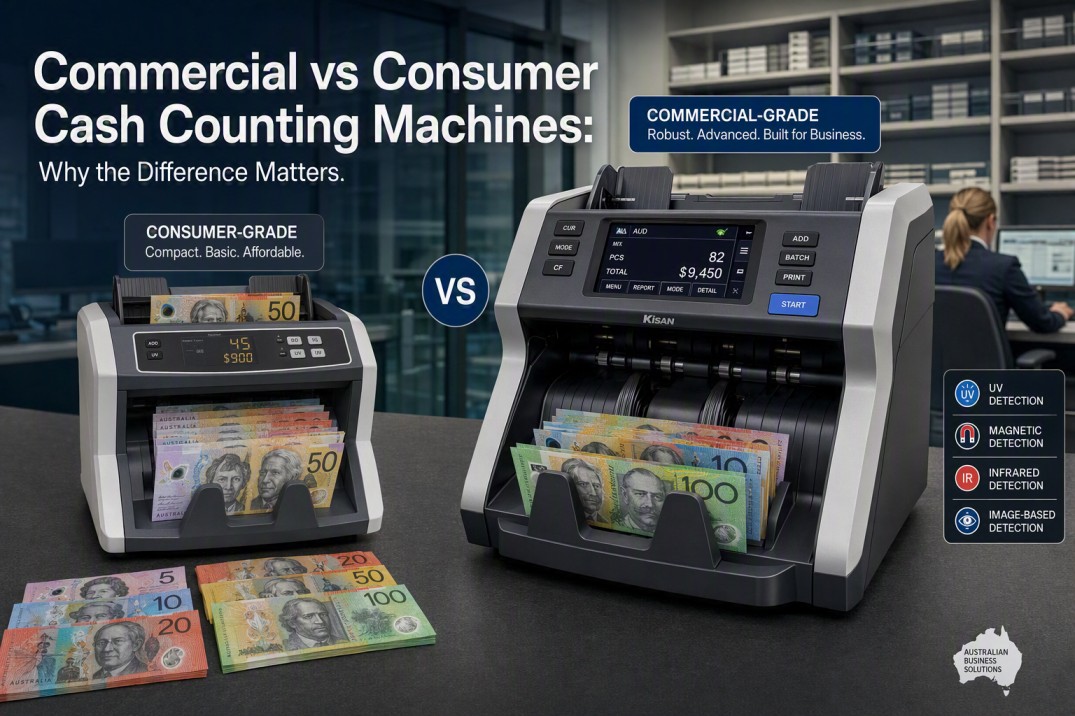
Consumer-grade cash counting machines (typically $30–$100) are designed for occasional, light use — they count notes and check UV. Commercial-grade machines are engineered for daily business use, with multi-layer counterfeit detection (UV + MG + IR + CIS), value counting, serial number logging, AUD-specific calibration, and build quality rated for continuous operation. The difference matters because: • Detection: UV-only detection is no longer sufficient in 2026 — modern counterfeit polymer notes can pass a UV check. A business relying on UV-only is accepting more counterfeit risk than it knows. • Durability: consumer machines are not built for daily commercial use. Running one as a business machine typically results in motor wear and accuracy degradation within 6–18 months. • Total cost: buying two or three replacement consumer machines over three years costs more than a single commercial machine that lasts the same period — with better detection throughout. |
The $60 Machine from the Electronics Store: What You’re Actually Getting
Walk into most electronics retailers or browse a major online marketplace in Australia and you will find cash counting machines priced between $30 and $100. They look similar to commercial models. They quote counting speeds of 900–1,000 notes per minute. Some mention UV detection. The product listing might even say ‘suitable for business use.’
Most of them are not suitable for daily business use. They are designed for occasional home or hobby applications — counting the contents of a cash box once a week, checking a coin jar, or processing a small float for an occasional event. The build quality, sensor depth, and detection capability reflect that use case, not a retail or hospitality business counting cash every trading day.
This matters in a practical sense because the gap between a consumer and a commercial machine is not primarily about counting speed — both can process 900–1,000 notes per minute. The gap is in detection depth, durability under sustained use, and the features that turn a counting machine into a genuine business tool: value counting, serial number logging, AUD-specific calibration, and local service support.
| A Day in the Life
A café owner buys a $65 cash counter from an online retailer in March. It works well through April and May — the till is counted down each night in under a minute, and it is significantly faster than counting by hand. In July, the display starts showing intermittent incorrect counts. By September the motor is noticeably slower and the machine occasionally misfeeds. By November the owner has ordered a replacement. The second machine costs $70. It fails in less time — the first machine conditioned the owner to reset and tolerate faults, so the second machine runs longer than it should before being replaced. By March the following year, the owner has spent $135 on two machines and is counting notes on a machine that is already degrading. A Cashcom H110 purchased in March of year one is still processing the same till’s notes accurately in November of year three — with a sensor clean once a week and an annual service. The total cost over three years is lower. The detection has been UV + MG + IR + CIS every single day rather than UV alone. |
What Actually Differs Between Consumer and Commercial Machines
1. Counterfeit Detection Depth
This is the most consequential difference for Australian businesses, and the one most likely to result in a direct financial loss if the wrong machine is chosen.
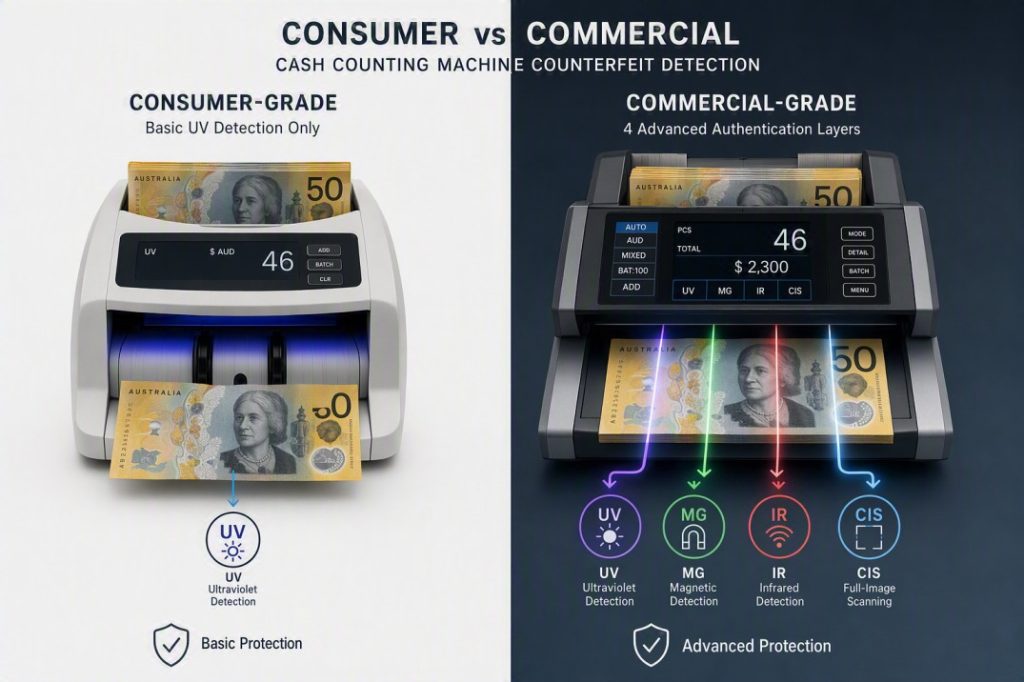
Consumer-grade machines typically include UV (ultraviolet) detection only. UV checks whether a note fluoresces under ultraviolet light — a security feature present in genuine AUD polymer notes. The problem is that UV-only detection was sufficient protection a decade ago. In 2026, sophisticated counterfeit polymer notes can replicate UV features well enough to pass a basic UV check. The additional detection layers — magnetic (MG), infrared (IR), and Contact Image Sensor (CIS) — are what catch counterfeits that UV alone misses.
- UV only (consumer): detects counterfeits that lack UV-reactive features. Misses fakes with basic UV replication.
- UV + MG + IR (entry commercial): adds magnetic ink detection and infrared pattern verification — significantly harder to replicate than UV alone.
- UV + MG + IR + CIS (full commercial — H110): adds full-image verification against a stored reference. The deepest available detection at this machine category. Dual CIS on the H110 runs two image sensors across the full note width simultaneously.
Every counterfeit note that passes through a UV-only machine and is accepted is a direct financial loss — and a loss that a UV-only machine gives no indication has occurred.
2. Build Quality and Duty Cycle
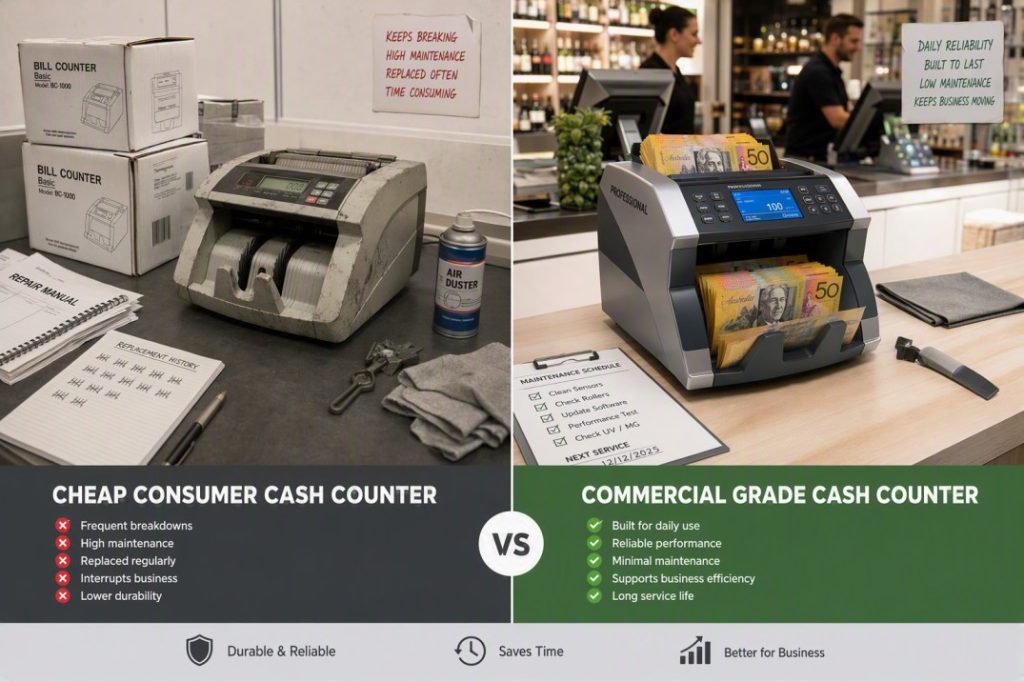
Consumer machines are built to a price point for occasional use. The transport rollers, motor, and sensor housings are designed for light load — perhaps a few hundred notes per week. A retail or hospitality business counting 200–500 notes every trading day is running a consumer machine at 5–10 times its designed duty cycle.
The result is predictable: motor wear accelerates, roller surfaces degrade faster than expected, and sensor housings accumulate contamination at a rate the machine’s build quality was not designed to handle. Counting accuracy drops, misfeeds increase, and the machine typically fails within 6–18 months of daily business use.
Commercial machines are rated for continuous daily operation. The Cashcom H110 is built for single-location business use; the LS-300 is engineered specifically for all-day continuous operation across full branch trading hours. The difference in component quality, motor specification, and housing design is substantial — and it is what determines whether a machine is still accurately counting notes in year three or has been replaced twice.
3. Value Counting vs Note Counting
A basic consumer counter tells you how many notes are in a stack. It does not tell you the total dollar value of mixed denominations — you still have to multiply and add manually. Most commercial machines include value counting as a standard mode: the machine identifies each denomination and totals the dollar amount automatically, ready to reconcile against the day’s POS total.
For a business doing a nightly till count with mixed $5, $10, $20, $50 and $100 notes, the difference is the difference between a machine that finishes the job and one that gets you halfway there.
4. AUD Polymer Note Calibration
Australian polymer banknotes have specific security features that differ from paper currency used in many other markets. Consumer machines imported through generic marketplace channels are often calibrated for multiple currency types using averaged thresholds, rather than being specifically tuned for AUD polymer notes.
The practical effect is higher false reject rates on genuine AUD notes — particularly older notes that are worn but still in circulation — and lower sensitivity to counterfeits that exploit the generic thresholds. Cashcom machines are calibrated specifically for current and older-series AUD polymer banknotes, with firmware updates available when the Reserve Bank of Australia releases new note security features.
5. Serial Number Logging and Connectivity
Consumer machines display a count and nothing more. Commercial machines capture each note’s serial number, log it against a batch or operator record, and export that data via LAN, USB, or serial port. The Cashcom H110 includes full serial number logging with LAN, 2x USB, and serial connectivity. This feature is what makes commercial machines useful for audit trails, counterfeit tracing, and multi-operator accountability — none of which is available on a consumer-grade machine regardless of price.
6. Local Support and Warranty
Consumer machines purchased through marketplace platforms typically come with no Australian warranty support. When they fail — and at daily business use volumes, they will fail — the options are to buy another one or try to ship a low-cost unit to an overseas manufacturer for a repair that costs more than the machine.
Cashcom is based in Haberfield, NSW, and provides local servicing across Australia. A commercial machine that develops a fault does not require an overseas return — and in many cases faults can be diagnosed remotely before the machine even needs to be brought in for service.
Full Feature Comparison: Consumer vs Commercial
The table below maps the key differences across all three tiers — consumer-grade, entry commercial, and full commercial — against the features that matter for Australian business use.
| Feature | Consumer-Grade | Entry Commercial | Full Commercial (H110+) |
| Typical price range | $30–$100 | $130–$300 | $300+ |
| Counting speed | 900–1,000 notes/min | 900–1,000 notes/min | 720–1,500 notes/min |
| Detection: UV | ✅ | ✅ | ✅ |
| Detection: MG (magnetic) | ❌ Rarely | ✅ | ✅ |
| Detection: IR (infrared) | ❌ Rarely | ✅ | ✅ |
| Detection: CIS (image sensor) | ❌ | ❌ Some models | ✅ (H110 Dual CIS) |
| Value counting (mixed denoms) | ❌ Rarely | ✅ Most models | ✅ |
| Serial number logging | ❌ | ❌ | ✅ |
| Fitness detection | ❌ | ❌ | ✅ 12-type (H110) |
| LAN / USB connectivity | ❌ | ❌ Rarely | ✅ |
| Daily use rating | Occasional use | Light daily use | Full commercial daily |
| Continuous operation | ❌ | ❌ | ✅ (LS-300) |
| Warranty / local service | Often none in AU | Limited | ✅ Local — Cashcom AU |
| AUD polymer note calibration | Generic / unverified | Varies by supplier | ✅ AUD-specific |
| Typical lifespan (daily use) | 6–18 months | 1–3 years | 3–7+ years |
The Real Cost of the Cheap Machine
The purchase price comparison — $60 vs a commercial machine — looks compelling at first glance. The three-year cost comparison looks very different.
| Scenario | Consumer Machine ($60) | Commercial Machine (H110) |
| Purchase price | $60 | Higher initial investment |
| Lifespan (daily business use) | 6–18 months before fault | 3–7+ years with normal maintenance |
| Replacement frequency (3 yrs) | 2–4 replacements likely | 0–1 service/replacement |
| 3-year hardware cost (est.) | $120–$240 | Lower total cost over 3 years |
| Counterfeit detection | UV only — modern fakes pass | UV + MG + IR + CIS — robust |
| Undetected counterfeits (est.) | Higher risk exposure | Near-zero with correct use |
| Staff reconciliation time | Same (no value counting) | Faster with value + add modes |
| Local warranty support | Usually none in Australia | ✅ Cashcom AU — local service |
| Quick Calculation
A single undetected counterfeit $50 note accepted by a UV-only machine represents 83% of the purchase price of the machine that missed it. A single undetected $100 note represents 167%. A commercial machine with four-layer detection that catches one counterfeit per month pays for the detection upgrade in prevented losses within the first year — before accounting for the reduction in replacement hardware costs. |
When a Consumer Machine Is Actually Fine
The honest answer is that consumer machines do have appropriate use cases. Not every cash-handling situation requires commercial-grade equipment:
- A weekend market stall counting $300–$500 in cash at the end of a two-day market — not daily business use, light volume, and the cost of a single undetected counterfeit over months is manageable.
- A school fete or charity event with a single cash box — occasional use, not repeated daily exposure to counterfeit risk.
- A very small home-based business with minimal weekly cash volume where the float is counted once a week and the total note count per session rarely exceeds 50–100 notes.
If your business is in any of these categories, a consumer machine may genuinely be sufficient short-term. The trigger for upgrading to commercial is consistent daily use — once you are counting cash every trading day, you have moved beyond the consumer machine’s design parameters.
Signs You Need a Commercial-Grade Machine
- You count cash every trading day — even a single till at close.
- Your daily note count regularly exceeds 100–150 notes per session.
- You handle cash from the public, where counterfeit risk is real and UV-only detection is not an adequate safeguard.
- You have already replaced a consumer machine once (or more) due to faults or accuracy degradation.
- You need a value total, not just a note count, for till reconciliation.
- You need a serial number log for audit, accountability, or counterfeit tracing purposes.
- You need local Australian warranty and service support.
Which Machine for Which Business? Decision Guide
The table below maps business type to the right machine tier and the relevant Cashcom model.
| Your Situation | Right Tier | Cashcom Model |
| Weekend market stall or very occasional use | Consumer OK short-term | — (any budget model) |
| Small single-till retail, café, or hospitality | Entry Commercial minimum | H110 |
| Multi-till retail, moderate daily volume | Full Commercial | H110 or H210 |
| High-volume retail, 3+ tills, busy trading hours | Full Commercial — high speed | LS-200 |
| Multi-site business, all-day continuous operation | Full Commercial — continuous | LS-300 |
| Bank branch or credit union | Full Commercial — bank-grade | LS-200 or LS-300 |
| Gaming venue | Full Commercial + recycler | K2 Cash Recycler |
| Cash-in-transit operator | Full Commercial — audit trail | H110 or H210 |
| Our Honest Assessment
We sell commercial cash counting machines. We have an obvious interest in telling you to buy one. So take this for what it is worth: if you genuinely count cash only a few times a month with light note volumes, a consumer machine is an acceptable short-term solution. But if you handle cash every trading day, serve the public, and need to know that the notes your machine accepts are genuine — a consumer machine is not adequate protection, and the price difference between a consumer and an entry commercial machine is small enough that it should not be the deciding factor. The Cashcom H110 is the entry point for genuine commercial use, and it is priced to be accessible to small businesses, not just large retailers. |
Frequently Asked Questions
| Question | Answer |
| What is the difference between a commercial and consumer cash counting machine? | Commercial machines are built for daily business use, with multi-layer counterfeit detection (UV + MG + IR + CIS), value counting, serial number logging, AUD-specific calibration, and components rated for continuous operation. Consumer machines are designed for occasional, light use — typically UV-only detection and no value counting or connectivity features. |
| Is UV detection enough for a business in 2026? | No. Modern counterfeit polymer notes can pass a basic UV check. The minimum standard for commercial business use in 2026 is UV plus magnetic (MG) plus infrared (IR) detection. The Cashcom H110 adds Dual CIS detection as a fourth layer, providing the deepest available authentication on a single counter machine. |
| How long does a consumer cash counting machine last with daily business use? | Most consumer machines are not rated for daily commercial use. Under daily business conditions — 200–500 notes per session, six days a week — consumer machines typically develop accuracy and reliability issues within 6–18 months. Commercial machines like the Cashcom H110 are built for years of daily operation with regular maintenance. |
| Are the cheap cash counters on Amazon Australia suitable for business use? | Most marketplace cash counters at low price points are consumer-grade — UV-only detection, no value counting, and not rated for daily commercial use. Some mid-range models at $130–$250 from reputable Australian suppliers offer genuine commercial-entry capability. Cashcom’s H110 is the baseline for full commercial detection and durability. |
| What is the minimum cash counting machine specification for a retail business in 2026? | For any retail business handling cash from the public daily, the minimum appropriate specification is: UV + MG + IR detection simultaneously, value counting (mixed denominations), and a duty cycle rated for daily commercial use. The Cashcom H110 meets and exceeds this baseline, adding Dual CIS detection, serial number logging, and LAN connectivity. |
| Do commercial cash counting machines work with Australian polymer banknotes? | Yes — Cashcom machines are calibrated specifically for current and older-series AUD polymer banknotes. Consumer machines from generic marketplace channels are often calibrated for multiple currency types using averaged thresholds, which can result in higher false reject rates on genuine AUD notes and reduced sensitivity to AUD-specific counterfeits. |
Find the Right Commercial Machine for Your Business
Whether you are replacing a consumer machine that has not kept up or equipping a new operation for the first time, Cashcom can recommend the right commercial configuration for your daily volume, till count, and budget.
Call: 0451 353 676 | Email: sales@cashcom.com.au | Web: cashcom.com.au
Also see: Cash Counting Machine Australia: The Ultimate Buyer’s Guide 2026 — for a full model comparison across the Cashcom range.
About the Author
This article was prepared by the Cashcom Team, Australian Cash Handling Specialists since 2015. Cashcom supplies and services cash counting, sorting and recycling equipment for retail, hospitality, banking, gaming and cash-in-transit businesses across Australia.
Get in touch: 0451 353 676 | sales@cashcom.com.au | cashcom.com.au