
| Quick Answer
For most Australian small businesses, choosing a cash counting machine comes down to four questions: • How many notes do you count per day? Under 300: the Cashcom H110 is the right machine. Over 1,000: consider the LS-200. • How many tills do you run? 1–2 tills: H110. 3+ tills needing denomination sorting: H210. • Do you need a dollar total or just a note count? Value counting (dollar total from mixed denominations) is standard on all Cashcom commercial models. • Do you need a printed or digital record? H110 includes LAN + USB connectivity and an optional printer port. Digital record via USB is sufficient for most small businesses. The Cashcom H110 is the right answer for the large majority of Australian small businesses running 1–3 tills with daily cash handling. The sections below explain how to confirm that — or identify if a different model fits better. |
Why Choosing the Right Machine Matters More Than Price
Most small business owners approaching this purchase for the first time focus on price — which is understandable. But price is the wrong starting point. The right starting point is what you actually need the machine to do, because the gap between an inadequate machine and the right one is not just a feature difference — it can be a direct financial loss.
A cash counting machine with UV-only counterfeit detection, purchased to save $100 over a commercial model, will miss sophisticated counterfeit notes that a commercial machine would catch. A machine not rated for daily commercial use will degrade within 12–18 months of nightly till counts. A machine without value counting will leave your staff manually adding up denominations each night regardless.
The good news is that for most Australian small businesses, the right machine is not complicated to identify — and the entry point for genuine commercial-grade equipment is accessible. This guide walks through the decision in plain English, with a framework you can apply in five minutes.
| A Day in the Life
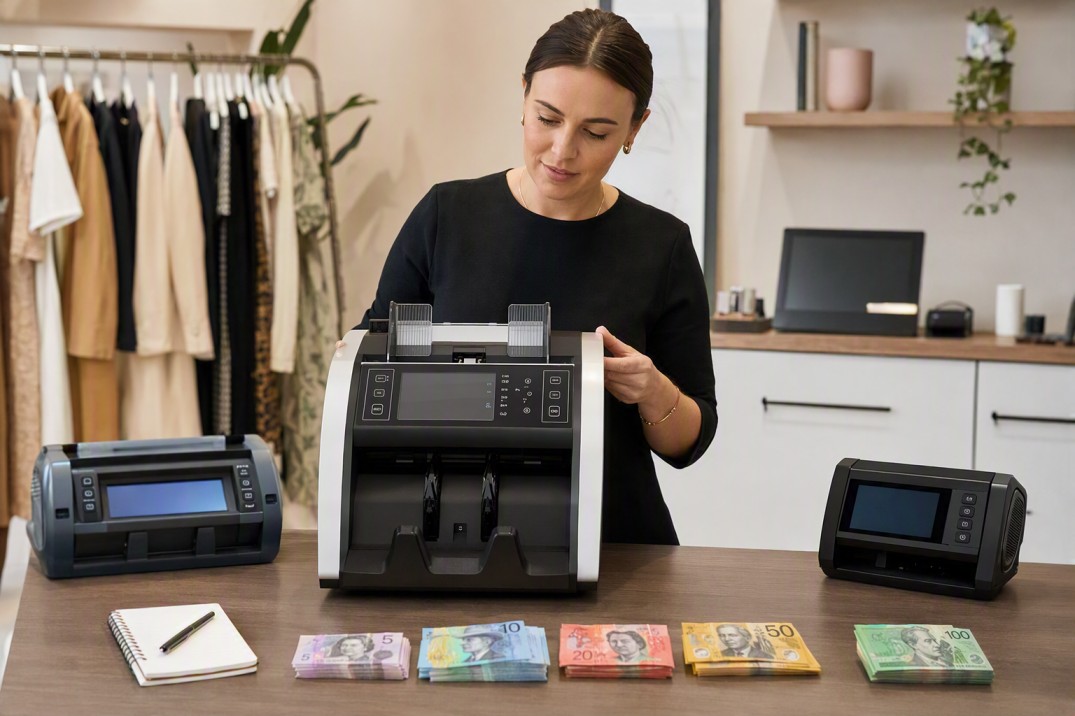
It is 6:15 pm at a small florist in Parramatta. The owner has just served her last customer and is closing the till for the day. Without a machine, she would spend 12–15 minutes counting and recounting a mixed stack of roughly 180 notes to confirm her daily takings, then manually adding up the denomination totals to cross-check against the POS figure. With a Cashcom H110 on the bench, she fans the stack, loads the hopper, presses start. In 22 seconds the display shows the note count and value total. She writes down the figure, balances against the POS, and locks the till. She is out the door by 6:20 pm. The machine also checked every note for counterfeits across four detection layers — something she could not have done manually in any amount of time. |
The Four Questions That Determine the Right Machine
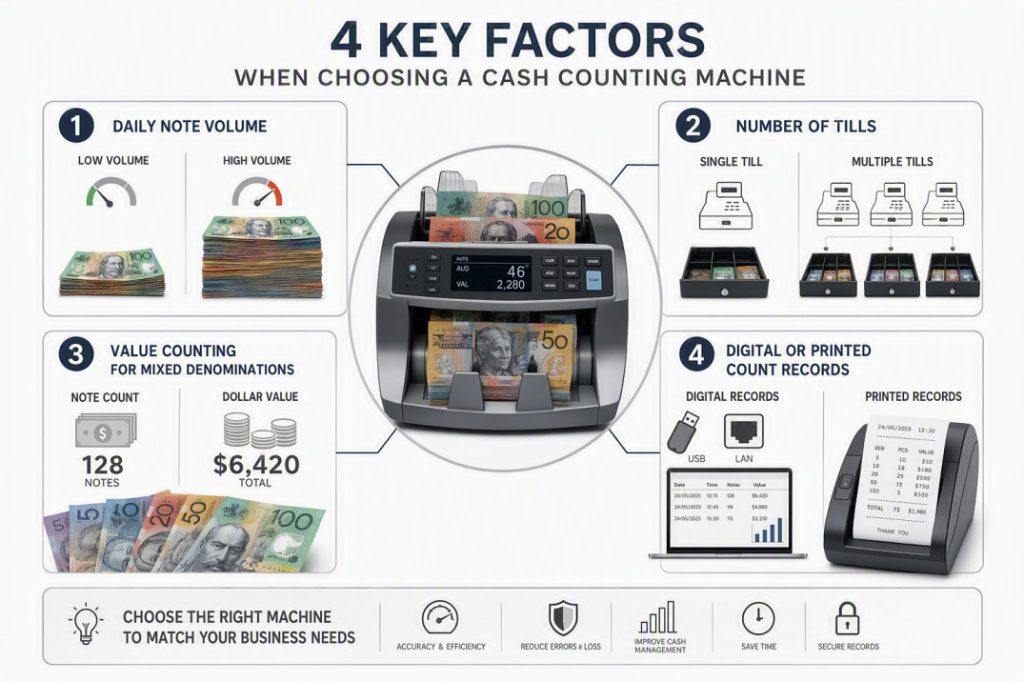
You do not need to compare every specification on every machine to make a good decision. Answer these four questions and the right machine becomes clear.
| Question | What It Determines | Low Answer → Machine | High Answer → Machine |
| How many notes per day? | Counting speed and hopper capacity needed | Under 300/day → H110 | Over 1,000/day → LS-200 |
| How many tills? | Whether denomination sorting adds value | 1 till → H110 | 3+ tills → H210 or LS-200 |
| Do you need a value total? | Value counting mode requirement | Note count fine → H110 | Mixed denom total → H110 or higher |
| Do you need an audit trail? | Serial number logging and connectivity needs | Basic count record → H110 | Per-employee log → H110 or K2 |
Question 1: How Many Notes Do You Count Per Day?
This is the primary driver of machine selection — not counting speed (which matters less than you think at small business volumes) but hopper capacity and duty cycle.
- Under 200 notes per day: any commercial machine handles this volume easily. The H110‘s 500-note hopper means you will count your entire day’s notes in a single load, most days.
- 200–500 notes per day: the H110 remains the right choice. For higher-volume days, load in two batches using Add mode to accumulate the running total.
- 500–1,000 notes per day: H110 with regular Add mode use, or consider the H210 if denomination sorting would streamline your process.
- Over 1,000 notes per day: the LS-200 at 1,500 notes per minute with 600-note hopper capacity is the right step up. At this volume, machine speed is a genuine operational factor.
Question 2: How Many Tills Do You Run?
Till count drives two decisions: whether you need denomination sorting (so each till’s count is separately sortable for banking preparation), and whether the hopper capacity and speed are sufficient to count multiple tills in a single closing session without becoming a bottleneck.
- 1 till: the H110 is the right machine. Denomination sorting is not necessary at single-till level — the full count goes to the bank as-is.
- 2–3 tills: the H110 handles this volume with Add mode for accumulating across tills. If you need denomination-sorted output for each till separately, the H210’s 3-pocket sorting is worth considering.
- 4+ tills: the H210 for sorting, or the LS-200 for speed. At four or more tills, the nightly close count is a genuine operational time investment — the right machine reduces it meaningfully.
Question 3: Do You Need a Value Total or Just a Note Count?
This is the question most first-time buyers overlook, and it is the one that determines whether the machine actually replaces manual work or just speeds up one step of it.
A note counter tells you how many notes are in the stack. A value counter totals mixed denominations and gives you the dollar figure. For a retail or hospitality business reconciling a till float against a POS total each night, the value counter is the machine that eliminates the manual calculation — not just the manual counting.
All Cashcom commercial machines include value counting as a standard mode. Verify this feature is present before purchasing any machine, as consumer-grade and some entry-level machines omit it.
Question 4: Do You Need a Physical or Digital Count Record?
For most small businesses, the answer to this question is that they need something — even if they have not thought about it explicitly. A count record is what lets you reconcile a discrepancy the next morning, or verify a count from three weeks ago if a question arises.
- Digital record via USB: most small businesses can export count data to a USB drive or connected computer at the end of each session. This is simpler and cheaper than a physical printer. H110 supports LAN + 2x USB + Serial.
- Physical printed receipt: for businesses where a signed paper record accompanies each count session (CIT environments, franchise operations with receipt requirements), the H110’s optional printer port allows an external receipt printer to be connected.
- No record needed: for very small operations where a manual note in a cash book is the extent of the record-keeping, neither option is strictly necessary — but the digital export via USB is so simple to set up that it is worth doing regardless.
What to Avoid When Choosing a Cash Counting Machine
Avoid UV-Only Detection
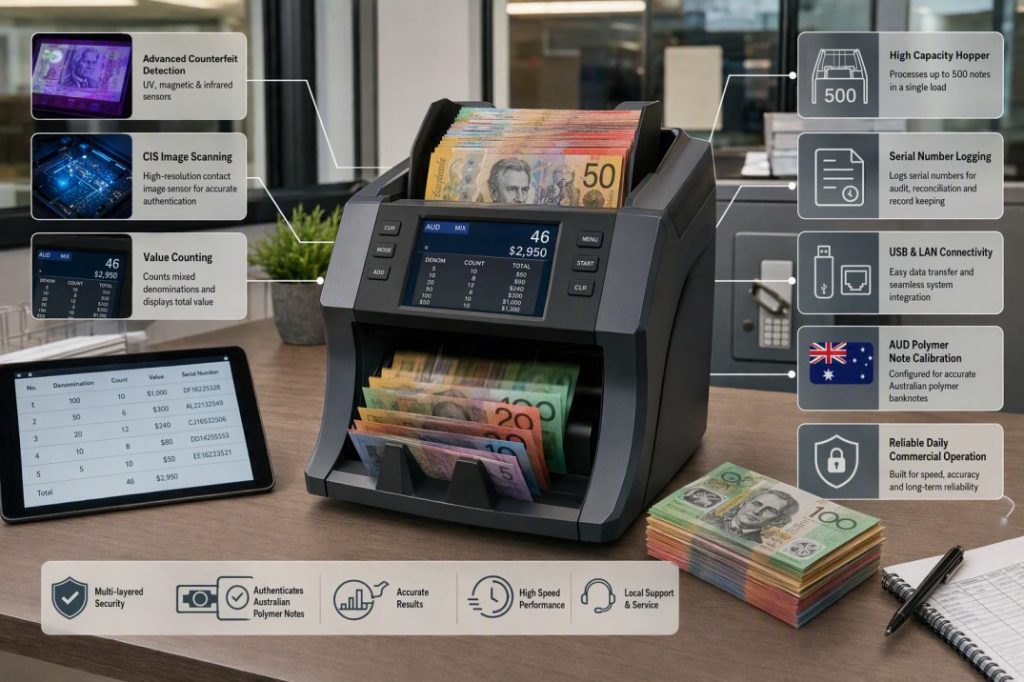
This is the most common mistake. A machine that checks only UV is not providing adequate counterfeit protection for a business taking cash from the public in 2026. Modern counterfeit polymer notes can replicate UV features. The minimum acceptable detection standard for commercial business use is UV plus magnetic (MG) plus infrared (IR). The H110 adds Dual CIS detection as a fourth layer.
Avoid Consumer-Grade Machines for Daily Business Use
The $30–$100 machines available through electronics retailers and online marketplaces are designed for occasional, light use — not daily commercial operation. Running a consumer machine as a business machine typically results in accuracy degradation and motor wear within 6–18 months. The total three-year cost of replacing consumer machines is typically higher than buying a single commercial machine at the outset. See our full breakdown: Commercial vs Consumer Cash Counting Machines.
Avoid Machines Without Local Australian Support
A machine that fails with no local warranty or service path means days of downtime waiting for an overseas return or a replacement to arrive. Cashcom is based in Haberfield, NSW, provides local servicing across Australia, and offers remote diagnosis for many common faults before a machine needs to come in for service.
Avoid Over-Specifying for Your Volume
Buying more machine than you need is a less serious mistake than buying less — but it is still a mistake. A single-till café does not need the LS-200’s 1,500-notes-per-minute throughput. That speed difference is not felt at 150 notes per day. Buy for your actual volume and actual workflow, not the highest number on the spec sheet.
Features Checklist: What to Look For
Use this checklist when comparing machines. Items marked Must-Have are non-negotiable for a business taking cash from the public daily.
| Feature | Must-Have? | Why It Matters for Small Business |
| UV + MG + IR detection | Yes | UV alone misses modern fakes. MG and IR add layers that catch what UV misses. Non-negotiable for any business taking cash from the public. |
| CIS (Contact Image Sensor) | Recommended | Full-image note verification — the deepest detection layer. Dual CIS on the H110 is the strongest single-machine option. |
| Value counting (mixed denoms) | Yes | Totals your till float in dollars, not just note count. Eliminates manual denomination addition at close. |
| Batch / Add modes | Yes | Batch mode for banking bundle prep; Add mode for counting across multiple hopper loads. Both save time in daily use. |
| Serial number logging | Beneficial | Captures every note’s serial number — useful for counterfeit tracing and accountability. Standard on H110. |
| LAN / USB connectivity | Beneficial | Allows count data export and LAN-based record keeping. Not essential for single-till small businesses but useful as you grow. |
| Optional printer port | Optional | For businesses needing a physical printed record per count session. H110 supports this via optional printer port. |
| AUD polymer calibration | Yes | Machine must be calibrated for Australian polymer notes — confirm before purchasing any imported machine. |
| Local AU warranty and service | Yes | A machine that fails with no local service path means days of downtime. Cashcom provides local service across Australia. |
| Hopper capacity ≥ 300 notes | Yes | A hopper too small for your daily stack means repeated reloading. H110’s 500-note hopper suits most small business volumes. |
Recommended Machine by Business Type
The table below maps common Australian small business types to their typical daily note volume and the recommended Cashcom model.
| Business Type | Typical Daily Notes | Tills | Recommended Model | Key Reason |
| Café or coffee shop | 100–250 | 1 | H110 | Single till, daily close count, strong detection |
| Small retail boutique | 150–350 | 1–2 | H110 | Mixed denominations, value counting at close |
| Restaurant or pub | 200–500 | 1–3 | H110 or H210 | Higher volume; H210 if sorting for banking |
| Pharmacy or chemist | 300–600 | 2–4 | H110 or H210 | Multi-till; denomination sorting beneficial |
| Market stall (casual) | 50–200 | 1 | H110 | Light volume; commercial detection still recommended |
| Small supermarket / IGA | 500–1,500 | 3–6 | LS-200 | High volume; speed and 18-channel MG detection |
| Petrol station / servo | 200–500 | 1–2 | H110 | Single or dual till; reliable daily operation |
| Hairdresser / beauty salon | 50–150 | 1 | H110 | Light volume; daily counting, counterfeit protection |
The Recommended Starting Point for Most Small Businesses
| Cashcom H110 — Best Overall for Small Business
The right starting point for 1–3 till small businesses across retail, hospitality and services Detection: Dual CIS + UV + MG + IR (4-method simultaneous) Speed: 720 notes per minute Hopper / Stacker / Reject: 500-note / 200-note / 100-note Fitness Detection: 12-type fitness detection Serial Numbers: Full serial number logging Connectivity: LAN + 2x USB + Serial + optional printer Compliance: CE, CB, FCC certified Verdict: The H110 covers everything a small business running 1–3 tills needs: the deepest available detection on a single-counter machine (Dual CIS plus three additional layers), value counting across mixed denominations, serial number logging, and the connectivity to export count records digitally or to an optional receipt printer. It is built for daily commercial use and backed by local Australian service. For most small businesses, this is the machine — and the only machine — you need to evaluate. View product → H110 Cash Counting Machine |

| Cashcom H210 — Best for Multi-Till with Denomination Sorting
Right choice if your workflow requires denomination-separated output from multiple tills Detection: Double-face counterfeit ID, multi-level damage detection Speed: 900 notes/min counting, 750 notes/min sorting Output: 3 pockets — 2 sorted exits + 1 reject Audit: Real-time serial ID queryable by serial number, operator, or batch Verdict: If your nightly process involves separating denominations for banking bundles or till-by-till sorted output, the H210 handles counting and sorting in a single pass — eliminating the manual denomination sort that follows a standard counter’s output. For a small business with a straightforward till count, the H110 is simpler and sufficient; the H210 earns its place when sorting is a genuine workflow step. View product → H210 Money Counter and Sorter Machine |
| Quick Calculation
A small business counting 200 mixed-denomination notes per night saves approximately 12–15 minutes per session compared to counting by hand. Across a six-day trading week, that is over an hour of staff time returned every week — roughly 55–65 hours per year. At award retail wages, that is $1,400–$2,100 in recovered labour annually from a single piece of equipment. |

Signs You Should Buy — and Signs You Can Probably Wait
Signs You Should Buy Now
- You count cash manually every trading day and it takes more than 5–10 minutes.
- You have had a counterfeit note pass through your business without being caught.
- Your current consumer machine is producing inaccurate counts or developing faults.
- You are opening a new location or adding tills and need a reliable daily counting process.
- Your accountant or bookkeeper has asked for a more reliable daily cash reconciliation record.
Signs You Can Probably Wait
- You handle cash only occasionally — a few times a week, small volumes — and counting by hand takes under three minutes.
- You are running a purely card-based business with minimal cash transactions.
- You are in the pre-revenue or early trading phase and cash volume is not yet consistent enough to justify the purchase.
| Our Honest Assessment
The Cashcom H110 is our recommendation for most Australian small businesses — and we are not going to pretend we do not sell it. What we will say is this: the H110 is the right machine for this use case because it is the entry point for genuine commercial-grade detection and daily-use build quality, not because it is the most expensive option we stock. If your business is very small, very low volume, or primarily card-based with minimal cash, you may genuinely not need a machine yet. We would rather tell you that than sell you something you will not use. When the volume justifies it — typically once you are counting cash every trading day — the H110 is where to start. |
Frequently Asked Questions
| Question | Answer |
| What is the best cash counting machine for a small business in Australia? | For most Australian small businesses running 1–3 tills with daily cash handling, the Cashcom H110 is the right machine — Dual CIS plus UV, MG, and IR detection, 720 notes per minute, 500-note hopper, value counting, serial number logging, and LAN connectivity. It is built for daily commercial use and backed by local Australian service. |
| Do I need a commercial or consumer cash counting machine for my small business? | If you count cash every trading day, you need a commercial machine. Consumer-grade machines (typically $30–$100) are not rated for daily commercial use and typically develop accuracy and reliability issues within 6–18 months of nightly business use. See our full comparison: Commercial vs Consumer Cash Counting Machines. |
| How much should a small business spend on a cash counting machine? | The entry point for genuine commercial-grade detection and daily-use durability is in the range covered by the Cashcom H110. The price difference between a consumer machine and an entry commercial machine is small enough that it is rarely the right decision factor — the relevant comparison is the total three-year cost, which typically favours the commercial machine. |
| What features does a small business need on a cash counting machine? | At minimum: UV + MG + IR counterfeit detection simultaneously, value counting (dollar totals from mixed denominations), AUD polymer note calibration, a hopper capacity of at least 300–500 notes, and a duty cycle rated for daily commercial use. The Cashcom H110 meets all of these and adds Dual CIS detection and serial number logging as standard. |
| Can a cash counting machine count different Australian note denominations together? | Yes — in Value mode, a commercial cash counting machine identifies each denomination ($5, $10, $20, $50, $100) and produces a combined dollar total from a mixed stack. This is value counting, and it is standard on all Cashcom commercial models including the H110. |
| How long does a commercial cash counting machine last? | With regular maintenance (sensor cleaning weekly, cleaning card monthly, annual professional service), a commercial machine like the Cashcom H110 is designed for years of daily business use. Consumer machines running at the same volume typically fail within 6–18 months. |
| Do I need a cash counting machine if I only have one till? | If you count cash every trading day — even from a single till — a machine saves meaningful time and provides counterfeit detection you cannot replicate manually. The H110 is specifically the right choice for single-till small businesses: it is built for that volume and does not over-specify for features you would not use. |
Talk to Cashcom About the Right Machine for Your Business
If you are still unsure which model fits your operation after working through the questions above, the Cashcom team can make a recommendation based on your daily volume, till count, and trading hours — no obligation.
Call: 0451 353 676 | Email: sales@cashcom.com.au | Web: cashcom.com.au
Once you have chosen your machine, see: How to Use a Cash Counting Machine: Step-by-Step Guide — for the correct operating procedure to get the most accurate results from day one.
About the Author
This article was prepared by the Cashcom Team, Australian Cash Handling Specialists since 2015. Cashcom supplies and services cash counting, sorting and recycling equipment for retail, hospitality, banking, gaming and cash-in-transit businesses across Australia.
Get in touch: 0451 353 676 | sales@cashcom.com.au | cashcom.com.au