
| Quick Answer
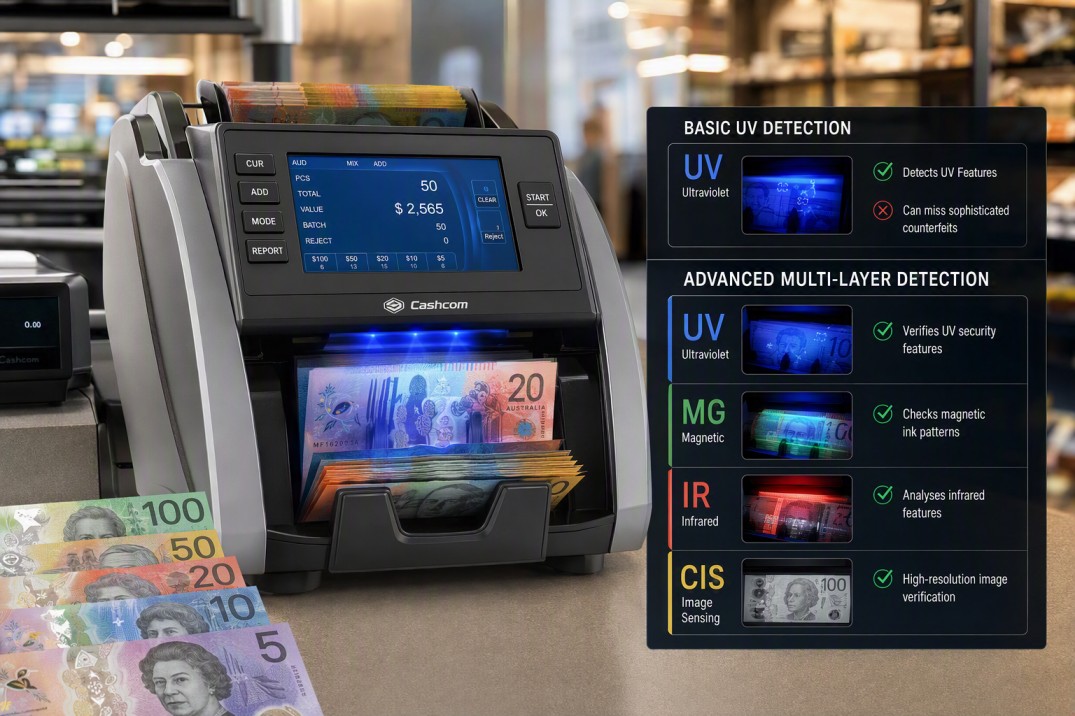
No. UV-only detection is not sufficient for commercial business use in Australia in 2026. UV (ultraviolet) detection was the standard when Australian banknotes were primarily paper-based. Modern Australian polymer banknotes — and, critically, modern counterfeit polymer notes — require a more layered detection approach. Sophisticated fakes can now pass a UV check while failing magnetic (MG) or infrared (IR) verification. The minimum acceptable detection standard for a commercial cash counting machine in 2026 is: • UV + MG + IR running simultaneously — the commercial baseline. Catches the vast majority of counterfeits in Australian circulation. • UV + MG + IR + CIS — the commercial best practice. Adds full-image verification. Standard on the Cashcom H110, which runs Dual CIS alongside the three other methods. Any machine offering UV detection only should be treated as inadequate for a business taking cash from the public on a daily basis. |
Why UV Detection Was Once Enough — and Why It No Longer Is
Ultraviolet detection works by checking whether a banknote fluoresces under UV light in the expected pattern. Genuine AUD banknotes include UV-reactive security features — specific fibres, inks, and patterns that glow under ultraviolet illumination in ways that older counterfeit methods could not replicate.
For most of the history of cash counting machines in Australia, UV detection provided meaningful protection. The counterfeits in general circulation were primarily low-quality fakes that lacked UV-reactive features entirely — easy to catch with even a basic UV check.
That threat model has changed. The combination of higher-quality printing technology, the shift from paper to polymer banknotes (which have different UV characteristics than paper), and the maturation of counterfeit production techniques means that UV-only detection in 2026 catches the unsophisticated fakes it always caught — and misses an increasing proportion of the ones that matter.
This is not a theoretical concern. Australian law enforcement and the Reserve Bank of Australia regularly report the ongoing evolution of counterfeit techniques targeting polymer currency. A business relying on UV-only detection is accepting a risk gap between what its machine can catch and what is actually in circulation.
What UV Detection Actually Checks
A UV sensor in a cash counting machine shines ultraviolet light across the note as it passes through the transport mechanism. The sensor then measures whether the note’s UV-reactive features respond in the expected way — emitting visible light at the right intensity and in the right pattern.
For a genuine AUD polymer note, the UV response is consistent and predictable. For a counterfeit without UV features, the response is absent or incorrect — and the machine flags it as a reject.
The limitation is straightforward: UV detection only tests UV response. It tells you nothing about the note’s magnetic ink signature, its infrared security patterns, or whether its printed image matches the dimensions and details of a genuine note. A counterfeit that replicates the UV response — but fails on magnetic, infrared, or image dimensions — passes a UV-only machine.
| The Detection Gap
A UV-only machine has one checkpoint. A note either passes UV or it does not. A machine running UV + MG + IR + CIS has four independent checkpoints — and a note must pass all four to be accepted. A sophisticated counterfeit that replicates UV features but cannot replicate magnetic ink properties will pass the UV check and fail the MG check. On a UV-only machine, that note is accepted. On the H110, it is rejected. |
The Four Detection Layers: What Each One Does
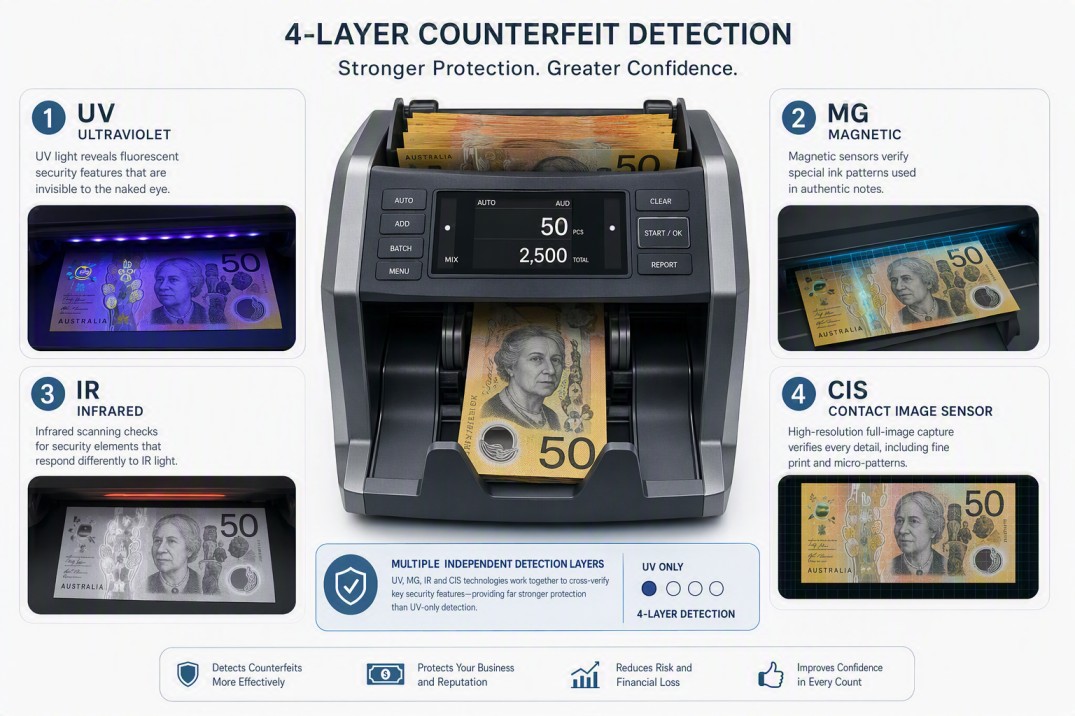
Understanding what each detection method checks — and what it catches that the others miss — explains why layered detection is more than just a marketing claim.
| Detection Method | What It Checks | What It Catches | What It Misses |
| UV (Ultraviolet) | UV-reactive security features and fibres in genuine AUD polymer notes | Counterfeits without any UV replication — basic fakes | Sophisticated fakes that replicate UV features; polymer notes where UV features have been transferred or copied |
| MG (Magnetic) | Magnetic ink signature unique to genuine banknotes | Counterfeits using non-magnetic printing — catches what UV misses on many mid-tier fakes | High-end counterfeits with magnetic ink replication — rare but present in high-risk environments |
| IR (Infrared) | Infrared-absorbing patterns invisible to the naked eye | Counterfeits missing IR security printing — a third independent verification layer | Sophisticated fakes replicating IR patterns — extremely rare; IR combined with UV and MG covers the vast majority of fakes |
| CIS (Image Sensor) | Full-width image of the note vs a stored reference | Dimensional anomalies, printing errors, incorrect proportions, sophisticated fakes passing UV/MG/IR | Nothing meaningful when combined with UV + MG + IR — the four-method stack is the most robust available |
Why Running All Four Simultaneously Matters
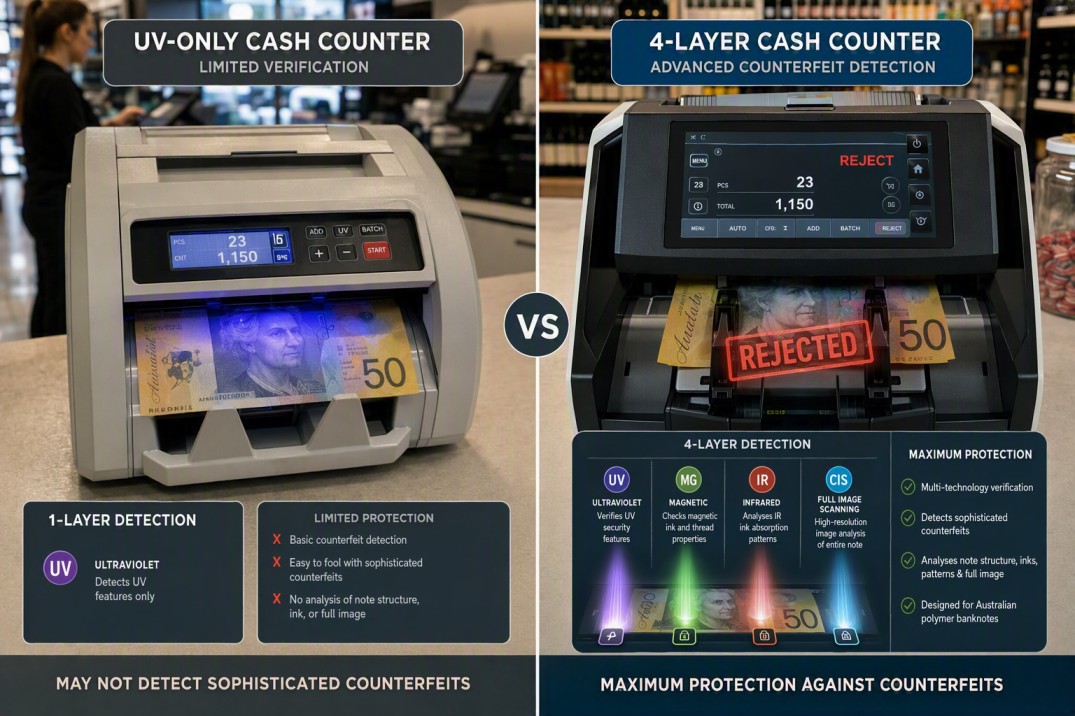
Some machines describe multi-layer detection but run the checks sequentially — a note that passes UV moves to MG, then to IR. Simultaneous detection means all four methods check the note in the same pass, at the same speed, without reducing throughput. The Cashcom H110 runs Dual CIS plus UV, MG, and IR simultaneously — four independent verification results per note, in a single transport pass at 720 notes per minute.
Sequential detection creates a logical dependency: if the first check passes, the note moves forward. Simultaneous detection means no single check outcome determines whether subsequent checks run — all four results are evaluated independently before a decision is made.
Why Australian Polymer Banknotes Require Layered Detection
Australian banknotes are polymer — a biaxially oriented polypropylene substrate rather than paper. Polymer notes have different UV, magnetic, and infrared security feature profiles than paper currency, and the security features used in AUD polymer notes are specifically designed to be verified across multiple detection methods simultaneously.
The Reserve Bank of Australia’s polymer note security architecture assumes multi-layer machine verification — not single-layer UV checking. When counterfeiters target AUD polymer notes, they are working against that multi-layer architecture. A machine that only checks one layer of a multi-layer security system is not using the tools the RBA’s note design makes available.
AUD-specific calibration also matters. A machine calibrated generically for multiple currency types uses averaged thresholds for UV, MG, and IR response — thresholds that may not align precisely with AUD polymer note specifications. Cashcom machines are calibrated specifically for current and older-series AUD polymer banknotes, reducing false rejects on genuine worn notes and maintaining sensitivity to AUD-specific counterfeiting signatures.
Counterfeit Risk by Business Environment
Not all Australian businesses face the same counterfeit exposure. The appropriate detection standard scales with risk — though the minimum for any business taking cash from the public is UV + MG + IR.
| Business Type | Counterfeit Risk Level | Minimum Detection Standard | Cashcom Model |
| High-traffic retail (supermarket, pharmacy) | High | UV + MG + IR + CIS | H110 or LS-200 |
| Café, restaurant, pub | Medium | UV + MG + IR minimum | H110 |
| Bank branch / credit union | High | UV + MG + IR + CIS | LS-200 or LS-300 |
| Gaming venue / club | High | UV + MG + IR + CIS | K2 Cash Recycler |
| Cash-in-transit operator | High | UV + MG + IR + CIS | H110 or H210 |
| Market stall (occasional) | Low | UV + MG + IR recommended | H110 |
| Small service business (low cash volume) | Low | UV + MG + IR minimum | H110 |
High-Traffic Retail: The Highest Risk Environment
A supermarket, pharmacy, or large-format retailer taking cash from hundreds of customers per day has the highest volume exposure to counterfeit notes. High volume, anonymous transactions, and time-pressured staff are exactly the conditions in which a sophisticated fake is most likely to be accepted without scrutiny. UV + MG + IR + CIS is the right detection standard here — not as a precaution but as a baseline.
Hospitality: Medium Risk, Still Needs MG + IR
A café, restaurant, or pub typically has lower daily note volume than large retail, but still takes cash from the public in time-pressured transaction environments. UV-only is not adequate. UV + MG + IR as a minimum is the right standard, with CIS providing additional confidence at very modest additional cost at the H110 level.
Low-Volume Service Businesses
A hairdresser, small tradespeople, or a service business taking occasional cash payments from known clients has lower risk exposure than high-traffic retail. The risk is lower — but not zero. UV + MG + IR remains the minimum recommended standard because the cost of upgrading from UV-only to the H110’s four-method detection is small relative to the cost of accepting even one undetected counterfeit per month.
| Our Honest Assessment
We are not going to claim that every Australian business faces an imminent counterfeit crisis from UV-only detection. The risk is real but not uniform — a business in a low-volume, low-traffic environment with regular customers has meaningfully lower exposure than a high-traffic retail store. What we will say clearly is this: the price difference between a UV-only machine and a Cashcom H110 with Dual CIS plus UV, MG, and IR is not large. The protection difference is significant. For any business counting cash from the public as a daily trading activity, the case for UV + MG + IR + CIS detection is straightforward — the cost of the upgrade is a fraction of the cost of a single undetected counterfeit per month. |
What to Look For When Buying: Detection Specification Red Flags
When evaluating any cash counting machine, these specification phrases are signals to look more carefully:
- “UV detection” listed alone: this means UV only. No MG, no IR, no CIS. Not adequate for commercial business use in 2026.
- “UV + MG” without IR: two layers is better than one, but still short of the commercial minimum. Confirm that the machine includes IR detection before purchasing.
- “Multi-function detection” without specifying layers: this phrase appears in marketing copy for machines that may have UV only. Ask explicitly: does the machine detect UV, MG, and IR simultaneously?
- No mention of AUD polymer calibration: imported machines with generic multi-currency calibration may not accurately verify AUD-specific note features. Confirm AUD polymer compatibility explicitly.
- “Advanced counterfeit detection” without specification: a marketing claim, not a technical specification. The specification you want is the list of detection methods: UV + MG + IR + CIS.
The Commercial Standard: Cashcom H110
| Cashcom H110 — Dual CIS + UV + MG + IR
Four-method simultaneous detection — the commercial standard for Australian businesses in 2026 Detection: Dual CIS + UV + MG + IR (4-method simultaneous) Speed: 720 notes per minute Hopper / Stacker / Reject: 500-note / 200-note / 100-note Fitness Detection: 12-type fitness detection Serial Numbers: Full serial number logging Connectivity: LAN + 2x USB + Serial + optional printer Compliance: CE, CB, FCC certified Verdict: The H110 is the baseline commercial detection standard for Australian businesses. Four detection methods running simultaneously means no single layer failure allows a counterfeit through — a note must pass UV, MG, IR, and both CIS sensors to be accepted. For businesses asking whether UV alone is enough, the H110 is the correct answer to ‘what should I have instead.’ View product → H110 Cash Counting Machine |
| Quick Calculation
A business taking 200 cash transactions per day accepts, on average, one note per transaction. If one in every 10,000 notes in circulation is a sophisticated counterfeit that passes UV but fails MG or IR — a conservative estimate in a high-traffic environment — a UV-only machine would accept approximately one fake note every 50 trading days. At an average value of $50, that is a monthly cash loss of roughly $30–$50 from undetected counterfeits alone, before accounting for any higher-value denominations. The cost difference between a UV-only machine and an H110 is recovered in prevented losses within the first year of operation. |
If You Currently Have a UV-Only Machine: What to Do
If your business is currently using a UV-only cash counting machine — whether a consumer-grade machine from an electronics retailer or an older commercial machine — the question is not whether to upgrade, but when.
- If the machine is still functioning reliably: plan the upgrade before the machine fails rather than after. A failing UV-only machine that businesses replace reactively often leads them to buy another UV-only machine because they make the decision under time pressure. Plan the upgrade deliberately and make the right choice.
- If the machine is producing irregular counts or faults: do not continue running it. An unreliable machine is accepting notes you cannot trust — a UV-only machine producing fault counts is worse than no machine at all, because it creates false confidence.
- If you are evaluating machines for a new business: do not buy UV-only. The entry point for commercial-grade four-method detection — the H110 — is accessible and does not require a significant premium over the UV-only machines commonly available through consumer retail channels.
Frequently Asked Questions
| Question | Answer |
| Is UV detection enough for a cash counting machine in 2026? | No. UV-only detection is no longer sufficient for commercial business use in Australia. Modern counterfeit polymer notes can replicate UV features. The minimum acceptable standard is UV plus magnetic (MG) plus infrared (IR) detection running simultaneously. The Cashcom H110 adds Dual CIS as a fourth layer. |
| What is the difference between UV, MG, IR, and CIS detection? | UV checks ultraviolet-reactive security features. MG checks the magnetic ink signature of genuine notes. IR checks infrared-absorbing patterns invisible to the naked eye. CIS captures a full-width image of the note and compares it against a stored reference. Each layer catches counterfeits that the others may miss — the four-method stack covers the full range of counterfeit techniques in current Australian circulation. |
| Do Australian polymer banknotes require different detection than paper notes? | Yes. Australian polymer notes have specific UV, magnetic, and infrared security feature profiles that differ from paper currency. Machines calibrated generically for multiple currency types may not verify AUD-specific features at the correct threshold sensitivity. Cashcom machines specifically calibrate their detection systems for current and older-series AUD polymer banknotes. |
| What cash counting machines have UV + MG + IR + CIS detection? | The Cashcom H110 runs Dual CIS plus UV, MG, and IR simultaneously — four independent detection methods in a single pass. The H210, LS-200, and K2 Cash Recycler also include multi-layer detection. Contact the Cashcom team to confirm the specific detection configuration for each model. |
| How do I know if my current machine has MG and IR detection? | Check the product specification sheet for the exact detection methods listed. If the spec sheet only mentions UV or ‘ultraviolet’ without specifying MG (magnetic) and IR (infrared), the machine has UV-only detection. Phrases like ‘multi-function detection’ or ‘advanced counterfeit detection’ without specifying the methods are not equivalent to confirmed MG + IR capability. |
| What happens if a counterfeit note passes through a UV-only machine? | The machine accepts it as genuine — it is counted, added to the total, and included in your cash balance. There is no alert, no flag, and no record that the note was suspect. A counterfeit accepted by a UV-only machine is a direct financial loss: you have given value (goods or services) in exchange for a note that has no monetary value. |
Upgrade to Commercial-Grade Detection
If you are currently using a UV-only machine — or evaluating machines for the first time — Cashcom can help you select the right detection specification for your business environment and daily cash volume.
Call: 0451 353 676 | Email: sales@cashcom.com.au | Web: cashcom.com.au
Also see: How to Choose a Cash Counting Machine for a Small Business in Australia — for the full decision framework including which Cashcom model fits your volume and workflow.
About the Author
This article was prepared by the Cashcom Team, Australian Cash Handling Specialists since 2015. Cashcom supplies and services cash counting, sorting and recycling equipment for retail, hospitality, banking, gaming and cash-in-transit businesses across Australia.
Get in touch: 0451 353 676 | sales@cashcom.com.au | cashcom.com.au