
| Quick Answer
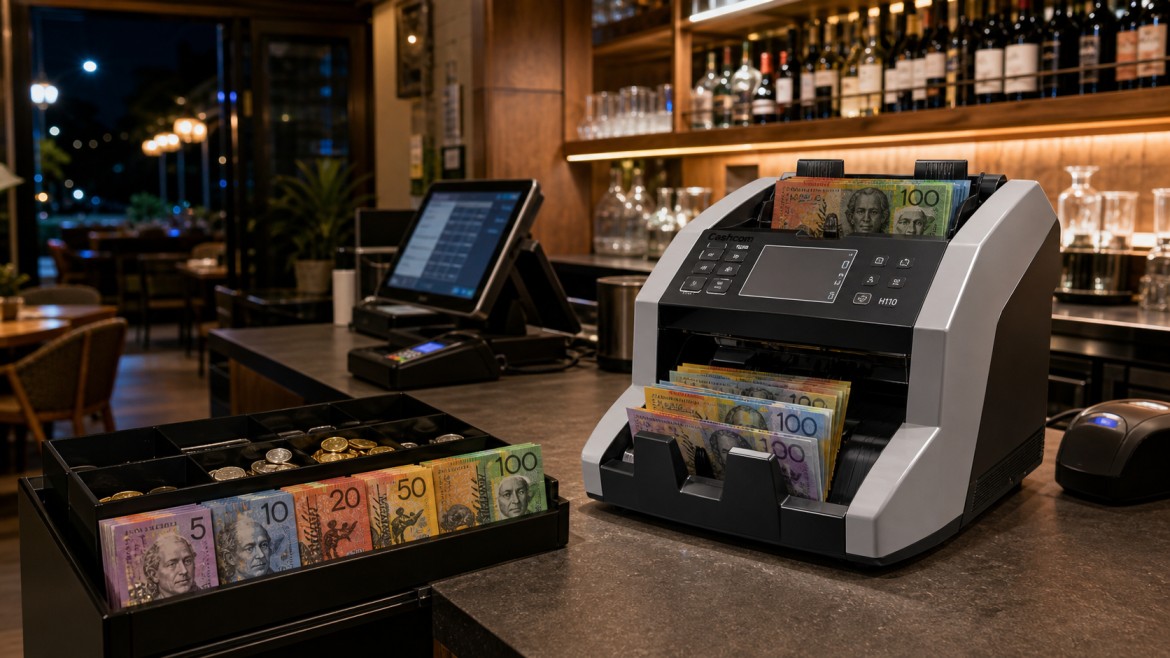
For most Australian hospitality businesses — cafés, restaurants, pubs, and food trucks — the Cashcom H110 is the right cash counting machine: • Single till: H110. Covers the full daily note count in one load, with four-method counterfeit detection and value counting at close. • Multi-till restaurant or pub (2–4 tills): H110 for most; H210 if your closing process involves denomination-sorted output per till for banking. • High-volume club or large venue (4+ tills, multi-shift): H210 or LS-200 depending on volume and whether speed is a genuine bottleneck. • High coin volume (busy café, food stall): pair the H110 with a Cashcom Con200 coin sorter — note counters do not handle coins. |
Why Hospitality Cash Handling Is Different
A restaurant, pub, or café is not a retail store with different products. The cash handling environment in hospitality has a specific character that shapes what a cash counting machine needs to do well.
Close happens late — often after 11:00 pm or midnight in a licensed venue. The person counting the till is typically the manager or a senior staff member who has just completed a full shift. The conditions — end-of-night fatigue, time pressure to get staff home, the desire to leave — are exactly the conditions under which manual counting errors multiply and counterfeit notes pass undetected.
Cash volume is unpredictable within a trading week. A Wednesday lunch service may generate 80 notes; a Saturday night may generate 400. A machine calibrated for the slow day will feel limiting on the busy one; a machine over-specified for the peak day is unnecessary overhead on the quiet ones.
Multi-staff cash handling creates accountability questions. In a venue where three bartenders and a manager have all handled the till float across a shift, tracing a discrepancy is difficult without a per-note record.
The right cash counting machine for hospitality addresses all three: it is fast enough for peak nights, accurate enough to catch counterfeits under fatigue conditions, and produces a record good enough to reconcile or investigate a discrepancy the next morning.
A Day in the LifeIt is 11:45 pm at a busy Sydney pub. Saturday night service has just finished. The floor manager has three tills to count down — bar, bistro, and functions. Without a machine, that is 30–40 minutes of manual counting, recounting and reconciling against the POS figures — the last thing anyone wants at the end of a ten-hour shift. With a Cashcom H110 on the back-office bench, each till takes under two minutes: fan the stack, load the hopper, press start. The H110 counts at 720 notes per minute, authenticates across four detection layers simultaneously, and displays the total value in under 90 seconds per till. All three tills are counted, reconciled against the POS, and locked in the safe by 12:05 am. On the way through, the H110’s reject pocket flags a $50 note that fails the magnetic detection check. The manager sets it aside for inspection in the morning. Manual counting would not have caught it — not at that hour, not after that shift. |
What a Cash Counting Machine Needs to Do in a Hospitality Setting
Count and Authenticate Quickly — Especially on Busy Nights
The time-saving argument is strongest in hospitality because closing time is the most fatigued, most time-pressured point in the trading day. A machine that saves 25–30 minutes at close is not just a convenience — it directly affects when staff get home, how the manager feels about closing procedures, and whether the closing count is done thoroughly or rushed.
At 720 notes per minute, the H110 processes a 300-note stack in under 30 seconds. The same stack takes a trained person 5–8 minutes to count by hand and 3–4 minutes to verify with a recount. The machine is faster every time, regardless of how tired the operator is.
Catch Counterfeits Under Fatigue Conditions
Cash counting machine hospitality is one of the higher-risk environments for counterfeit notes — not because hospitality businesses are uniquely targeted, but because the transaction conditions (busy bar, dimly lit, time-pressured) make manual detection particularly difficult. A note handed over during a busy service period may receive a fraction of a second of scrutiny from a staff member juggling multiple customers.
A machine with four-method detection (UV + MG + IR + CIS) provides consistent, fatigue-independent authentication on every note, regardless of how busy the service was or how late it is. The Cashcom H110’s Dual CIS detection captures a full-image comparison on every note — a level of verification that no manual check under pub lighting can replicate.
Produce a Usable Reconciliation Total
The purpose of the close count in hospitality is to verify the day’s cash takings against the POS total. This requires a value total — the dollar amount of the mixed notes in the till — not just a note count. Value counting mode (standard on the H110) provides this directly: load the mixed stack, and the machine displays the total AUD value automatically.
Work Reliably Every Trading Day
Hospitality is a seven-day-a-week operation in most venues. A machine used for end-of-shift counting six or seven nights per week needs to be built for continuous daily commercial use — not a consumer-grade machine sold through an electronics retailer. See: Commercial vs Consumer Cash Counting Machines for a full breakdown of why the distinction matters.
Features to Look For in a Hospitality Cash Counting Machine
| Feature | Why It Matters in Hospitality | H110 | H210 |
| UV + MG + IR + CIS detection | Hospitality staff accept cash under time pressure — multi-layer detection catches what a rushed manual check misses | Dual CIS | Yes |
| Value counting (mixed denoms) | End-of-shift reconciliation needs a dollar total, not a note count, to match the POS figure | Yes | Yes |
| 500+ note hopper | A busy pub or restaurant may count 300–600 notes per shift — a small hopper creates repeated reload interruptions | 500-note | 500-note |
| Denomination sorting | Multi-till venues preparing denomination-sorted banking bundles benefit from sorted output per till | No | 3-pocket |
| Serial number logging | Multi-staff environments benefit from per-note accountability, particularly if cash discrepancies arise between shifts | Yes | Yes |
| LAN / USB connectivity | Digital count records exportable for manager review or bookkeeper reconciliation without physical presence | Yes | Yes |
| Optional receipt printer | Some venues require a physical signed record per shift for accountability — H110 supports optional printer port | Optional | — |
| Commercial-grade build | Hospitality machines are used at the end of long, busy shifts — build quality and reliability under fatigue-prone use matters | Yes | Yes |
| Local AU service | A machine that fails on a Friday night is a real operational problem — local service access matters | Cashcom AU | Cashcom AU |
Recommended Machine by Hospitality Venue Type
The table below maps common Australian hospitality venue types to their typical daily note volume and the recommended Cashcom model.
| Venue Type | Typical Daily Notes | Tills | Cash Mix | Recommended Model |
| Café (single) | 80–200 | 1 | Notes dominant; some coin | H110 |
| Café (multi-site) | 150–400 | 1–2 | Notes; moderate coin volume | H110 + Con200 if high coin |
| Restaurant (fine dining) | 100–300 | 1–2 | Mostly notes; card dominant | H110 |
| Restaurant (casual) | 200–500 | 2–4 | Mixed notes and coin | H110 or H210 |
| Pub / hotel bar | 300–700 | 2–4 | High cash; busy peak periods | H110 or H210 |
| Club / large venue | 500–1,500 | 4+ | High volume; multi-shift | H210 or LS-200 |
| Food hall stall | 100–300 | 1 | Very cash-heavy; coin-intensive | H110 + Con200 |
| Food truck | 100–250 | 1 | Cash-heavy; mostly notes | H110 |
The Best Cashcom Models for Hospitality
| Cashcom H110 — Best for Most Hospitality Venues
Best for single-till cafés, restaurants, pubs, and food trucks — and the right starting point for most hospitality operations Detection: Dual CIS + UV + MG + IR (4-method simultaneous) Speed: 720 notes per minute Hopper / Stacker / Reject: 500-note / 200-note / 100-note Fitness Detection: 12-type fitness detection Serial Numbers: Full serial number logging Connectivity: LAN + 2x USB + Serial + optional printer Compliance: CE, CB, FCC certified Verdict: The H110 is the right machine for the large majority of Australian hospitality venues. A single-till café or restaurant counting 80–300 notes per night processes the entire stack in under 30 seconds with full four-method authentication. The 500-note hopper handles even a busy Saturday night in a single load for most venues. Serial number logging and LAN connectivity give managers a digital count record without needing to print a receipt at every close. View product → https://cashcom.com.au/products/h110 |
| Cashcom H210 — Best for Multi-Till Venues Needing Denomination Sorting
Best for pubs, restaurants and clubs where denomination-sorted banking bundles are part of the closing process Detection: Double-face counterfeit ID, multi-level damage detection Speed: 900 notes/min counting, 750 notes/min sorting Output: 3 pockets — 2 sorted exits + 1 reject Audit: Real-time serial ID queryable by serial number, operator, or batch Verdict: Where the H110 counts and authenticates, the H210 also separates notes by denomination into output pockets in the same pass — useful for venues that need denomination-sorted cash for banking bundles or float preparation across multiple tills. For venues where the closing count ends with a mixed unsorted stack going to the safe, the H110 is simpler and sufficient; the H210 earns its place when sorting is a genuine closing step. View product → https://cashcom.com.au/products/h210 |
Practical Setup for Hospitality Cash Handling
Where to Put the Machine
The cash counting machine belongs in the manager’s office or a secured back-of-house area — not on the bar or front counter. Staff should count tills in a designated space away from the trading floor, where the machine can run without customer visibility and with a lockable surface nearby for the counted notes.
When to Count
Most hospitality businesses count at end of service — after the last customer leaves and the POS is closed. In multi-shift venues, count between each shift handover rather than only at end of day. This creates a per-shift record that can be traced if a discrepancy appears, rather than a single daily total that obscures when the issue occurred.
Using Add Mode Across Multiple Tills
A restaurant or pub with three tills counting at close uses Add mode to accumulate the total across all three loads without resetting between tills. Count till 1, leave the machine in Add mode, count till 2, count till 3. The display shows the combined total for all three tills. Cross-check against the combined POS total for the session.
What to Do with Rejected Notes
The reject pocket collects notes that failed counterfeit or fitness checks. At close of a late service, this is not the time to investigate each rejected note in detail — set aside rejects in a separate envelope marked with the date and shift, and review them the next morning with fresh eyes and in good lighting. Never put a rejected note back into a counted stack or the safe without manual inspection.
| Quick Calculation
A restaurant or pub counting three tills manually at close — averaging 200 notes per till — typically takes 25–35 minutes including recounts and reconciliation. With a Cashcom H110 in Add mode across three loads, the same count takes 5–7 minutes. Across six closing nights per week, that is approximately 2 hours of manager time returned every week — 100+ hours per year. At a senior hospitality wage, that is $3,500–$4,500 in annual labour value recovered from a single piece of equipment. |
Signs Your Venue Should Buy — and Signs You Can Probably Wait
Why You Should Buy Now
- Your closing count takes more than 15 minutes on a typical night.
- You have had a counterfeit note accepted during service — or suspect you have.
- Staff are closing later than necessary because the count is slow.
- You have experienced till discrepancies that were difficult to trace without a per-note record.
- You are opening a new venue or adding a till and want a consistent cash close process from day one.
Signs You Can Probably Wait
- Your venue takes predominantly card payments with only occasional small cash transactions.
- Your daily cash volume is under 50 notes and manual counting takes under five minutes.
- You are in the early trading phase of a new venue and cash patterns are not yet consistent.
| Our Honest Assessment
The H110 is the right machine for most hospitality venues and we are confident in that recommendation — but not because it is the most expensive option we carry. It is right because four-method detection, commercial-grade build quality, and value counting cover exactly what hospitality cash handling requires, at a price point accessible to independent operators without a large equipment budget. If your venue is primarily card-based with minimal cash — which describes an increasing proportion of Australian hospitality businesses — a cash counting machine may not be the most urgent equipment investment. When your cash volume genuinely justifies it, the H110 is where to start. |
Frequently Asked Questions
| Question | Answer |
What is the best cash counting machine for a restaurant or café? |
For most Australian restaurants and cafés, the Cashcom H110 is the right machine — Dual CIS plus UV, MG, and IR detection, 720 notes per minute, 500-note hopper, value counting, and serial number logging. It processes a full single-till count in under two minutes and produces a digital record exportable via LAN or USB. |
Do I need a coin sorter alongside my note counter for a hospitality business? |
It depends on your coin volume. Restaurants and pubs with moderate coin change per transaction may manage coin manually. High-volume cafés, food stalls, and venues with significant coin-generating transactions (bar change, food trucks) benefit from pairing the H110 with a Cashcom Con200 coin sorter. |
| Can a cash counting machine help detect counterfeit notes in a pub or bar? | Yes — and this is one of its strongest use cases in hospitality. Staff accepting cash during a busy service cannot realistically scrutinise every note manually. A machine with four-method detection (UV + MG + IR + CIS) authenticates every note automatically, regardless of how busy or late it is. |
How long does it take to count a restaurant till with a cash counting machine? |
A stack of 200 notes takes approximately 17 seconds on the H110 at 720 notes per minute. Including loading and reading the display, a full till count is typically done in under two minutes per till. Three tills in Add mode takes 5–7 minutes, compared to 25–35 minutes manually. |
| What is the difference between the H110 and H210 for a hospitality venue? | The H110 counts and authenticates notes, outputting them to a single stacker. The H210 also sorts by denomination into three output pockets (2 sorted exits + 1 reject) in the same pass. For venues that need denomination-sorted output for banking bundles, the H210 earns its place. For venues counting into a single safe envelope at close, the H110 is simpler and sufficient. |
Do I need to use Add mode to count multiple tills? |
Yes — use Add mode to accumulate a running total across multiple till loads without resetting between them. Count till 1, leave the machine in Add mode, load till 2, count, then till 3. The machine displays the combined total for the full session, ready to cross-check against your POS end-of-day report. |
Talk to Cashcom About Your Venue
Whether you are setting up cash handling for a new venue or replacing a machine that is not keeping up with your closing process, the Cashcom team can recommend the right configuration for your till count, volume, and trading hours.
Call: 0451 353 676 | Email: sales@cashcom.com.au | Web: cashcom.com.au
Also see: How to Use a Cash Counting Machine: Step-by-Step Guide — for the correct operating procedure to get the most accurate results from your first close.
About the Author
This article was prepared by the Cashcom Team, Australian Cash Handling Specialists since 2015. Cashcom supplies and services cash counting, sorting and recycling equipment for retail, hospitality, banking, gaming and cash-in-transit businesses across Australia.
Get in touch: 0451 353 676 | sales@cashcom.com.au | cashcom.com.au