
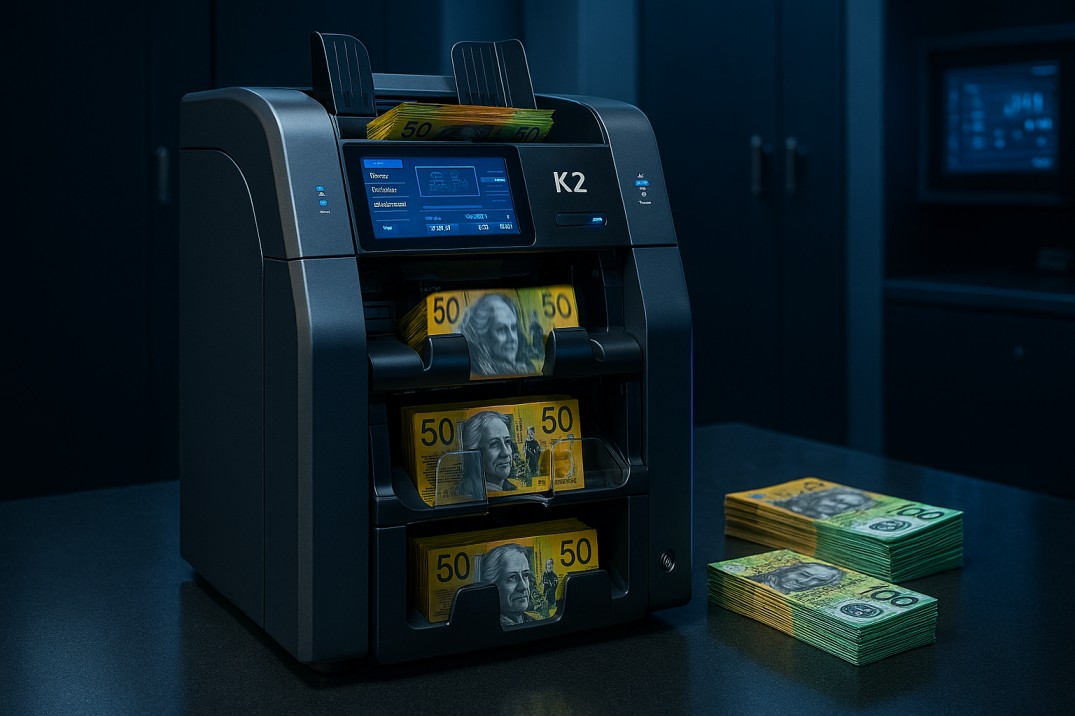
The cash recycler market in Australia has matured significantly in recent years. Where once professional cash recycling equipment was the exclusive territory of major banks and casino operators, machines like the K2 Cash Recycler Sorter Machine from Cashcom have made this capability accessible to licensed clubs, gaming venues, large retail operations, and entertainment businesses.
This review covers the K2 Cash Recycler in full — every specification that matters, honest pros and cons based on real-world Australian deployments, a direct comparison against the LS-300 for buyers evaluating both, and a clear verdict on who the K2 is and is not the right machine for.
Cashcom supplies the K2 Cash Recycler to Australian businesses. We are not a neutral third-party reviewer — we sell this machine. What we can offer is direct operational knowledge from supporting K2 deployments across clubs, gaming venues, and large retail across Australia since the machine entered our range.
| Quick verdict:
The K2 Cash Recycler is the right cash recycler machine for Australian operations with high daily note volumes, active float management needs, and multi-staff cash access requirements. Its 1,000-note hopper is the largest in the Cashcom range and the most immediately practical differentiator. For operations that need all-day continuous-duty design and remote currency updates, the LS-300 note counter is the comparison point. The two machines serve different primary needs. |
K2 Cash Recycler Sorter Machine — Overview
The K2 Cash Recycler Sorter Machine is Cashcom’s high-capacity back-office cash recycler — a machine that accepts, authenticates, sorts, and stores banknotes while making them available for on-demand dispensing to authorised staff. It combines the authentication depth of a professional notes counter with the operational utility of a cash recycler in a compact, relatively portable form factor.
Three things define the K2’s market position in the Australian cash handling space:
- The 1,000-note hopper — the largest input capacity in the Cashcom range, enabling high-volume deposits without mid-run reloading.
- Full 4-method detection — UV + magnetic + infrared + CIS colour imaging on every note simultaneously, meeting the authentication standard required for Australian $50 and $100 polymer notes.
- Denomination-to-fitness sorting in one pass — every authenticated note is sorted by denomination, orientation, facing, and fitness condition simultaneously, making the output immediately usable without further manual sorting.
K2 Cash Recycler — Full Specifications
| Specification | K2 Cash Recycler Details |
| Counting Speed | 1,000 notes per minute (value counting) |
| Fitness Sort Speed | 800 notes per minute |
| Hopper Capacity | 1,000 notes — largest in the Cashcom range |
| Stacker Capacity | 200 notes |
| Reject Pocket | 100 notes — automatic separation of counterfeits and damaged notes |
| Detection Methods | UV + Magnetic (MG) + Infrared (IR) + CIS — full 4-method simultaneously |
| Sorting Capability | Denomination, orientation, facing, and fitness — all in one pass |
| Currency Support | Up to 7 currencies simultaneously with auto-detect |
| AUD Configuration | Fully configured for Australian polymer notes ($5–$100) |
| Display | 4.3-inch touch screen — intuitive navigation |
| Optional TITO | Barcode and TITO ticket detection — available for gaming venues |
| Design | Compact — relatively portable for its performance level |
| Power Supply | Standard Australian power — no special installation required |
| Best For | Licensed clubs, gaming, large retail, entertainment, hospitality groups |
Honest Pros and Cons
| ✅ What We Like | ⚠️ Worth Knowing |
| • 1,000-note hopper eliminates mid-run reloading for high-volume operations
• Full 4-method detection (UV + MG + IR + CIS) — genuine bank-grade authentication • Denomination, orientation, facing, and fitness sorting in a single pass • 7-currency simultaneous support — handles foreign notes alongside AUD • Optional TITO integration — processes gaming tickets and cash in one unit • 4.3-inch touch screen — minimal staff training required • Compact design for its performance level — fits most back-office environments • Configured for AUD polymer notes from Australian Cashcom stock |
• Higher price point than a standalone notes counter — ROI requires sufficient volume
• No 18-channel magnetic detection (LS-300 has this — K2 uses standard MG) • No dust-free vertical path design (relevant for continuous all-day operation) • No remote currency database upgrade — manual update process • TITO is optional extra — confirm at time of order for gaming deployments • LAN connectivity — confirm specification requirements with Cashcom at order • More complex setup than a standalone notes counter |
Performance Ratings
|
Detection Accuracy ★★★★★ 5/5 Processing Speed ★★★★☆ 4/5 Hopper Capacity ★★★★★ 5/5 Ease of Use ★★★★☆ 4/5 Build Quality ★★★★☆ 4/5 Value for Money ★★★★☆ 4/5 TITO / Gaming Suitability ★★★★☆ 4/5 Multi-Currency Capability ★★★★☆ 4/5 |
Detection Performance: How the K2 Handles Australian Polymer Notes
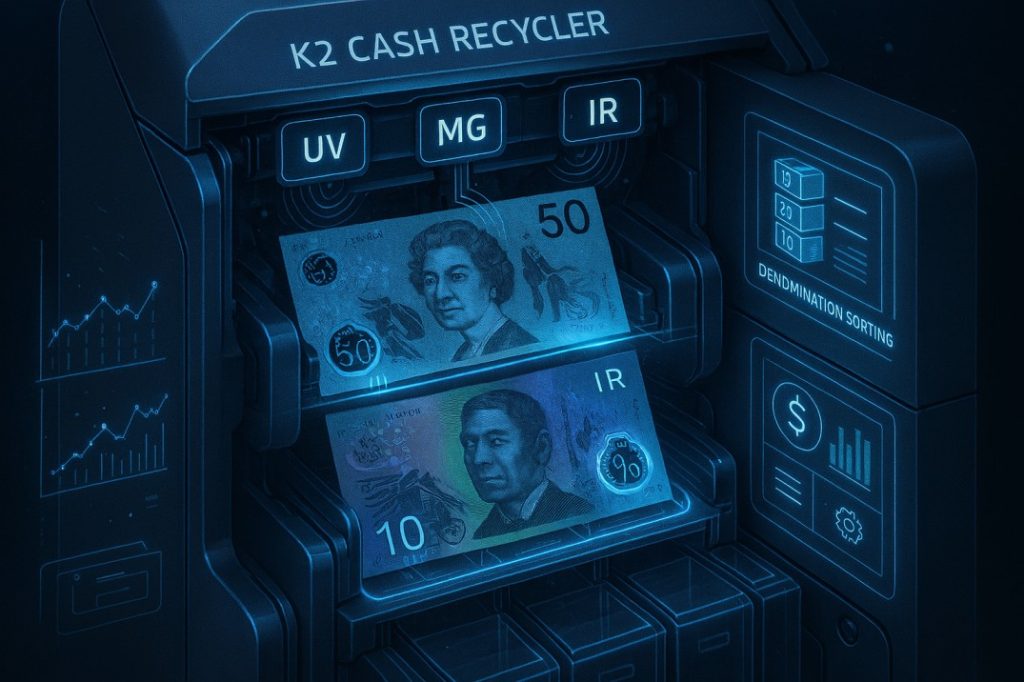
The K2 Cash Recycler uses a four-method detection array — UV, magnetic (MG), infrared (IR), and CIS colour image sensing — running simultaneously on every note as it enters the machine. This is the same detection standard used across Cashcom’s professional notes counter range and is the minimum reliable standard for authenticating Australian $50 and $100 polymer notes in 2026.
UV Detection
Ultraviolet sensors check the UV-fluorescent security markings present on genuine Australian polymer notes. The K2’s UV detection identifies the correct pattern and intensity for each denomination. Notes that fail UV — either showing no fluorescence (common in very worn notes) or incorrect patterns (common in counterfeits) — are flagged for further assessment by the combined sensor array.
Magnetic Detection
Genuine Australian banknotes are printed with magnetic ink in denomination-specific patterns. The K2’s magnetic sensors read these patterns during transit. Magnetic detection is one of the most reliable authentication methods for Australian polymer notes because the specific magnetic ink formulations used by Note Printing Australia are not commercially replicable. The K2 uses standard MG detection — effective for the vast majority of Australian counterfeit threats. Note: the LS-300 uses an 18-channel MG system (full note-width scanning) which provides greater sensitivity for edge-region magnetic ink patterns. For most commercial operations the K2’s standard MG is more than adequate.
Infrared Detection
Infrared sensors measure the IR absorption profile of each note’s inks. Different AUD denominations have distinct IR signatures that commercial counterfeit inks cannot accurately replicate. The K2’s IR detection adds a highly reliable secondary authentication layer that specifically targets the note’s chemical composition rather than its visual appearance.
CIS Colour Image Sensing
The K2’s CIS system captures full-colour images of both note faces and compares them against a genuine note reference database in real time. This is the most comprehensive single detection method available — it compares the entire visual profile of the note against what a genuine note should look like for that denomination. Combined with the three physical property checks above, the K2’s four-method system provides authentication depth that is reliable for high-stakes commercial cash operations.
The 1,000-Note Hopper: Why It Matters in Practice
The K2’s 1,000-note hopper is its most distinctive specification and the one that generates the most immediate operational benefit in high-volume deployments. To understand why, consider the alternative.
A machine with a 500-note hopper — like the H110 — processes a 500-note batch and then requires reloading before the next batch can begin. For a gaming club cashier collecting from 20 electronic gaming machines across a floor, each with $50–$200 in accumulated notes, the total collection might be 800–1,200 notes. With a 500-note machine, that means at least one mid-collection reload — the cashier waits, loads the next batch, waits again.
With the K2’s 1,000-note hopper, the entire collection fits in a single load in the majority of cases. One pour, one run, complete. The cashier can move on to the next task while the machine processes.
For a large supermarket cash office manager handling till drops from 15 lanes throughout a trading day, the same principle applies at greater scale. Fewer reloads means fewer interruptions, less staff attention required per cash processing event, and a faster overall cash office throughput.
| Practical time calculation:
Each reload cycle — pausing the count, removing the processed stack, reloading the hopper, restarting — takes approximately 45–60 seconds. For a cash office processing 3,000 notes per day, the difference between a 500-note and 1,000-note hopper is 2 fewer reload cycles per session. Across 250 trading days, that is 500 fewer reload events per year — approximately 7–8 hours of recovered staff time annually from hopper capacity alone. |
TITO Integration: What Gaming Venues Need to Know
Ticket-In, Ticket-Out (TITO) is the technology used by modern electronic gaming machines (EGMs) to issue and accept printed tickets as a cash equivalent — a player cashes out their credits and receives a printed ticket rather than coins or notes, which they can then redeem at a redemption terminal or cage.
In gaming venues that operate TITO-enabled EGMs alongside cash transactions, staff handle both cash notes and gaming tickets throughout each shift. Without TITO integration on the cash recycler, venues typically use two separate machines — a cash recycler for notes and a separate ticket validator for gaming tickets. This creates additional workflow steps and two separate transaction records.
How K2 TITO Integration Works
With the optional TITO barcode and ticket detection add-on enabled, the K2 Cash Recycler can process gaming tickets alongside cash notes. Tickets are scanned and validated against the gaming system, their value is authenticated, and they are processed in the same workflow as cash notes. The machine maintains separate accounting for cash and ticket transactions, with the combined record available in the transaction log.
Confirming TITO Compatibility
TITO integration requires specific configuration for your gaming system. Not all TITO implementations are identical across different EGM manufacturers and gaming platforms. Before ordering the K2 with TITO option, contact Cashcom on 0451 353 676 to confirm compatibility with your specific gaming system configuration.
| ⚠️ TITO is an optional add-on — confirm at time of order. The base K2 Cash Recycler processes cash notes only. For gaming venues, specify TITO when ordering. |
K2 Cash Recycler vs LS-300: Which Is Right for Your Business?
The K2 Cash Recycler and the LS-300 Note Counter Machine are both at the top end of the Cashcom professional range and both get evaluated by buyers with high-volume cash handling needs. They serve genuinely different primary purposes, which makes the comparison straightforward once you understand what each is optimised for.
| Feature | K2 Cash Recycler | LS-300 Note Counter |
| Primary function | Cash recycling + dispensing | High-speed notes counting + sorting |
| Note dispensing | ✅ | ❌ |
| Hopper capacity | 1,000 notes | N/A (continuous feed) |
| Counting speed | 1,000/min (value) | 1,200/min (value + auth) |
| Magnetic detection | Standard MG | 18-channel MG (full width) |
| Ultrasonic detection | ❌ | ✅ (21-channel) |
| Dust-free vertical path | ❌ | ✅ |
| Remote currency upgrade | ❌ | ✅ |
| Stacker side LED | ❌ | ✅ |
| TITO support | Optional | Optional |
| Currency support | 7 currencies | 48 currencies (20 auto) |
| All-day continuous design | High capacity | Dust-free continuous |
| Best for | Float management + recycling | All-day counting + sorting |
The decision comes down to one question: does your operation need to dispense notes as well as count them?
If yes — if your workflow requires automated float distribution to service points throughout the day — the K2 is the right machine. The LS-300 does not dispense notes.
If no — if your need is high-speed, high-accuracy notes counting and sorting for end-of-session reconciliation, with all-day continuous operation and the deepest possible detection standards — the LS-300 is the right machine. Its 18-channel MG system, dust-free vertical path, and remote upgrade capability are features the K2 does not have.
Many large operations that need both capabilities deploy both — the LS-300 for high-volume authenticated counting in the cash room, and the K2 as the operational cash recycler on the floor. Contact Cashcom to discuss a combined solution.
Who Should Buy the K2 Cash Recycler?
Strong fit — buy with confidence
- Licensed clubs with gaming floors, bars, and bistros — multiple staff, multiple cash streams, active float management throughout operating hours
- Gaming venues with 20+ EGMs — high coin-to-note conversion volumes, TITO ticket processing needs
- Large supermarkets and retail stores — 10+ checkout lanes, continuous float replenishment throughout the trading day
- Entertainment venues — concerts, sporting events, markets — high note volumes over short periods
- Large hospitality groups — multiple revenue points, centralised cash management, clear audit trail requirements
Not the right fit — consider alternatives
- Small to medium retail (1–4 tills, end-of-day counting only): H110, H210, or LS-200 is a better match — simpler, lower cost, sufficient capability
- Operations needing all-day continuous running with minimal jams: LS-300’s dust-free vertical path is the purpose-built solution
- Maximum detection depth is the primary requirement: LS-300’s 18-channel MG and 21-channel ultrasonic provide greater detection sensitivity
- Currency database must stay current automatically: LS-300’s remote upgrade capability is designed for this
K2 Cash Recycler in Real-World Australian Deployments
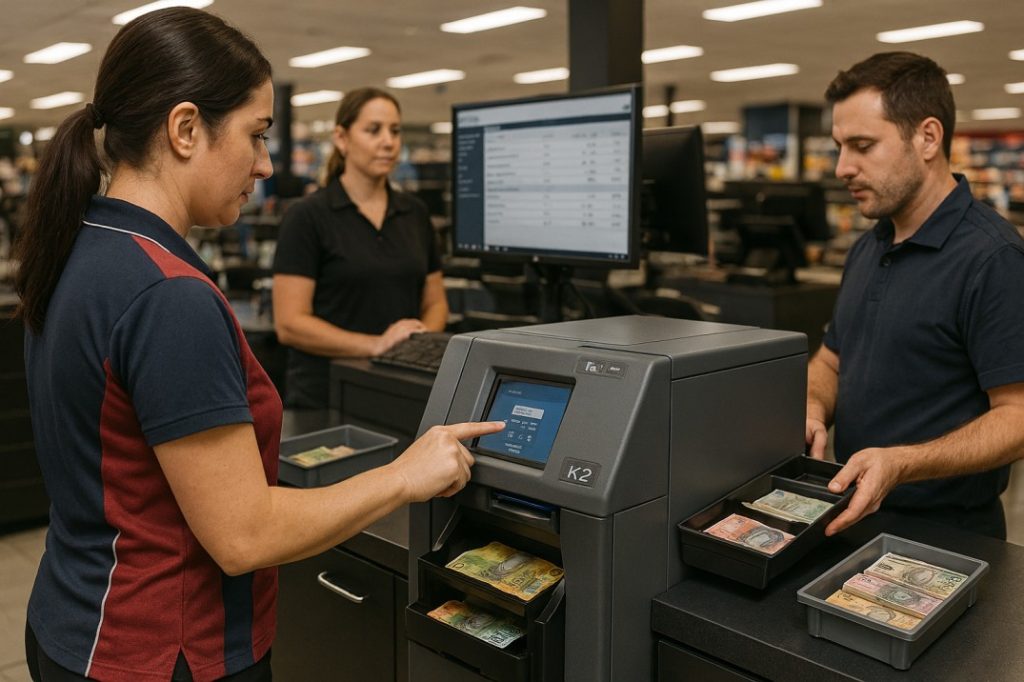
Based on K2 deployments Cashcom has supported across Australian businesses, here are the use cases where the machine consistently delivers the most operational value:
Gaming Club — Mid-Size NSW
A licensed club with 45 EGMs, a bar, bistro, and TAB operates 10am–midnight seven days per week. Previously, the cash manager spent 2.5–3 hours per day on manual float runs — collecting gaming proceeds, counting denomination packages, and restocking the bar and bistro cashiers. After K2 deployment, collection runs are faster (1,000-note hopper handles a full floor collection), float dispensing is automated, and the per-shift transaction log replaces the manual float record sheets. Staff time on manual cash management reduced by approximately 60%.
Supermarket — Large Format Retail
A large format supermarket with 22 checkouts, self-checkout bays, and a deli counter. The cash office manager was doing 4–6 float top-up runs per trading day. With the K2 as the central cash recycler, cashiers request denomination replenishment through the machine, the machine dispenses it, and the cash office manager has real-time visibility of note inventory and all dispensing transactions. Float preparation for opening is a machine function rather than a manual counting exercise.
Entertainment Venue — Major Events
A mid-size entertainment venue running 3–4 events per week uses the K2 to manage the cash surge during and after events. Large note collections from bar points and merchandise move through the K2 quickly thanks to the 1,000-note hopper. Float distribution to opening positions before each event is dispensed by the machine rather than prepared manually. Post-event reconciliation takes minutes from the machine’s transaction report rather than 45–60 minutes of manual counting.
Frequently Asked Questions
| Q: What is the K2 Cash Recycler?
The K2 Cash Recycler Sorter Machine is a professional back-office cash recycler from Cashcom — an automated cash handling machine that accepts banknotes, authenticates them using four-method detection (UV, MG, IR, CIS), sorts them by denomination and fitness, stores them securely, and dispenses them on demand to authorised staff. It is designed for high-volume Australian business environments including licensed clubs, gaming venues, large retail stores, and entertainment venues. |
| Q: What makes the K2 different from a standard notes counter?
A standard notes counter processes notes in one direction — notes go in, get counted and authenticated, and come out sorted. It cannot dispense notes. The K2 Cash Recycler does everything a notes counter does, plus stores authenticated notes internally and can dispense them on demand as change or float. Every transaction — deposit and withdrawal — is logged with employee identification, denomination detail, and timestamp. This is what makes it a cash recycler rather than just a cash counter. |
| Q: Does the K2 detect counterfeit Australian notes?
Yes. The K2 uses full four-method detection — UV, magnetic (MG), infrared (IR), and CIS colour image sensing — simultaneously on every note. This combination provides reliable authentication of Australian polymer banknotes ($5 through $100). Counterfeit and damaged notes are automatically rejected to the reject pocket and never enter the machine’s internal storage cassettes. Only authenticated genuine notes are available for dispensing. |
| Q: Does the K2 support TITO tickets for gaming venues?
Yes — TITO (Ticket-In, Ticket-Out) ticket detection is an optional add-on for the K2. For gaming venues processing both cash notes and gaming tickets, the TITO option allows the K2 to handle both in a single machine. TITO must be specified and configured at the time of ordering. Contact Cashcom on 0451 353 676 to confirm TITO compatibility with your specific gaming system. |
| Q: How does the K2 compare to the LS-300?
The K2 Cash Recycler and LS-300 serve different primary needs. The K2 is a cash recycler — it dispenses notes as well as counting them, making it the right choice for operations that need automated float management. The LS-300 is a professional notes counter and sorter — it does not dispense notes, but has 18-channel magnetic detection, a dust-free vertical path for all-day continuous operation, and remote currency database upgrade. If you need dispensing capability, the K2. If you need all-day continuous counting with maximum detection depth, the LS-300. |
| Q: What fuels or currencies does the K2 support?
The K2 supports up to 7 currencies simultaneously with auto-detect mode. This includes AUD as the primary currency, configured specifically for Australian polymer notes. For businesses that regularly handle foreign currencies alongside AUD — tourist-area hospitality, entertainment venues, international hotels — the K2 eliminates the need for separate foreign currency counting passes. |
| Q: Where can I buy the K2 Cash Recycler in Australia?
Cashcom supplies the K2 Cash Recycler Sorter Machine to businesses across Australia from our base in Haberfield, NSW. We ship to all states and territories. View the full K2 specification at cashcom.com.au/product/k2-cash-recycler/, call 0451 353 676, or email sales@cashcom.com.au. Our team is available Monday to Friday, 9am–6pm and can confirm TITO configuration, LAN specifications, and current pricing. |
The K2 Cash Recycler Sorter Machine is a well-specified, operationally practical cash recycler machine for Australian businesses that genuinely need cash recycling capability — not just fast counting.
The 1,000-note hopper is the specification that most immediately separates it from alternatives, and for high-volume operations like gaming clubs and large retail, it is the most directly impactful feature in daily use. The four-method detection provides reliable authentication for Australian polymer notes. The denomination-to-fitness sorting in one pass delivers output that is immediately usable without additional manual sorting. The TITO option makes it a genuine all-in-one solution for gaming venues.
Where the K2 falls short relative to the LS-300 is in sustained all-day continuous operation design — the dust-free vertical path, 18-channel MG, and remote upgrade capability of the LS-300 are purpose-built for environments where the machine runs all day every day and where detection standards must remain current automatically. For businesses in that category, the LS-300 is the right machine.
For the majority of businesses evaluating a cash recycler in the Australian market in 2026 — gaming clubs, medium to large retail, entertainment and hospitality — the K2 delivers the right combination of recycling capability, detection depth, hopper capacity, and operational practicality.
To discuss whether the K2 is the right cash recycler for your business, or to compare it with other machines in the Cashcom range, call 0451 353 676, email sales@cashcom.com.au, or view the K2 at cashcom.com.au/product/k2-cash-recycler/. Monday to Friday, 9am–6pm.