
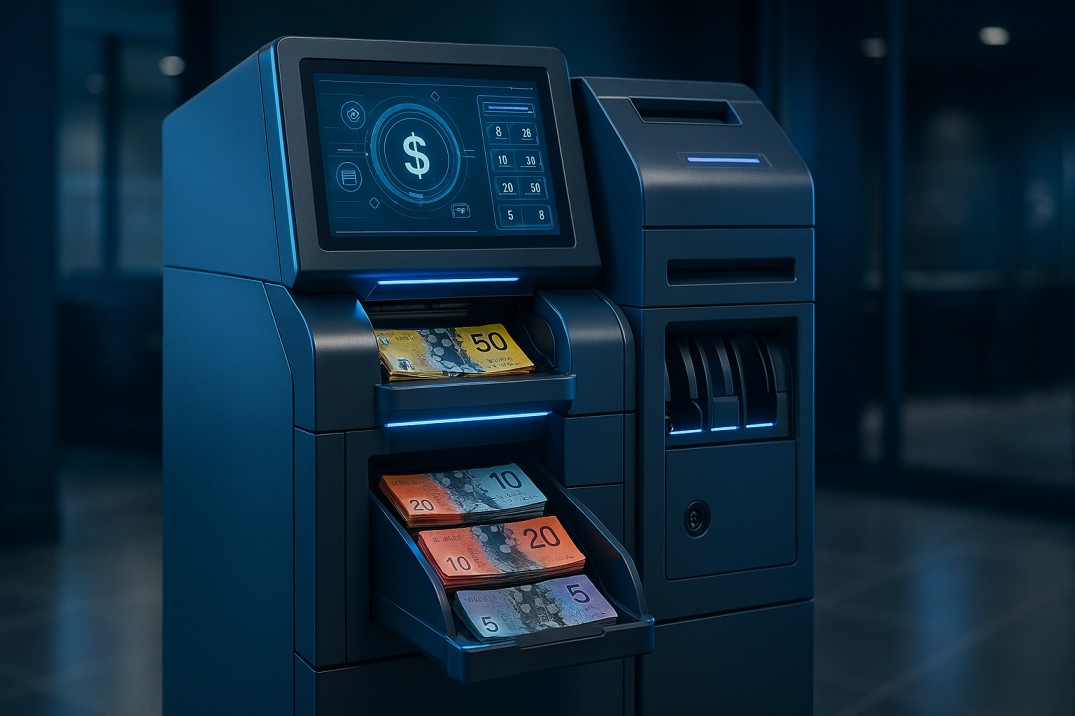
The term notes recycler machine is used across Australian banking, gaming, retail, and hospitality sectors to describe equipment that processes banknotes through the complete cash handling cycle — accepting deposits, authenticating every note, sorting by denomination and condition, storing securely, and dispensing on demand. It is also called a cash recycler or money recycler, depending on the industry. The function is identical regardless of the label.
For businesses that handle large volumes of cash continuously throughout the day — rather than counting it once at close — a notes recycler machine changes the operational equation significantly. Float distribution becomes automated. Staff accountability becomes auditable. End-of-day reconciliation becomes a report printout rather than a counting session. And the risk of internal shrinkage drops materially because every cash movement is logged against an employee identifier.
This guide covers everything an Australian business needs to know about notes recycler machines in 2026 — how the technology works, which businesses benefit most, what to look for when buying, and the best options available from Cashcom.
| Quick orientation:
‘Notes recycler machine’, ‘cash recycler’, and ‘money recycler’ are the same equipment described with different labels. This guide uses ‘notes recycler machine’ as the primary term but all three are used interchangeably throughout — because all three are terms potential buyers use to search for this equipment in Australia. |
What Is a Notes Recycler Machine?
A notes recycler machine is an automated cash handling device that processes a bidirectional cycle — accepting deposits and dispensing withdrawals — while maintaining a complete authenticated record of every transaction.
The word ‘recycler’ is the key distinction from a standard notes counting machine or money counter. A notes counter processes notes in one direction: notes go in, get counted and authenticated, and come out sorted. A notes recycler machine does all of that, but the authenticated notes stay inside the machine in secured cassettes, ready to be dispensed again when needed. The same notes are ‘recycled’ through the operation rather than being manually redistributed each time.
The Notes Recycling Process Step by Step
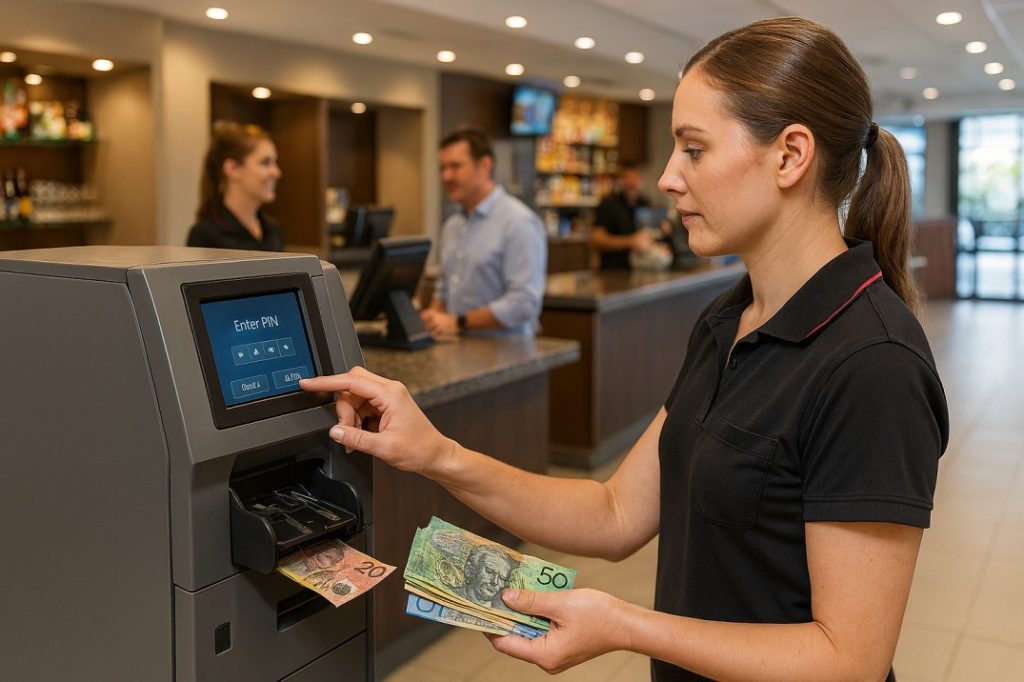
- A staff member deposits banknotes into the machine’s input slot or hopper using their individual PIN to identify themselves.
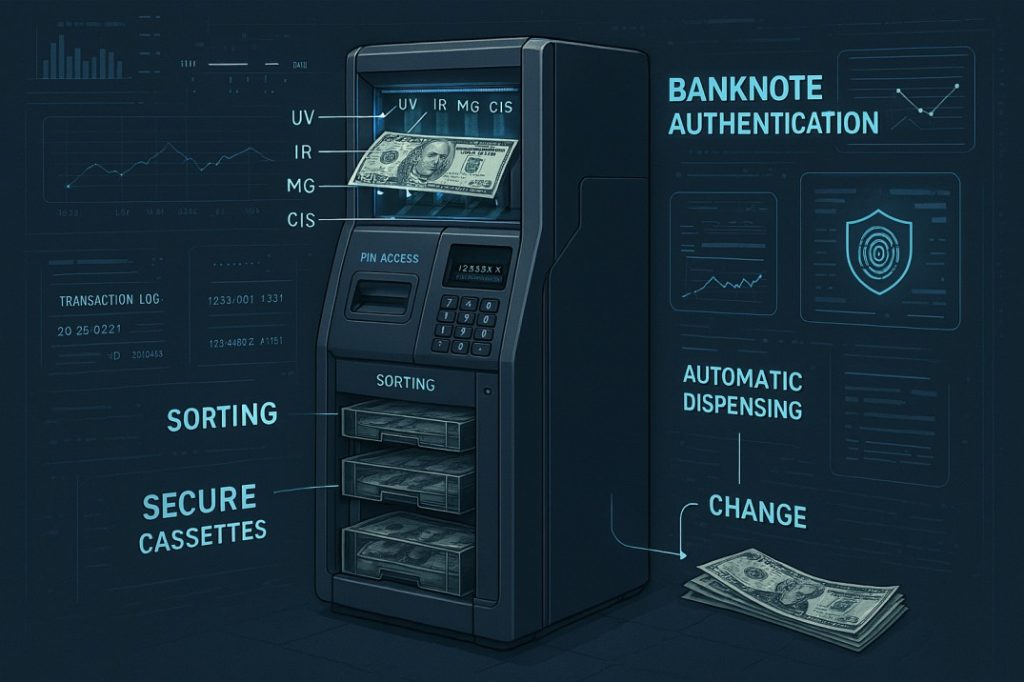
- Each note passes through the authentication sensors — UV, magnetic, infrared, and CIS colour imaging — simultaneously. Counterfeits and damaged notes are rejected automatically to a separate pocket.
- Authenticated notes are sorted by denomination and condition (fitness sorting) and stored in secured internal cassettes. The machine updates its internal inventory in real time.
- When change or float replenishment is needed, an authorised staff member logs in with their PIN and requests specific denominations. The machine dispenses the exact notes requested.
- Every transaction — deposit and withdrawal — is logged: timestamp, employee ID, denominations, and amounts.
- The manager can view a complete transaction log at any time, or print a reconciliation report showing the machine’s current note inventory and all movements since last cleared.
| Why ‘recycler’?
The ‘recycling’ is the cash itself — rather than notes being deposited into a safe and then manually counted and redistributed as change, the machine handles both sides of the transaction. A $50 note deposited by a gaming attendant at 2pm can be dispensed as change to a bar cashier at 4pm, all without a supervisor physically handling or counting it. That is the cash recycling cycle. |
Notes Recycler vs Notes Counter vs Notes Sorter: Key Differences
These three types of equipment are related but serve different purposes. Understanding where each fits helps you make the right purchasing decision.
| Feature | Notes Counter | Notes Sorter | Notes Recycler Machine |
| Count + authenticate | ✅ | ✅ | ✅ |
| Sort by denomination | ❌ | ✅ | ✅ |
| Fitness sorting | ✅ | ✅ | ✅ |
| Serial number logging | ✅ | ✅ | ✅ |
| Dispense notes | ❌ | ❌ | ✅ |
| Per-employee audit trail | ❌ | ❌ | ✅ |
| Float automation | ❌ | ❌ | ✅ |
| 24/7 cash availability | ❌ | ❌ | ✅ |
| Best for | End-of-day reconciliation | Reconciliation + banking prep | All-day cash cycle management |
| Typical daily volume | 500–5,000 notes | 1,000–10,000 notes | 5,000+ notes |
The progression is clear: a notes counter is the entry point, a notes sorter adds physical denomination separation, and a notes recycler machine adds the dispensing capability that closes the cash cycle. Each step up in capability comes with a step up in cost and complexity — which is why it is important to buy the level of capability you genuinely need rather than the most sophisticated option available.
How a Notes Recycler Machine Works: The Technology Inside
A notes recycler machine combines several distinct mechanical and electronic systems in a single unit. Understanding how each component works helps explain why these machines cost more than standard notes counters and why they deliver the capabilities they do.
The Authentication System
As each note enters the machine, it passes through a multi-sensor array that runs four detection checks simultaneously. UV sensors verify ultraviolet security markings. Magnetic sensors read the magnetic ink patterns unique to each denomination. Infrared sensors check the note’s infrared absorption profile. CIS (colour image sensor) cameras capture full-colour images of both faces of the note and compare them against a genuine note database in real time. The entire authentication process happens in under 30 milliseconds per note — faster than any person could manually examine a note.
The Sorting System
Authenticated notes are physically routed into denomination-specific internal cassettes — $5s to one location, $10s to another, and so on through to $100s. Advanced notes recycler machines also perform fitness sorting at this stage, separating notes in good condition from worn, soiled, or damaged notes. Notes that fail fitness standards are stored separately or routed to a reject pocket, ensuring only fit notes are available for dispensing.
The Secured Storage Cassettes
The internal cassettes where notes are stored are the key security feature of a notes recycler machine. These cassettes are tamper-resistant and can only be accessed through the machine’s authorised access protocol. They cannot be removed or accessed without triggering the machine’s audit system. This design means that even staff with deposit access cannot retrieve previously deposited notes — only the dispensing function can return notes to users, and only in authorised amounts that are fully logged.
The Dispensing Mechanism
When an authorised dispensing request is made, the machine’s internal feeding mechanism retrieves the requested denomination notes from the appropriate cassettes and presents them through the output slot. The machine counts the dispensed notes as they exit to confirm the exact amount dispensed matches the request. The transaction is logged immediately.
The Audit and Reporting System
Every transaction — deposit or withdrawal — is recorded in the machine’s internal log with timestamp, employee PIN, denomination breakdown, and total amount. This log can be viewed on screen, printed, or exported via USB or network connection. For multi-machine or multi-location operations, network-connected notes recycler machines can report to a central system, giving management complete visibility across all cash points without being physically present.
Which Australian Businesses Need a Notes Recycler Machine?
A notes recycler machine is not the right solution for every business. The operational case is strongest where several specific conditions are present simultaneously. Here is an honest breakdown by business type:
Licensed Clubs — Strongest Use Case
Licensed clubs in Australia operate across long trading hours, multiple revenue streams (gaming, bar, bistro, membership), and typically employ rotating staff across three or more shifts. Cash flows from gaming machine collections, over-the-counter transactions, and various other sources throughout the day. A notes recycler machine centralises this — every cash movement goes through a single authenticated, logged system. The per-employee PIN tracking is particularly valuable in club environments where staff accountability is a regulatory and governance requirement.
The TITO (Ticket-In, Ticket-Out) integration available on the Cashcom K2 Cash Recycler makes it especially suited to gaming clubs — the machine processes both cash notes and gaming tickets, eliminating a separate processing step for gaming cashiers.
Gaming Venues and Casinos
Gaming environments have the highest cash volume, the most complex note movement patterns, and the strictest accountability requirements of any commercial setting. Notes recycler machines are standard equipment in casino cash rooms and are increasingly common in gaming venues of all sizes. The combination of continuous authentication, fitness sorting (ensuring only fit notes re-enter circulation), and complete transaction audit trails addresses both operational and regulatory requirements.
Large Retail Stores and Supermarkets
A large supermarket with 20 active checkout lanes and continuous trading generates float replenishment requirements throughout every trading day. Without a notes recycler machine, a cash office manager manually counts change, prepares denomination bundles, and physically delivers them to checkouts multiple times per shift. A notes recycler machine automates this entirely — cashiers request float replenishment through the machine, the machine dispenses it, and the transaction is logged automatically. The labour saving at scale is significant.
Entertainment Venues and Event Operations
Venues running events — concerts, sporting matches, festivals — face a particular cash management challenge: extremely high note volumes over short periods, multiple simultaneous service points, and a need to rapidly distribute float to new positions as crowds build. A notes recycler machine handles rapid cash collection and redistribution during events in a way that purely manual processes cannot match for speed or accountability.
Large Hospitality Groups
A hotel group or multi-venue hospitality operator managing several restaurants, bars, and event spaces under one ownership structure benefits from centralised cash management. A notes recycler machine at the back-of-house level serves as the cash hub — outlets deposit at the end of their service, withdraw float for the next service, and the central management team has visibility across all transactions without being physically present at each location.
When a Notes Recycler Machine Is NOT the Right Answer
| Honest assessment:
If your business counts cash once at end of trading, has fewer than 4 tills, and does not need to dispense notes from a central machine during the day — a notes recycler machine is more complexity and cost than your operation requires. A professional notes counting machine or notes sorter from the Cashcom range will serve you better. The step up to a notes recycler machine is justified when active float distribution and per-transaction accountability are genuine operational requirements, not aspirational ones. |
What to Look for When Buying a Notes Recycler Machine
-
Detection Method Depth
The most important specification for a notes recycler machine is the authentication method. In 2026, UV-only detection is inadequate for Australian polymer notes. Look for machines that combine UV, magnetic (MG), infrared (IR), and CIS colour image detection simultaneously. This four-method combination is the current standard for reliable authentication of Australian $50 and $100 polymer notes, which are the highest-value and most counterfeited denominations.
-
Hopper and Cassette Capacity
For high-volume environments, the machine’s capacity determines how frequently it needs to be serviced. The Cashcom K2 Cash Recycler has a 1,000-note hopper — the largest in the Cashcom range — which means it can process a large collection run without reloading. Internal cassette capacity determines how long the machine can operate between cash management cycles. Match capacity to your typical peak-period volume.
-
Dispensing Denominations
Confirm which denominations the machine can dispense and in what combinations. A notes recycler machine that can only dispense one or two denominations creates workflow gaps for operations that need a full range of change denominations. The K2 handles denomination sorting across its full accepted currency range, making notes of any authenticated denomination available for dispensing.
-
Per-Employee Access Control
Individual PIN-based access is the accountability feature that separates professional notes recycler machines from simpler counting equipment. Each deposit and withdrawal should be attributed to a specific employee identifier. This is the feature that enables forensic investigation of discrepancies — you can see exactly who handled what amount and when.
-
Network Connectivity for Multi-Location Reporting
For businesses operating multiple cash points or multiple locations, network connectivity (LAN) allows centralised reporting without physical access to each machine. Area managers and finance teams can view transaction logs across all machines from a single dashboard. This is particularly relevant for club groups, retail chains, and hospitality groups with multiple sites.
-
TITO Integration for Gaming Environments
If your operation involves electronic gaming machines with Ticket-In, Ticket-Out capability, confirm that the notes recycler machine supports TITO ticket processing. The K2 Cash Recycler has TITO as an optional add-on, allowing it to process both cash notes and gaming tickets in a single unit.
-
Australian Currency Configuration
Confirm explicit AUD polymer note configuration before purchasing. Notes recycler machines calibrated for other currencies — particularly paper-note currencies like USD or EUR — may not correctly authenticate or dispense Australian polymer notes. All Cashcom machines are configured for the Australian market.
Cashcom K2 Cash Recycler Sorter Machine — Australia’s Recommended Notes Recycler
Cashcom has supplied cash handling equipment to Australian businesses, banks, clubs, gaming venues, and CIT operators since 2015. The K2 Cash Recycler Sorter Machine is our recommended notes recycler machine for Australian businesses that have determined they need a recycling solution.
| Specification | K2 Cash Recycler Details |
| Counting Speed | 1,000 notes per minute (value counting) |
| Fitness Sort Speed | 800 notes per minute |
| Hopper Capacity | 1,000 notes — largest in the Cashcom range |
| Stacker Capacity | 200 notes |
| Reject Pocket | 100 notes — counterfeits and damaged notes separated automatically |
| Detection | UV + Magnetic (MG) + Infrared (IR) + CIS — full 4-method |
| Sorting | Denomination, orientation, facing, and fitness — one pass |
| Currency Support | Up to 7 currencies simultaneously with auto-detect |
| Display | 4.3-inch touch screen — intuitive, minimal training required |
| TITO Option | Barcode and TITO ticket detection — available for gaming venues |
| Design | Compact — relatively portable for its performance level |
| AUD Configuration | Fully configured for Australian polymer notes |
| Best For | Licensed clubs, gaming venues, large retail, entertainment, hospitality |
Three specifications stand out for Australian businesses evaluating the K2 as their notes recycler machine.
The 1,000-note hopper is the most immediately practical. For a gaming club collecting from multiple EGMs throughout a trading day, this capacity means the notes recycler machine processes a full round of collections in a single load — no mid-run reloading, no waiting for the machine to clear before the next cashier can use it.
The 7-currency simultaneous support means foreign notes alongside AUD do not require a separate processing run — relevant for entertainment venues, large hotels, and tourist-area businesses where international guests regularly pay in foreign currency.
The optional TITO integration converts the K2 from a cash-only notes recycler into a unified gaming cash and ticket processing machine — eliminating the common inefficiency of processing gaming tickets and cash notes on separate machines.
To enquire about the K2 Cash Recycler Sorter Machine or to discuss whether it is the right notes recycler for your business, visit cashcom.com.au/product/k2-cash-recycler, call 0451 353 676, or email sales@cashcom.com.au. Our team is available Monday to Friday, 9am–6pm.
Return on Investment: Does a Notes Recycler Machine Pay for Itself?
The investment in a notes recycler machine is higher than a professional notes counting machine or notes sorter. Whether it pays for itself depends on how clearly the conditions for ROI are present in your operation.
Labour Saving Calculation
The most direct ROI driver for a notes recycler machine is the labour cost of manual float management. If a cash office manager or supervisor currently spends 2–3 hours per day on float runs — collecting from service points, counting and sorting, preparing denomination packages, and delivering them back to cashiers — a notes recycler machine automates this entirely.
At a fully loaded staff cost of $35 per hour, 2.5 hours per day, 250 operating days per year: that is $21,875 in annual labour cost on float management alone. A notes recycler machine that eliminates this cost recovers its investment in under two years in a typical club or large retail environment.
Shrinkage Reduction
Internal cash shrinkage — whether from theft, miscounting, or float management errors — is a significant unquantified cost in many cash-intensive operations. The per-employee transaction logging of a notes recycler machine creates accountability that substantially reduces this exposure. Businesses that have implemented notes recycler machines typically report a measurable reduction in unexplained cash discrepancies within the first three months of operation.
The Conservative Test
| Apply this test to your operation:
Add up the hours your team spends per week on manual float management — float runs, change counting, denomination preparation. Multiply by your hourly staff cost. If the annual total exceeds the cost of a notes recycler machine within a 3-year payback period, the ROI case is positive. Call Cashcom on 0451 353 676 to get pricing and run the numbers for your specific operation. |
Notes Recycler Machines in the Australian Market: What You Need to Know
The Australian cash handling equipment market in 2026 has evolved significantly from five years ago. Notes recycler machines that were previously the exclusive domain of major banks and casino operators are now accessible at price points that make them viable for medium-sized commercial operations.
Australian Polymer Note Compatibility Is Non-Negotiable
Australian banknotes are printed on polymer substrate — a biaxially oriented polypropylene film — rather than the cotton-linen paper used in most other countries. Polymer notes have fundamentally different physical properties that affect how authentication sensors interact with them. A notes recycler machine calibrated for paper currencies will produce unreliable authentication results on Australian polymer notes. Always confirm explicit AUD polymer note configuration before purchasing any notes recycler machine for Australian deployment.
The AML/CTF Compliance Angle
Australian businesses subject to Anti-Money Laundering and Counter-Terrorism Financing (AML/CTF) obligations — which includes clubs, casinos, gaming venues, and financial service providers — benefit from the detailed transaction logging of notes recycler machines as a component of their cash management compliance framework. The per-employee, per-transaction, denomination-level logs provide the audit trail that compliance teams need. This is not a substitute for AML/CTF program obligations, but it is a meaningful operational tool within a compliance framework.
Servicing and Support Considerations
Notes recycler machines are complex equipment combining mechanical and electronic systems. Unlike a standard notes counting machine, which can be maintained with routine cleaning and occasional sensor calibration, a notes recycler machine requires more structured maintenance. When purchasing, confirm the supplier’s Australian service capability — response times, spare parts availability, and whether firmware/currency database updates are provided. Cashcom provides ongoing support for all machines in our range from our Sydney base.
Frequently Asked Questions
| Q: What is a notes recycler machine?
A notes recycler machine — also called a cash recycler or money recycler — is an automated cash handling device that accepts, authenticates, sorts, stores, and dispenses banknotes as part of a continuous cash cycle. Unlike a notes counter that simply counts notes in one direction, a notes recycler machine allows authenticated notes to be dispensed on demand as change or float replenishment. Every transaction is logged with employee identification, denomination detail, and timestamp. |
| Q: What is the difference between a notes recycler machine and a notes counter?
A notes counter processes notes in one direction — notes go in, get counted and authenticated, and come out sorted. It requires manual redistribution of notes afterwards. A notes recycler machine does all of this but also stores authenticated notes internally and dispenses them on demand. The notes recycler adds two capabilities a counter cannot provide: automated dispensing and per-employee transaction logging. For most small businesses, a notes counter is sufficient. For operations with active float management needs, a notes recycler machine is the appropriate tool. |
| Q: Are notes recycler machines, cash recyclers, and money recyclers the same thing?
Yes — notes recycler machine, cash recycler, and money recycler all describe the same type of equipment. These terms are used interchangeably across different Australian industries. Banking and financial services tend to use ‘cash recycler’. Gaming and hospitality venues often say ‘money recycler’. The broader retail and commercial market increasingly uses ‘notes recycler machine’. The function and core technology is identical regardless of the label used. |
| Q: Does the Cashcom K2 work as a notes recycler machine for Australian currency?
Yes. The K2 Cash Recycler Sorter Machine is configured for Australian currency — all detection parameters are calibrated for AUD polymer note denominations ($5, $10, $20, $50, $100). The K2 also supports up to 7 currencies simultaneously, making it suitable for businesses handling foreign notes alongside AUD. Contact Cashcom on 0451 353 676 to confirm currency configuration for your specific deployment. |
| Q: Can a notes recycler machine detect counterfeit Australian notes?
Yes. Professional notes recycler machines use the same multi-method authentication as the best notes counters — UV, magnetic (MG), infrared (IR), and CIS colour image detection simultaneously on every note. The Cashcom K2 uses all four methods. Counterfeit and damaged notes are automatically rejected to a separate pocket and never enter the machine’s storage cassettes. This means only authenticated genuine notes are available for dispensing — the recycler cannot circulate unverified notes. |
| Q: How much does a notes recycler machine cost in Australia?
Notes recycler machines for commercial business use vary in price based on specification and capability. Contact Cashcom on 0451 353 676 or email sales@cashcom.com.au for current pricing on the K2 Cash Recycler Sorter Machine. Our team can also help you assess whether the ROI case justifies a notes recycler machine versus a professional notes counter for your specific volume and workflow. |
| Q: What is TITO integration and does the K2 support it?
TITO stands for Ticket-In, Ticket-Out — the system used by electronic gaming machines to issue and accept gaming tickets as an alternative to cash. Notes recycler machines with TITO integration can process both cash banknotes and gaming tickets, allowing gaming venues to handle both in a single machine rather than two separate units. The K2 Cash Recycler supports TITO ticket detection as an optional feature. Confirm this option when ordering. Contact Cashcom to discuss configuration for your gaming environment. |
| Q: Where can I buy a notes recycler machine in Australia?
Cashcom supplies the K2 Cash Recycler Sorter Machine — our recommended notes recycler — to businesses across Australia from our Sydney base at 181 Parramatta Rd, Haberfield NSW 2045. We ship to all states and territories. View the K2 at cashcom.com.au/product/k2-cash-recycler/, call 0451 353 676, or email sales@cashcom.com.au. Available Monday to Friday, 9am–6pm. |
A notes recycler machine — whether you call it a cash recycler, money recycler, or notes recycler machine — represents a meaningful step up in cash handling capability for operations where the full cash cycle needs to be automated, not just the counting step.
For licensed clubs, gaming venues, large retail stores, entertainment venues, and hospitality groups processing thousands of notes daily across multiple shifts and service points, the notes recycler machine addresses the operational problems that a notes counter alone cannot: active float distribution, per-employee accountability, and continuous authenticated cash availability throughout the operating day.
For businesses below this scale — and the majority of Australian small and medium businesses fall into this category — a professional notes counting machine or notes sorter is the right tool. Simpler, lower cost, and perfectly suited to end-of-day reconciliation workflows.
The decision is not about which machine is more impressive. It is about which machine matches your actual workflow. Cashcom’s team can help you make that assessment in a five-minute conversation.
Call 0451 353 676, email sales@cashcom.com.au, or browse the full range at cashcom.com.au/products. Monday to Friday, 9am–6pm.