
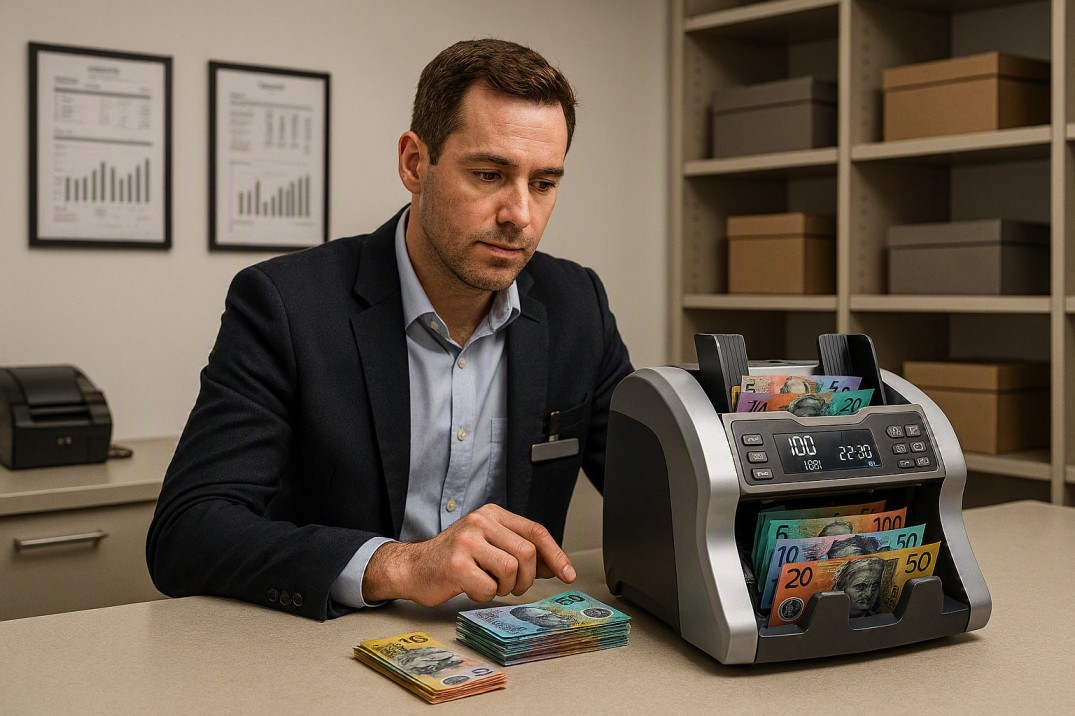
Why Retail Stores Need a Dedicated Money Counting Machine
End-of-day reconciliation is one of the most error-prone parts of running a retail store. A till short by even a few dollars can take an employee twenty minutes to chase down — time better spent serving customers or closing up. Counterfeit notes are also a growing concern: sophisticated fakes can now pass basic ultraviolet checks, which means relying on a staff member’s eyesight is no longer good enough.
A purpose-built money counting machine solves both problems. It counts a stack of mixed notes in seconds, flags anything suspicious, and gives you a number you can trust without recounting. For Australian retail stores specifically, that machine also needs to handle the full family of current AUD polymer banknotes — including older notes still in circulation — without missing a beat.
This guide compares the best options for retail in 2026, from single-till stores to multi-location operations, and explains exactly which features matter and why.
What Makes a Money Counting Machine “Best” for Retail
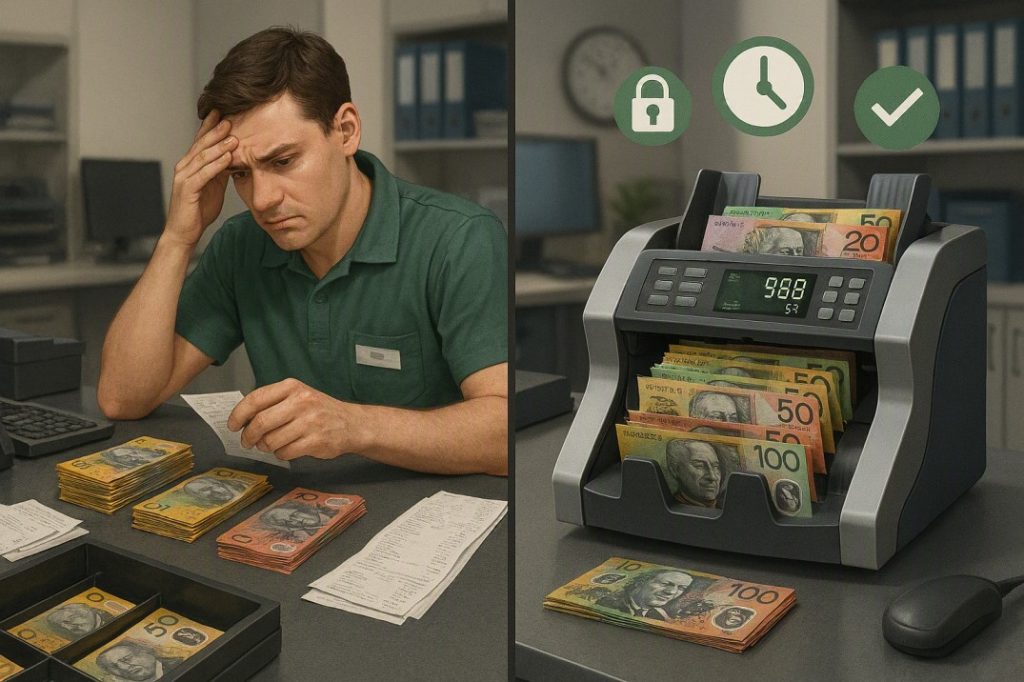
Counterfeit Detection That Matches Current Threats
UV-only detection is no longer sufficient. Newer counterfeit polymer notes can pass a basic UV check, so retail stores should look for machines combining UV, magnetic (MG), and infrared (IR) detection at a minimum. Busier stores — particularly those handling higher cash volumes — benefit from the added accuracy of CIS (Contact Image Sensor) detection, which checks the printed image itself against a stored reference.
Counting Speed That Matches Your Trading Volume
A machine rated at 1,000 notes per minute clears a 500-note stack in about 30 seconds — the same stack takes a staff member five minutes or more by hand. For a single-till boutique, a mid-speed machine is fine. For a multi-till store processing several thousand dollars in notes daily, speed becomes a genuine staffing efficiency issue, particularly at closing time.
Note Counting vs. Value Counting
A standard note counter tells you how many notes are in a stack. A value counter goes further, automatically totalling mixed denominations to tell you the actual dollar figure. For most retail stores reconciling a till float each night, value counting removes a manual calculation step entirely and reduces the chance of a transcription error.
Build Quality for Daily Use
Retail machines get used every single day, often by multiple staff members across different shifts. A machine designed for occasional home or small-office use will wear out quickly under that load. Look for commercial-grade construction rated for continuous daily operation, not a consumer model repurposed for business use.
Local Servicing and Support
Imported machines bought through generic online marketplaces often come with no local warranty support, meaning a fault can put your cash handling process out of action for weeks while parts are shipped from overseas. An Australian-based supplier with local servicing — like Cashcom in Haberfield, NSW — keeps downtime to a minimum.
Best Money Counting Machines for Retail Stores: Comparison
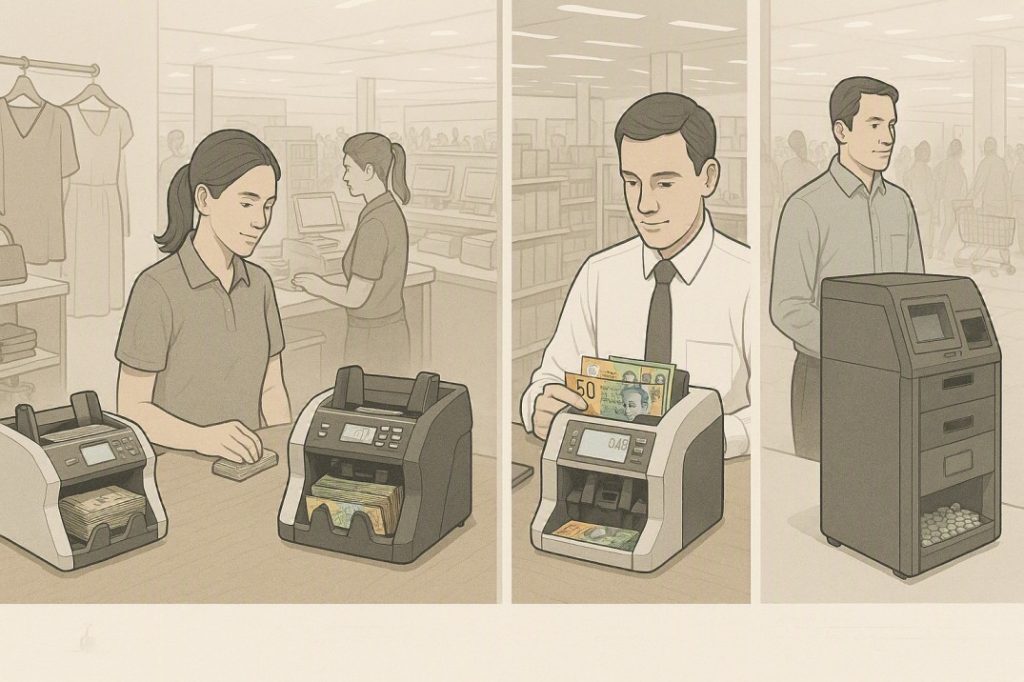
The table below compares the Cashcom models best suited to retail environments, based on store size and typical cash volume.
| Model | Best For | Speed | Detection | Indicative Price |
| Cashcom H110 | Small to medium retail stores; single-till counting | Up to 1,000 notes/min | UV + MG + IR | $$ |
| Cashcom H210 | Multi-till retail; higher daily volume | Up to 1,000 notes/min | UV + MG + IR + CIS | $$$ |
| Cashcom LS-200 | Retail wanting value (mixed denomination) counting | Value + note counting | UV + MG + IR | $$$ |
| Cashcom LS-300 | Larger retail / multi-store operations | High-volume value counting | UV + MG + IR + CIS | $$$$ |
| Cashcom K2 Cash Recycler | High-traffic retail wanting automated float recycling | Recycles + dispenses notes | UV + MG + IR + CIS | $$$$$ |
Pricing tiers shown as $ (most affordable) to $$$$$ (premium/automated). For exact current pricing, contact the Cashcom team on 0451 353 676 or sales@cashcom.com.au.
Our Picks, Explained
Best Overall: Cashcom H110
The H110 is the machine we recommend most often for general retail use. It counts up to 1,000 notes per minute, uses UV, MG and IR detection to catch the vast majority of counterfeit notes in circulation, and is built to handle daily commercial use without the bulk or price tag of a high-end model. For a single-till retail store — a boutique, a pharmacy, a specialty grocer — it covers everything that matters without paying for features you won’t use.
Best for Multi-Till or High-Volume Stores: Cashcom H210
Stores running multiple registers, or processing a high volume of cash daily, benefit from the H210’s added CIS detection layer and faster sustained throughput. It’s built for the kind of repeated, back-to-back counting sessions a busy retail closeout demands — multiple tills, multiple staff, one consistent result.
Best for Value Counting: Cashcom LS-200 and LS-300
If your end-of-day process involves manually adding up mixed $5, $10, $20, $50 and $100 notes to get a total float value, the LS-200 (for standard volume) or LS-300 (for larger or multi-store operations) removes that step. These machines count and total mixed denominations automatically, reducing reconciliation time and the risk of arithmetic error.
Best for Automated Float Management: Cashcom K2 Cash Recycler
High-traffic retail environments — large format stores, busy hospitality-retail hybrids, multi-lane checkouts — can benefit from the K2 Cash Recycler, which doesn’t just count cash but recycles accepted notes back out as change, reducing manual float top-ups throughout the trading day.
Which One Should You Choose?
- Single till, moderate daily cash volume: Cashcom H110.
- Multiple tills or high daily cash volume: Cashcom H210.
- Want automatic value totals instead of manual addition: Cashcom LS-200 or LS-300.
- High-traffic store wanting automated change dispensing: Cashcom K2 Cash Recycler.
- Also handling significant coin volume: Pair any of the above with the Cashcom Con200 Coin Sorting Machine.
If you’re unsure which model fits your store, the Cashcom team can recommend a configuration based on your daily cash volume, till count and trading hours — get in touch on 0451 353 676 or sales@cashcom.com.au.
Frequently Asked Questions
| Question | Answer |
| What’s the best money counting machine for a small retail store? | For most small to medium retail stores in Australia, the Cashcom H110 offers the best balance of speed, counterfeit detection and price for everyday use. |
| Do retail money counters detect Australian polymer banknotes correctly? | Yes — Cashcom machines are built and calibrated specifically for current and older AUD polymer banknotes, including mixed stacks of both. |
| Is a value counter worth the extra cost for a retail store? | If your staff currently manually total mixed denominations for till reconciliation, a value counter like the LS-200 or LS-300 typically pays for itself in saved labour time within a few months. |
| How often should a retail money counting machine be serviced? | Most commercial machines benefit from an annual service check, though high-volume stores running machines daily may want servicing every six months. Cashcom offers local servicing across Australia. |
| Can one machine handle both notes and coins? | Note counters and coin counters are generally separate machines. Retail stores with significant coin volume should pair a note counter (such as the H110 or H210) with a dedicated coin sorter like the Cashcom Con200. |
About the Author
This article was prepared by the Cashcom Team, Australia’s specialists in cash handling equipment for retail, hospitality, banking, gaming and cash-in-transit businesses. Based in Haberfield, NSW, Cashcom has supplied and serviced cash counting and sorting equipment to Australian businesses since 2015.
Get in touch: 181 Parramatta Rd, Haberfield NSW 2045 | 0451 353 676 | sales@cashcom.com.au | cashcom.com.au