
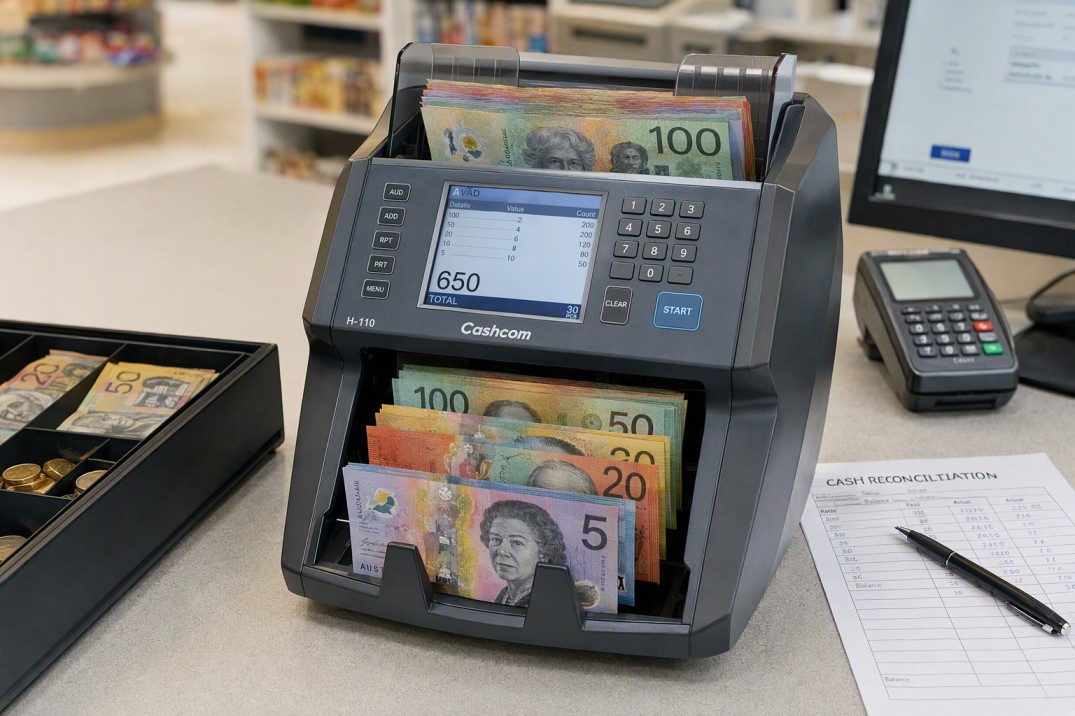
Quick AnswerYes, with one important qualifier. A cash counting machine calibrated specifically for Australian dollars works with every current and older-series AUD polymer note, including mixed stacks of both. A generic consumer import built on averaged multi-currency thresholds is different. Expect more false rejects on worn Australian notes and weaker counterfeit detection. |
What Makes Australian Polymer Notes Different
Australia introduced polymer banknotes in 1988, and today’s notes are printed on BOPP (biaxially oriented polypropylene) film rather than paper. That substrate changes how a note behaves under every sensor in a counting machine.
- UV response. UV security features are screen-printed onto the polymer surface rather than embedded in paper fibres. The fluorescence looks different, and a sensor tuned for paper can misread it.
- Magnetic properties. Magnetic ink patterns are denomination-specific. A machine must match the pattern for each AUD denomination, not simply detect that magnetic ink is present.
- IR characteristics. Polymer and its clear window respond to infrared differently from paper, so IR readings must be compared against AUD reference values.
- Physical behaviour. Polymer is dimensionally stable, but it flexes differently from paper and holds creases once folded. Both affect how notes feed and how sensors see them.
Old and New Series: Both in CirculationEvery Australian denomination was redesigned between 2016 and 2020, and the older series remain legal tender. Your till therefore holds both generations at once, often in the same bundle. A machine must recognise the whole family, not just the newest notes. Cashcom machines handle the full family across all five denominations. |
AUD Note Series Compatibility
| Denomination | Current Series | Older Series in Circulation | H110 Compatible |
| $5 | 2016 redesign | 1992–2015 | Yes |
| $10 | 2017 redesign | 1993–2016 | Yes |
| $20 | 2019 redesign | 1994–2018 | Yes |
| $50 | 2018 redesign | 1995–2017 | Yes |
| $100 | 2020 redesign | 1996–2019 | Yes |
Series dates are indicative. Verify against rba.gov.au/banknotes before publishing.
| A Day in the Life
It is 4:45pm on a Friday and the owner of a suburban hardware store is closing the tills. The bundle of $20s and $50s on the counter mixes older and redesigned notes, and several are soft from months in pockets. A generic import stops repeatedly, flagging good notes as suspect, and she re-feeds each one by hand while the team waits. With an AUD-calibrated machine the same bundle runs straight through. The only notes set aside are the ones that genuinely need a closer look. |
Why Generic Calibration Falls Short
Most low-cost imports are built to sell worldwide, so they ship with detection thresholds averaged across many currencies. On Australian polymer, that compromise creates two problems.
Problem 1: High False Rejects on Worn AUD Notes
A threshold tuned to the average of several currencies is not tuned to AUD. Once an Australian note is scuffed, creased or faded, its sensor readings drift, and a loosely matched threshold reads that drift as a fault. Genuine notes get rejected and staff re-check them by hand. That cancels the time saving which justified buying the machine.
Problem 2: Reduced AUD Counterfeit Sensitivity
The same averaging works against security. Thresholds not matched to AUD reference signals are less able to separate a genuine note from a convincing fake. Some machines also widen their tolerance to hide the false-reject problem, which lets more questionable notes through. For how UV checks work in practice, see our guide to UV detection in notes counters.
AUD-Specific vs Generic Calibration
| Calibration | Detection Thresholds | Worn AUD Notes | AUD Counterfeit Sensitivity | Firmware Updates |
| AUD-specific (Cashcom) | Matched to AUD UV, MG and IR reference signals | Normal wear tolerated; fewer false rejects | Full sensitivity to AUD security features | Updated when the RBA releases a new series |
| Generic multi-currency | Averaged across several currencies | Higher false-reject rate | Reduced sensitivity | Often unavailable |
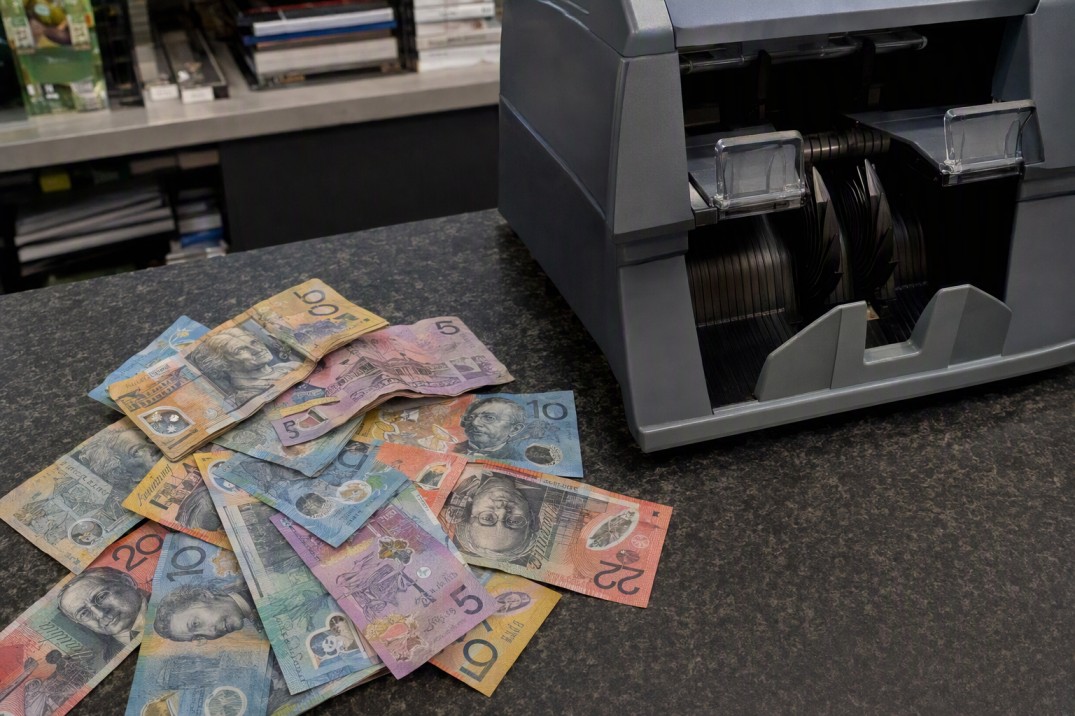
How Cashcom Machines Handle AUD Polymer Notes
- Detection thresholds. Cashcom machines are calibrated to AUD polymer reference signals for UV, magnetic and infrared detection. The H110, for example, runs four methods at once: dual CIS, UV, MG and IR.
- Worn note tolerance. Because thresholds are set for AUD, normal wear is not treated as a fault. Genuine but tired notes pass, and suspect notes are still caught.
- Mixed stack handling. Older and redesigned notes can be loaded together, with no need to sort by series first.
- Firmware currency. When the RBA releases a new series, Cashcom firmware is updated to recognise it, so a machine bought today is not stranded by the next design change.
Which Cashcom Machine Suits Your Operation
Every machine in the range carries AUD calibration. Choose by volume and workflow. For a full comparison, see our Buyer’s Guide or browse the cash counter machine range.
H110 Cash Counting MachineThe all-rounder for small-to-medium business (1–3 tills) Detection: Dual CIS + UV + MG + IR (4-method simultaneous) Speed: 720 notes/min Hopper: 500-note hopper / 200 stacker / 100 reject Fitness Detection: 12 types Serial Numbers: Logging Connectivity: LAN + 2×USB + Serial + optional printer Compliance: CE / CB / FCC Verdict: The best starting point for most Australian shops and cafés. Four simultaneous detection methods give solid authentication on polymer notes at a scale that suits one to three tills. |
H210 Money Counter & SorterDetect and sort in one pass Speed: 900 notes/min counting / 750 notes/min sorting Sorting: 3 output pockets (2 sorted exits + 1 reject) Detection: Double-face counterfeit ID; multi-level damage detection Serial Numbers: Real-time serial ID, queryable by serial, operator or batch Verdict: For retailers who need detection plus denomination sorting, particularly where mixed-era notes arrive from several tills. |
LS-200 Note CounterHigh-speed counting with deep authentication Speed: 1,500 notes/min (1,200 in value-counting mode) Detection: 18-channel magnetic detection across the full note width Hopper: 600-note hopper Verdict: For operations with three or more tills that need high authentication depth. Full-width magnetic detection suits the denomination-specific patterns on AUD notes. |
LS-300 Note CounterBuilt for all-day, multi-site cash management Operation: All-day continuous; vertical path design (particles fall clear of the sensors) Connectivity: LAN + remote management Verdict: For multi-site or centralised cash rooms. A path that keeps particles clear of the sensors suits sites that run all day. |
K2 Cash Recycler SorterCounts, authenticates, stores and dispenses Detection: UV + MG + IR + CIS Speed: 1,000 notes/min value counting Hopper: 1,000-note hopper Sorting: Denomination-to-fitness sorting in one pass Currencies: Up to 7 simultaneously Optional / Audit: Optional TITO for gaming; PIN-based per-employee audit trail Verdict: The only recycler in the range, for venues that want counting, authentication, storage and dispensing in a single machine. |
Practical Tips for Counting Polymer Notes
1. Fan Thoroughly
Polymer notes have smooth surfaces and can cling together, especially in dry conditions. Fan the edges of each stack before loading to prevent double-feeds and miscounts.
2. Handle Older Notes Carefully
Older-series notes in circulation have often been folded many times, and polymer holds a crease. Straighten heavily creased notes by hand before loading, and set aside any that are badly folded or torn.
3. Clean Sensors Weekly
Polymer can leave a thin residue on sensor windows, which slowly degrades detection. A weekly wipe keeps readings consistent. Our cleaning guide covers the steps.
4. Check Firmware After New Series Releases
The RBA has announced a redesigned $5 note. Whenever a new series arrives, ask your supplier for the matching firmware update and install it before the notes reach your tills. For more on keeping readings accurate, see our accuracy guide.
Quick Calculation: What a 3% False Reject Rate Costs3% of a 200-note stack = 6 genuine notes rejected 6 notes × 15–20 seconds each = 90–120 seconds of extra inspection per stack 1,800 stacks a year × 90–120 seconds = 45–60 hours of manual inspection At an illustrative $35 an hour, that is $1,575–$2,100 in labour every year AUD-specific calibration eliminates most of this. |
Our Honest AssessmentCashcom correctly calibrates every machine in its range for Australian polymer notes. Many cheap imports are not, even when the listing claims AUD support. A line in a product description proves nothing. Before you buy any machine, ask the supplier two questions: 1. Is it calibrated specifically for AUD polymer notes? 2. Are firmware updates available when the RBA releases a new series? If either answer is vague, treat that as your answer. |
Signs You Should Buy
- Your current machine rejects genuine notes on a regular basis
- You take in both older and redesigned notes and want them counted in one pass
- Your machine is a generic import with no AUD-specific calibration or firmware support
- You count several stacks a day and staff re-check rejects by hand
Signs You Can Probably Wait
- You handle only a few notes a week and count them by hand without trouble
- Your existing machine already supports AUD calibration and firmware updates.
- Rejects are rare and limited to notes that are badly damaged
Frequently Asked Questions
| Question | Answer |
| Do cash counting machines work with Australian polymer notes? | Yes, when they are calibrated for AUD. Cashcom calibrates its machines for Australian polymer notes to count and authenticate them accurately and reject suspicious notes reliably. Generic multi-currency imports may struggle. |
| Can they handle both old and new note series? | Yes. The RBA redesigned all five denominations between 2016 and 2020, and both series remain legal tender. Cashcom machines recognise all denominations in both series. |
| Why does my machine reject so many genuine notes? | The most common cause is averaged multi-currency detection thresholds, which misread worn or creased AUD notes. Dirty sensors can add to the problem, so clean them weekly before assuming a calibration fault. |
| What is the difference between AUD-calibrated and generic machines? | An AUD-calibrated machine uses thresholds matched to AUD UV, magnetic and IR signals. A generic machine uses averaged settings, which means more false rejects and weaker counterfeit detection. |
| Do I need a firmware update when a new series is released? | Possibly. A firmware update lets the machine recognise the new notes. Cashcom updates its firmware whenever the RBA releases a new series, so ask us before the notes enter circulation. |
| Can I mix old and new notes in one stack? | Yes. Cashcom machines process mixed stacks of older and redesigned notes in a single run, with no need to sort by series first. |
| Need a counting machine that handles Australian polymer notes properly?
Talk to the Cashcom team about the right machine for your volume. 0451 353 676 | sales@cashcom.com.au Start with the H110 Cash Counting Machine or browse the full cash counter machine range. |
About the Author
The Cashcom Team are Australian cash handling specialists based in Haberfield, NSW. Since 2015 we have supplied counting, sorting and recycling equipment to retail, hospitality, banking, gaming and cash-in-transit businesses across Australia.