
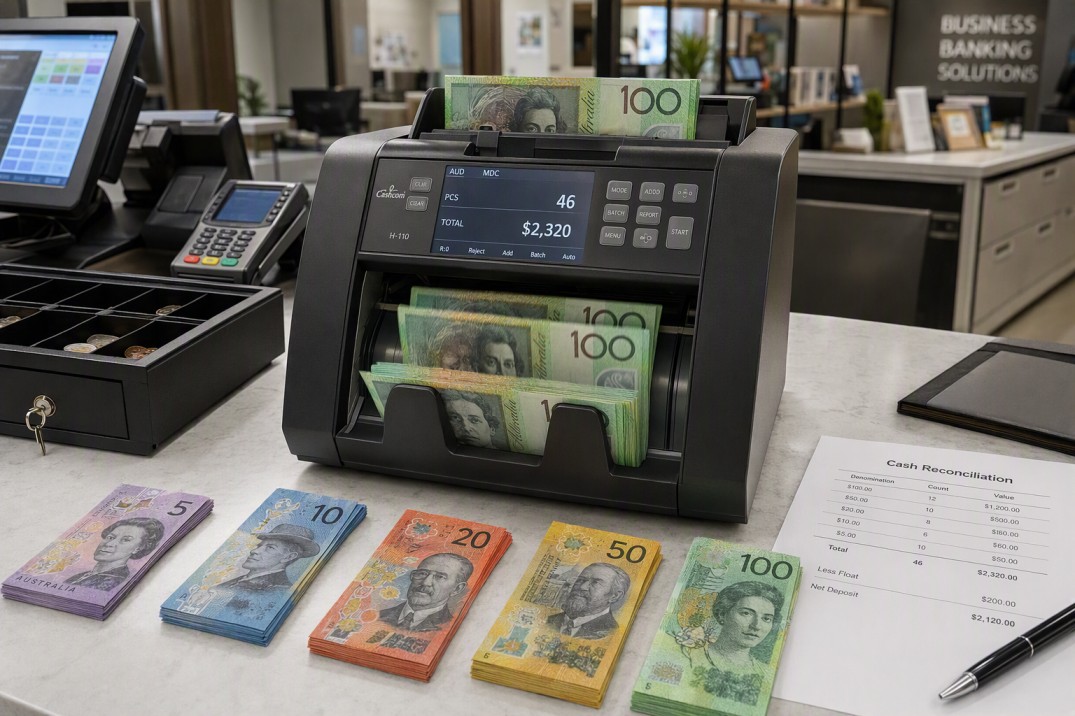
| Quick Answer
Commercial cash counting machines are rated for near-100% counting accuracy under correct operating conditions. In practice, accuracy depends on four things: · Note preparation: notes not properly fanned before loading are the single biggest cause of counting errors — double-feeds create undercounts. Fan every stack before loading. · Machine maintenance: dirty sensors reduce accuracy over time. A weekly sensor wipe and monthly cleaning card keep the machine at its rated accuracy. · Correct mode: running COUNT mode when you need a dollar VALUE total is not a machine error — it is an operator mode error. Confirm the mode before every session. · Machine quality: consumer-grade machines are not rated for daily commercial use and degrade under sustained load. Commercial machines like the Cashcom H110 maintain accuracy under daily operation across years of use. When all four are right, a commercial machine is significantly more accurate than manual counting — and consistent in a way that human counting is not. |
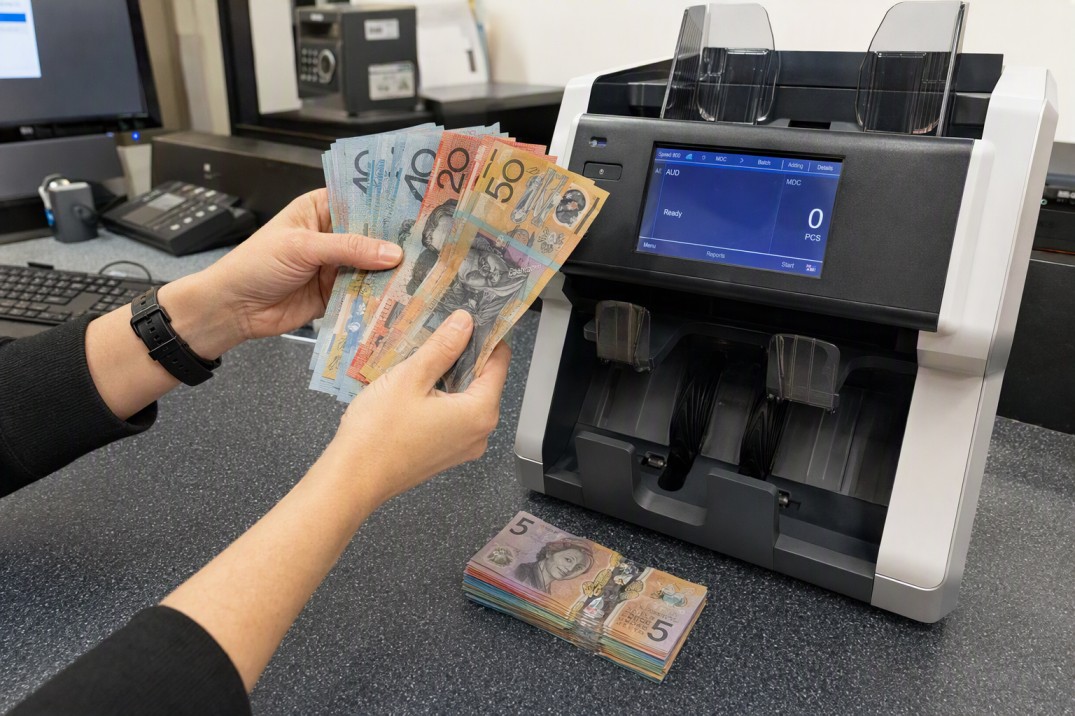
The Accuracy Question: What It Really Means
“How accurate is a cash counting machine?” is a question that sounds simple but has a more nuanced answer than most product listings suggest. The quoted accuracy of 99.9% or “near-100%” that appears in commercial machine specifications refers to counting accuracy under optimal conditions — correct note preparation, clean sensors, appropriate machine type for the volume.
The more useful question for an Australian business owner is: what causes a machine to produce an inaccurate count, and how do you prevent it? Because the vast majority of cash counting errors attributed to machines are not machine faults at all — they are operator preparation errors, maintenance gaps, or the wrong machine being used for the job.
This guide answers both questions: what accuracy you can realistically expect from a commercial machine, and what the specific factors are that reduce accuracy so you can eliminate them from your operation.
Machine Accuracy vs Manual Accuracy: The Honest Comparison
The starting point for understanding machine accuracy is understanding what it is being compared to. Manual cash counting — the benchmark most businesses are implicitly using when they ask whether a machine is accurate — is less accurate than commonly assumed.
A trained cashier counting a 200-note mixed-denomination stack typically makes one to two errors per count under normal conditions. Fatigue, distractions, and time pressure increase that rate. Manual counts rarely produce an identical result on a recount — a discrepancy of $5–$20 between two manual counts of the same stack is not unusual. Most businesses reconcile against a tolerance rather than expecting an exact manual count to hit the POS total precisely.
A commercial cash counting machine eliminates the human variability component entirely. The same stack, counted twice in sequence on a correctly operated and maintained H110, produces the same result both times. This consistency — not just the raw accuracy figure — is the primary value of a machine over manual counting.
| Comparison Point | Manual Counting | Commercial Machine (H110) |
| Error rate (trained operator, normal conditions) | 1–2 errors per 200 notes (industry estimate) | Near-zero under correct operating conditions |
| Effect of fatigue on accuracy | Significant — error rate rises sharply after 9+ hours | None — machine performance is consistent regardless of time of day |
| Consistency across multiple recounts | Varies — rarely produces identical result twice | Consistent — same stack produces same result on recount |
| Speed of count | 200 notes in 4–5 minutes | 200 notes in under 20 seconds (H110 at 720 notes/min) |
| Detection of counterfeit notes | Unreliable — depends on staff training and lighting | Consistent — UV + MG + IR + CIS on every note regardless of conditions |
| Denomination value total | Manual addition required — additional error point | Automatic in VALUE mode — no manual addition |
| Result reproducibility | Low — manual recounts often produce different figures | High — same stack consistently produces same count |
What Actually Affects Cash Counting Machine Accuracy
Every cause of inaccuracy in a commercial cash counting machine falls into one of three categories: operator preparation errors, maintenance gaps, or machine specification mismatches. The table below maps each specific cause to its effect and the fix.
| Factor | Effect on Accuracy | How to Address It |
| Notes not fanned before loading | Double-feeds — two notes pass as one, undercounting the total | Fan every stack before loading — bend back and forth several times to fully separate notes |
| Overloaded hopper | Misfeeds and jams mid-count, interrupting accuracy | Load to rated capacity only (500 notes H110, 600 LS-200). Use Add mode for larger stacks |
| Dirty sensors (UV/MG/IR/CIS) | False rejects on genuine notes; degraded detection accuracy over time | Weekly sensor wipe with dry microfibre cloth; monthly cleaning card through transport path |
| Wrong counting mode selected | COUNT mode gives note quantity, not dollar value — looks like a wrong total | Confirm mode before every session: VALUE for dollar total, COUNT for note quantity |
| Worn or damaged notes in the stack | Borderline fitness reads, elevated false rejects | Remove heavily torn or sharply folded notes before loading; review reject pocket after each run |
| Machine not warmed up / self-test | First count of the day may be slightly less stable on some models | Allow machine to complete startup self-test (5–10 seconds) before loading notes |
| Sensor contamination (advanced) | Long-term drift in detection thresholds — rejects increase, accuracy drifts | Annual professional calibration service; do not skip if machine is used daily |
| Consumer-grade machine under load | Components not rated for daily commercial use degrade and miscounted | Replace with commercial-grade machine (H110) rated for daily business operation |
The Four Most Common Accuracy Issues — Explained
1. Double-Feeds from Unfanned Notes
This is the most frequent cause of undercounts in everyday cash counting machine use. When two notes pass through the transport sensors simultaneously — because they were stuck together in the input stack — the machine’s optical sensors may read them as a single note. The count total comes up short; the operator assumes the machine made an error.
The fix is entirely in note preparation, not the machine. Fan the stack by bending it back and forth three to four times before loading — this air-separates the notes and prevents stuck pairs from entering the hopper together. The Cashcom H110’s Dual CIS sensors run a full-width image comparison on every note, which catches many double-feed scenarios that basic sensors miss, but even the best sensors benefit from properly prepared input.
For a step-by-step guide to correct note preparation before loading, see: How to Use a Cash Counting Machine: Step-by-Step Guide.
2. Sensor Contamination Reducing Detection Accuracy
Accurate cash counting machines process hundreds of AUD polymer banknotes per session. Polymer notes shed microscopic fibres and ink particles with every pass through the transport mechanism. Over time, this residue settles on the UV, MG, IR, and CIS sensor surfaces — reducing their sensitivity and causing two accuracy problems:
- False rejects increase: genuine notes trigger rejection because a contaminated sensor misreads them as suspect. The machine is still counting correctly — but notes are being diverted to the reject pocket that would normally pass.
- Detection sensitivity drifts: in more advanced contamination, the detection threshold shifts enough that the machine accepts notes it should flag. This is the more serious accuracy problem because it creates false confidence rather than visible errors.
The solution is the weekly sensor wipe described in: How to Clean and Maintain Your Cash Counting Machine. Five minutes of preventive maintenance per week preserves the accuracy that the machine was calibrated to when new.
3. Wrong Counting Mode
This is the most common “machine accuracy” issue that is not actually a machine issue at all. A business owner counts their mixed-denomination till in COUNT mode (which returns the number of notes) instead of VALUE mode (which returns the dollar total). The display shows 287. They expected to see $4,210. They conclude the machine is wrong.
The machine is not wrong — it answered the question COUNT mode asks, which is “how many notes?” VALUE mode is the correct mode for till reconciliation. Confirm the mode setting before every session, particularly in environments where multiple staff members use the machine and may have changed settings between uses.
4. Consumer-Grade Machines Running Daily Commercial Loads
Consumer machines are not engineered for daily commercial counting. Running a $60–$80 consumer machine as a business machine — counting 200–400 notes every trading day — exceeds its design parameters. The transport rollers wear faster than their commercial-grade equivalents. The motor runs hotter. The sensor housing accumulates contamination at a rate the machine’s maintenance specification was not designed for.
The result is not a sudden dramatic failure — it is a gradual degradation: slightly higher false reject rates, the occasional miscounted stack, intermediate results that are hard to reproduce. By the time the issue is obvious, the machine is typically past the point where a clean and recalibrate will fix it. See: Commercial vs Consumer Cash Counting Machines: Why the Difference Matters for a full breakdown.
What “Near-100% Accuracy” Actually Means in Practice
Commercial accurate cash counting machine specifications quote accuracy figures of 99.9% or near-100%. For an Australian business, here is what that means in practical terms:
- For a 300-note stack: at 99.9% accuracy, the expected error rate is 0.3 notes — statistically, less than one error every three full-hopper counts under optimal conditions.
- For a daily till count of 200 notes across 250 trading days: 50,000 notes processed per year at 99.9% accuracy produces approximately 50 counting errors per year — or roughly one per week, on a worst-case basis.
- In practice: most Australian small businesses running a commercial machine correctly experience far fewer discrepancies than even this figure suggests, because the primary causes of error (unfanned notes, dirty sensors, wrong mode) are preventable. A well-operated H110 with weekly maintenance often runs for months between any miscounted session.
The qualification “under optimal conditions” is where the specification meets reality. Optimal conditions means fanned notes, clean sensors, correct mode selection, and a machine rated for the daily volume being run. All four are within the operator’s control.
How to Verify Your Machine Is Counting Accurately
If you suspect your machine is producing inaccurate counts, the fastest diagnostic is a recount test:
- Step 1 — count a known stack manually and record the exact note count and value total.
- Step 2 — fan the stack thoroughly, load into the machine, count in VALUE mode. Record the result.
- Step 3 — reload the same stack without reflipping and count again. Record the second result.
- Consistent results on steps 2 and 3: if both machine counts match each other, the machine is counting consistently. If the machine total differs from your manual count, the likely cause is mode error (COUNT vs VALUE) or unfanned notes causing double-feeds.
- Inconsistent results between steps 2 and 3: different results on the same stack across two runs indicates a sensor or mechanical issue. Clean the sensors and retest. If inconsistency persists after cleaning, contact Cashcom for a service assessment.
For a full troubleshooting guide when accuracy problems persist, see: Cash Counting Machine Not Working? Common Problems and How to Fix Them.
| Quick Calculation
A business doing a manual till count that is typically $5–$20 off the POS total — accepted as normal ‘counting variance’ — is experiencing an error rate of 0.1–0.5% on a $4,000 daily take. A commercial cash counting machine operating correctly produces a result within a few dollars of the POS total consistently, every session. Over a year of trading, the reduction in unresolved cash discrepancies and the time saved on recount investigations adds up to a meaningful operational benefit beyond the headline time saving. |
| Our Honest Assessment
No machine is perfectly immune to counting errors — including the Cashcom H110. A genuinely worn or stuck pair of notes can occasionally result in a double-feed that passes the sensor stack. A sensor cleaning session left two weeks overdue can produce elevated false reject rates. These are real, if infrequent, occurrences. What we can say honestly is that a correctly operated and maintained commercial machine produces dramatically fewer counting errors than manual counting — and the errors it does produce are systematic and diagnosable, rather than random and invisible. When the H110 produces a result that does not match your expectation, there is almost always a specific, addressable reason — and finding it takes minutes rather than a full recount. |
Signs Your Machine’s Accuracy May Be Degrading
- Count results are inconsistent across two runs on the same stack — different totals without changing the notes.
- False reject rate has increased noticeably without a change in the notes being counted.
- Results differ from your POS total by more than your usual variance, consistently across sessions.
- The machine is producing error codes mid-count that clear on power cycle but keep returning.
- The machine is a consumer-grade model that has been in daily business use for more than 12–18 months.
If any of these signs are present, clean the sensors first — this resolves most accuracy issues. If problems persist after cleaning, see the troubleshooting guide or contact Cashcom for a service assessment.
Frequently Asked Questions
| Question | Answer |
| How accurate are cash counting machines? | Commercial cash counting machines are rated for near-100% counting accuracy under correct operating conditions — properly fanned notes, clean sensors, correct mode selected, and a machine rated for the daily volume being run. In practice, the vast majority of counting errors attributed to machines are caused by unfanned notes (double-feeds), dirty sensors, or wrong mode selection — all of which are preventable. |
| Why does my cash counting machine give a different result than my manual count? | The most common reasons are: (1) mode mismatch — the machine is in COUNT mode showing note quantity when you need VALUE mode showing dollar total; (2) double-feeds from unfanned notes causing an undercount; (3) dirty sensors causing false rejects that reduce the accepted count. Fan your notes thoroughly, confirm the mode, clean the sensors, and recount. |
| Are cash counting machines more accurate than counting by hand? | Yes — significantly. Manual counting by a trained operator produces one to two errors per 200 notes under normal conditions, and more under fatigue or time pressure. A correctly operated commercial machine produces near-zero counting errors and, critically, produces consistent results on a recount of the same stack — which manual counting rarely does. |
| What causes a cash counting machine to miscount? | The four main causes are: unfanned notes causing double-feeds; contaminated sensors from polymer note residue; wrong counting mode selected; and consumer-grade machines degrading under daily commercial load. All four are preventable with correct note preparation, regular cleaning, mode awareness, and the right machine for the volume. |
| How do I know if my cash counting machine is accurate? | Run a recount test: count a stack twice in sequence without changing the notes between runs. Consistent results across both runs indicate the machine is counting reliably. Inconsistent results across two runs on the same stack — without changing the notes — indicate a sensor or mechanical issue. Clean the sensors and retest; if inconsistency persists, contact Cashcom for a service check. |
| Does the type of machine affect counting accuracy? | Yes. Consumer-grade machines are not rated for daily commercial use and degrade under sustained load — producing gradually increasing count errors as roller and sensor components wear. Commercial machines like the Cashcom H110 are built for daily business operation and maintain accuracy across years of use with regular maintenance. |
Questions About Your Machine’s Accuracy?
If your machine is producing inconsistent results and a sensor clean has not resolved the issue, Cashcom’s service team can diagnose the problem remotely in many cases before the machine needs to come in for a physical service.
Call: 0451 353 676 | Email: sales@cashcom.com.au | Web: cashcom.com.au
Also see: How to Clean and Maintain Your Cash Counting Machine — the regular maintenance routine that keeps your machine at its rated accuracy specification.
About the Author
This article was prepared by the Cashcom Team, Australian Cash Handling Specialists since 2015. Cashcom supplies and services cash counting, sorting and recycling equipment for retail, hospitality, banking, gaming and cash-in-transit businesses across Australia.
Get in touch: 0451 353 676 | sales@cashcom.com.au | cashcom.com.au