
| Quick Answer
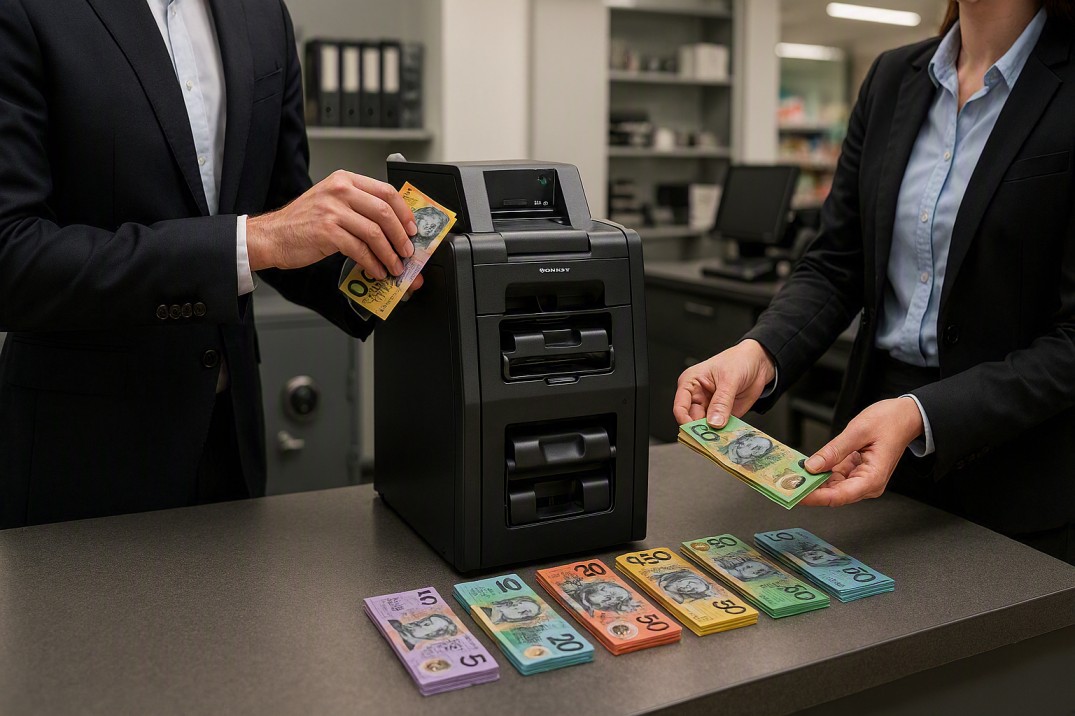
A cash recycler machine automates the most time-consuming parts of retail float management — morning float preparation, mid-shift top-ups, and end-of-day reconciliation — by storing accepted notes and dispensing them back out as change or float, without manual counting or denomination sorting between each step. Time saving: most retail stores running 3+ tills cut daily float management time from 60–90 minutes to 15–20 minutes. Accuracy: UV + MG + IR + CIS detection authenticates every note in and out; PIN-based audit trail tracks every transaction per employee. Right for your store if: you run 2+ tills, spend significant staff time on float prep and change management, and handle meaningful daily cash volume. Not right if: you run a single quiet till — a Cashcom H110 cash counter is the more cost-effective choice. |
The Float Management Problem Every Cash Retailer Knows
If you run a cash-handling retail store, float management is one of those costs that’s easy to underestimate because it’s spread across every shift. Someone counts out the morning float. Someone replenishes the till mid-afternoon when the $5 and $10 notes run low. Someone counts every till down at closing and reconciles the result against the day’s takings. Someone sorts the banking bundle by denomination before the CIT pickup.
In a single-till store, that overhead is manageable. In a multi-till retail environment — a supermarket, a pharmacy, a large-format retailer, a chain with high daily cash volume — it adds up fast. Industry estimates put the daily float management overhead for a three-till store at 60–90 minutes of staff time across the full trading day. Across a six-day trading week, that is 6–9 hours of labour spent moving cash around and counting it repeatedly.
A cash recycler machine for retail addresses this directly. Rather than counting cash out of the machine at the start of the day, replenishing tills manually mid-shift, and counting cash back in at closing, the recycler handles all three — automatically, with a complete audit trail per note and per employee.
| A Day in the Life
It is 8:45 am at a busy suburban pharmacy. Three tills need to be floated before the 9:00 am opening. Without a recycler, the store manager manually counts three denomination-sorted floats from the safe — typically 20–25 minutes. With a Cashcom K2 Cash Recycler, the manager enters their PIN, selects the float amount for each till, and the machine dispenses pre-sorted, authenticated notes automatically. All three tills are floated and ready by 8:52 am. At 2:30 pm, till 2 is running low on $10 notes. Without a recycler, a staff member leaves the floor, goes to the back office, manually counts replacement notes, and returns — 5–8 minutes off the shop floor per top-up. With the K2, the till replenishment is handled by the recycler in under a minute, with a logged transaction record. At 6:00 pm, all three tills are counted down. The K2 processes each till’s notes in under two minutes per till — authenticating, logging serial numbers, and producing a denomination-level report ready for the banking bundle. Total closing time for float reconciliation: 12 minutes, down from 35. |
How a Cash Recycler Machine Works in a Retail Context
A cash recycler is not simply a cash counter with extra features — it is a fundamentally different machine that operates as an active cash management hub rather than a passive counting tool.
Step 1: Notes In — Count, Authenticate, Store
When a staff member deposits cash into the recycler (from a till, a customer transaction, or a cash drop), the machine counts each note, runs it through UV, MG, IR and CIS detection simultaneously, and stores authenticated notes in internal denomination-specific cassettes. Notes that fail detection are rejected to a separate pocket for manual review. Every accepted note’s serial number is logged against the operator’s PIN and a timestamp.
Step 2: Notes Out — Dispense on Demand
When a till needs a float top-up or change, a staff member requests the denomination and amount from the recycler’s interface. The machine dispenses the requested notes from its internal cassettes — pre-sorted by denomination, already authenticated — without any manual counting or sorting required. The dispensing transaction is logged against the operator PIN.
Step 3: Reconciliation — Automatic Running Total
Because every note in and out is tracked, the recycler maintains a real-time running total of its contents. End-of-day reconciliation is a comparison of the recycler’s logged total against the day’s recorded transactions — not a manual recount of physical notes. Discrepancies are flagged to the specific transaction and operator rather than requiring a full till recount to locate.
Step 4: Audit Trail — Per Note, Per Employee
Every transaction through the Cashcom K2 is recorded against a PIN-based employee identifier. If a discrepancy appears, the audit log shows which operator handled the relevant notes, at what time, and in what quantity. This accountability layer is not available on a standard cash counter — it is a feature specific to the recycler category.
Before and After: Float Management With and Without a Cash Recycler
The table below compares typical float management times for a three-till retail store with and without a Cashcom K2 Cash Recycler.
| Float Management Task | Without Recycler | With K2 Recycler |
| Morning float preparation (3 tills) | 20–30 min manual count + denomination sort | 2–3 min — recycler dispenses pre-sorted float automatically |
| Mid-shift float top-up (per till) | 5–8 min per till — staff leaves floor to get change | Automatic — recycler replenishes without staff intervention |
| End-of-day till count (3 tills) | 25–35 min manual count + reconciliation | 5–8 min — recycler counts, authenticates and logs automatically |
| Banking preparation | Manual denomination sort + bundle prep | Denomination-sorted output ready from recycler |
| Discrepancy investigation | Manual recount — no per-note audit trail | Per-note serial log + per-employee PIN record — traceable instantly |
| Total daily float management time | Approx. 60–90 min across 3 tills | Approx. 15–20 min — saving 45–70 min per trading day |
| 💡 Quick Calculation
A three-till retail store saving 50 minutes per day in float management time, across a six-day trading week, recovers approximately 260 hours of staff time per year. At an average retail wage of $28–$32 per hour (including on-costs), that is $7,300–$8,300 in recovered labour value annually — before accounting for the reduction in cash discrepancies and the cost of investigating them. |
The Cashcom K2 Cash Recycler — Specifications
| Cashcom K2 Cash Recycler
The only recycler in the Cashcom range — counts, authenticates, stores and dispenses Detection: Full UV + MG + IR + CIS (4-method simultaneous) Speed: 1,000 notes per minute (value counting) Hopper: 1,000-note capacity Sorting: Denomination-to-fitness sorting in a single pass Currency: Up to 7 currencies handled simultaneously Audit: PIN-based, per-employee audit trail Connectivity: LAN connectivity for multi-till and multi-site integration Compliance: Suitable for retail, gaming (TITO optional), and high-volume environments Verdict: The K2 is built for high-traffic retail environments where float management is a daily time drain and cash accuracy is non-negotiable. It is not the right tool for a single quiet till — but for any multi-till store spending 60+ minutes a day on float prep and reconciliation, it pays for itself in recovered staff time within months. View product → K2 Cash Recycler Sorter Machine |
Cash Counter vs Cash Recycler: Which One Does Your Store Need?
The K2 Cash Recycler is not the right machine for every retail business. The table below compares it directly with the Cashcom H110 Cash Counting Machine — the right choice for most single-till or lower-volume stores.
| Feature | Cash Counter (H110) | Cash Recycler (K2) |
| Counts notes | ✅ | ✅ |
| Detects counterfeits (UV/MG/IR/CIS) | ✅ | ✅ |
| Denomination sorting | ❌ | ✅ |
| Stores notes internally | ❌ | ✅ |
| Dispenses notes as change/float | ❌ | ✅ |
| Automated float top-up | ❌ | ✅ |
| Per-employee audit trail (PIN) | ❌ | ✅ |
| Multi-currency (up to 7) | ❌ | ✅ |
| Hopper capacity | 500 notes | 1,000 notes |
| Counting speed | 720 notes/min | 1,000 notes/min |
| Best for | 1–3 till counting | High-traffic multi-till retail |
Signs You Should Buy a Cash Recycler — and Signs You Can Probably Wait
Signs a Cash Recycler Is Right for Your Retail Store
- You run 2 or more tills and spend more than 30 minutes per day on float preparation, mid-shift top-ups, or end-of-day reconciliation.
- Your staff regularly leave the floor to manually replenish tills with change — creating service gaps and supervision blind spots.
- You have experienced cash discrepancies that were difficult to trace because there was no per-transaction, per-employee record.
- Your store processes high daily cash volume and denomination sorting for banking takes meaningful time at end of day.
- You have multiple staff members handling cash across different shifts and want accountability at the individual employee level.
- You are growing — opening additional tills or extending trading hours — and current manual float processes won’t scale cleanly.
Signs You Can Probably Wait (and a Counter Is Enough)
- You run a single till with light to moderate daily cash volume — a Cashcom H110 will cover your counting and authentication needs at a fraction of the cost.
- Float management takes under 20 minutes per day total across your operation — the time saving from a recycler won’t justify the investment at that volume.
- Your business is predominantly card-based, with cash representing a small proportion of daily transactions.
- You have a simple, predictable cash flow that doesn’t require frequent mid-shift float adjustments.
| ⚠️ Our Honest Assessment
A cash recycler machine is a significant investment compared to a standard cash counter, and the honest answer is that it is only the right tool for a specific type of retail operation. If your daily float management overhead is under 30 minutes, the payback period stretches considerably and a quality counter is the better choice. But for a multi-till retail store where float prep, mid-shift top-ups, and end-of-day reconciliation are consuming 60–90 minutes of staff time every day — the K2 pays for itself in recovered labour within the first year of use, while simultaneously improving cash accuracy and creating an audit trail that a counter cannot provide. |
Getting a Cash Recycler Into Your Retail Operation
Placement
The K2 is designed for back-of-house placement — a secure room or manager’s office where tills are floated and cashed up. It does not need to be at the point of sale. LAN connectivity allows the machine’s audit data to be accessed remotely without physically attending the machine.
Staff Training
The PIN-based interface is straightforward for staff to learn — most retail teams are comfortable with the full workflow within a single training session. The key procedural shift is moving from manual float counts to requesting amounts from the recycler’s interface, and from manual reconciliation to reading the recycler’s printed or digital totals.
Integration with Your Existing Process
The K2 does not require changes to your POS system or banking arrangements. It operates as a standalone cash management hub — notes go in, notes come out, and the audit log is exportable via LAN for your records. Your banking process remains the same; the denomination sorting the recycler provides simply means less manual sorting at the banking preparation stage.
Servicing and Support
Cashcom provides local servicing for the K2 across Australia. Given the K2’s role as an active cash management hub rather than a passive counter, scheduled annual servicing — covering roller condition, sensor calibration, and firmware currency — is particularly important. Contact the Cashcom team to discuss a service arrangement that fits your trading schedule.
Frequently Asked Questions
| Question | Answer |
| What is a cash recycler machine? | A cash recycler machine counts, authenticates, stores, and re-dispenses banknotes automatically. Unlike a standard cash counter, which simply counts notes and outputs them to a stacker, a recycler keeps accepted notes in internal denomination cassettes and dispenses them on demand as change or float — without manual counting between transactions. |
| How much time does a cash recycler save in a retail store? | For a three-till retail store, a Cashcom K2 Cash Recycler typically reduces daily float management time from 60–90 minutes to 15–20 minutes — a saving of 45–70 minutes per trading day. The saving scales with the number of tills and the frequency of mid-shift float top-ups. |
| Is a cash recycler machine the same as a cash counter? | No — they are different machine categories. A cash counter counts and authenticates notes and outputs them to a stacker. A cash recycler also stores accepted notes and dispenses them back out as change or float. See our full comparison: Cash Recycler vs Cash Counter. |
| Does the Cashcom K2 work with Australian polymer banknotes? | Yes — the K2 is configured and tested for current and older series AUD polymer banknotes, including mixed stacks of both. Full UV + MG + IR + CIS detection authenticates every note regardless of denomination or age. |
| How many notes can the Cashcom K2 hold? | The K2 has a 1,000-note hopper capacity — the largest in the Cashcom range — and processes notes at 1,000 notes per minute in value-counting mode. Internal cassette capacity depends on configuration; contact the Cashcom team for current cassette configuration options. |
| Can a cash recycler machine track which employee handled which cash? | Yes — the K2 uses PIN-based per-employee authentication, creating an audit trail that records every cash-in and cash-out transaction against a specific operator. This is a key accountability feature not available on standard cash counters. |
| What is the difference between a cash recycler and a cash sorter? | A cash sorter separates notes by denomination into output pockets but does not store or re-dispense them. A cash recycler stores authenticated, sorted notes internally and dispenses them on demand. The K2 is a recycler — it includes denomination sorting as part of its processing, but its defining capability is the store-and-dispense function. |
Talk to Cashcom About the K2 Cash Recycler
If your retail store is spending significant time on float management every day, the Cashcom K2 Cash Recycler is worth a closer look. The Cashcom team can walk you through the configuration options, answer questions about your specific operation, and advise on whether a recycler or a counter is the right fit for your current volume.
Call: 0451 353 676 | Email: sales@cashcom.com.au | Web: cashcom.com.au
Also see: Cash Recycler Machine Australia: Complete Buyer’s Guide 2026 — for a full overview of the recycler category and everything to consider before buying.
About the Author
This article was prepared by the Cashcom Team, Australian Cash Handling Specialists since 2015. Cashcom supplies and services cash counting, sorting and recycling equipment for retail, hospitality, banking, gaming and cash-in-transit businesses across Australia.
Get in touch: 181 Parramatta Rd, Haberfield NSW 2045 | 0451 353 676 | sales@cashcom.com.au | cashcom.com.au