
| A Note on Terminology
Cash recycler and money recycler and notes recycler all refer to the same machine category. Likewise, cash counter, money counter, and notes counter are the same equipment under different names. This guide uses these terms interchangeably throughout. The comparison here is between machine categories — recycler vs counter — not between names. |
| Quick Answer
Both machines count and authenticate banknotes. The difference is what happens next: • Cash counter: counts notes, flags counterfeits, outputs notes to a stacker. Job done. • Cash recycler: counts notes, flags counterfeits, stores accepted notes internally, and dispenses them back out as change or float — automatically, with a per-employee audit trail. Which one is right depends entirely on your operation: • Choose a cash counter if: you run 1–2 tills and your main need is accurate counting and counterfeit detection at end of day. Cashcom H110. • Choose a cash recycler if: you run multiple tills, spend significant time on float management, and want to automate change dispensing and shift reconciliation. Cashcom K2. |
The Core Question: What Do You Actually Need the Machine to Do?
Most Australian businesses searching for a cash recycler vs cash counter comparison are solving one of two problems. The first is accuracy — they want to stop counting notes by hand and catch counterfeits reliably. The second is time — they want to stop spending 60–90 minutes a day on float preparation, mid-shift change replenishment, and end-of-day reconciliation.
A cash counter solves the accuracy problem. A cash recycler solves both — but at a higher cost and with a more significant operational footprint. The question is whether your operation generates enough cash handling overhead to justify the difference.
This guide answers that question clearly, with a full feature comparison, a cost-benefit breakdown, and a decision guide matched to real Australian business scenarios.
What Each Machine Actually Does
The Cash Counter
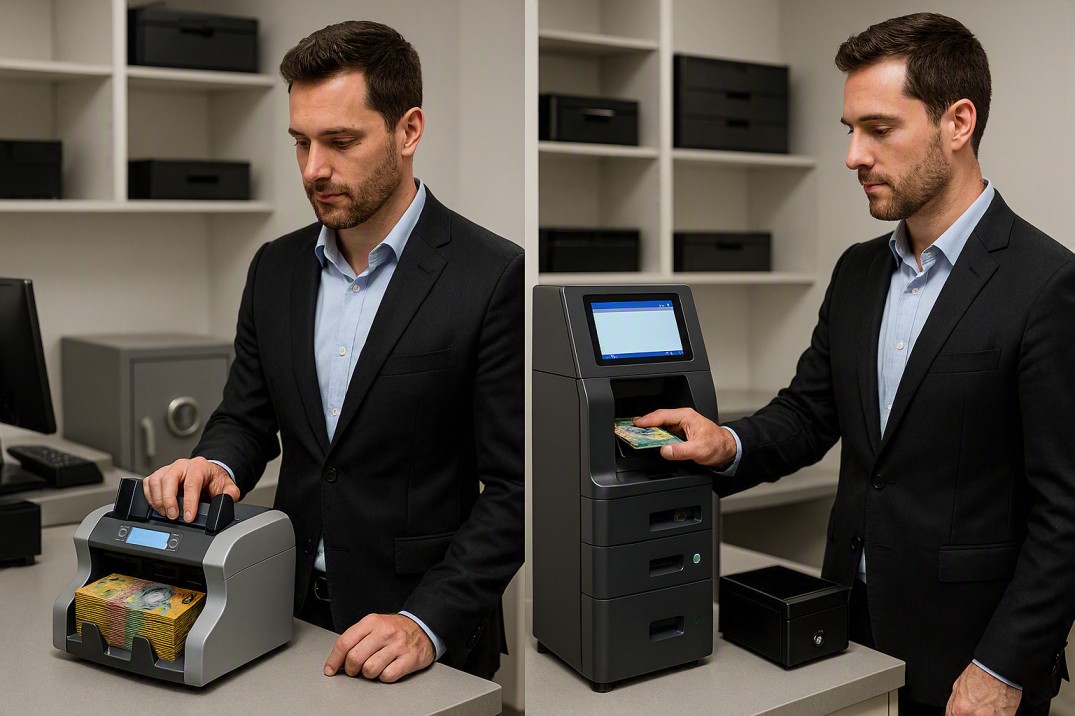
A cash counter — also called a money counter, notes counter, cash counting machine, or money counting machine — takes a stack of notes from the hopper, processes each note through a set of sensors, and outputs them to a stacker with a count on the display. Commercial-grade machines do this at 720–1,500 notes per minute, with UV, MG, IR, and CIS counterfeit detection running simultaneously.
What a cash counter does not do: it does not store notes. It does not dispense notes. It does not top up your till float. Every note that goes in comes straight back out the other side — counted, authenticated, and stacked. The machine’s role ends there.
For most Australian businesses, this is exactly what they need. A counter is simple, reliable, and cost-effective — and the Cashcom H110, with Dual CIS plus four-method simultaneous detection, handles even high-risk counterfeit environments without the complexity of a recycler.
The Cash Recycler
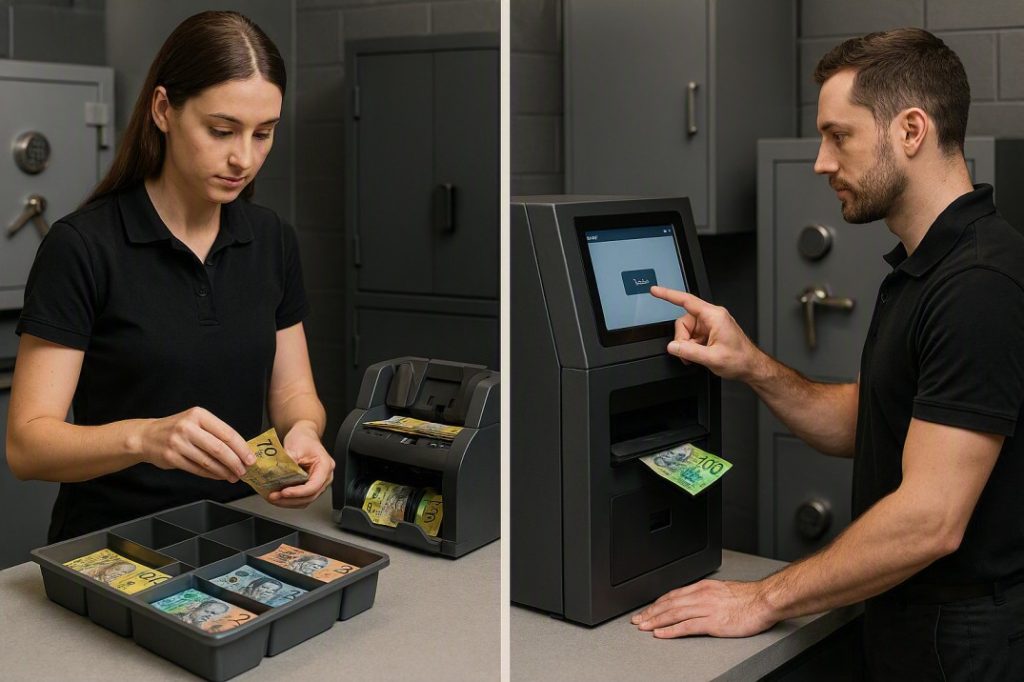
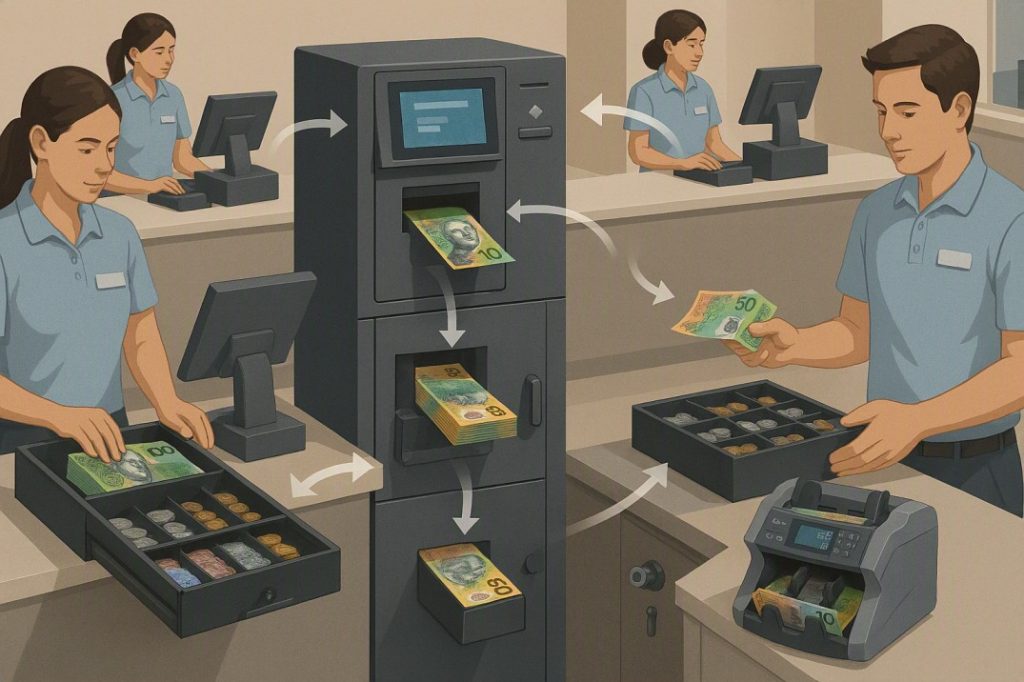
A cash recycler — also called a money recycler or notes recycler — does everything a counter does, and then keeps going. Accepted notes are sorted by denomination into internal cassettes. When a till needs a float top-up or change, staff request the amount from the recycler’s interface and the machine dispenses pre-sorted, authenticated notes directly — no manual counting, no separate denomination sort, no staff leaving the floor to get change from the safe.
Every transaction in and out is logged against a PIN-based employee identifier, creating a per-note, per-employee audit trail. End-of-day reconciliation becomes a comparison of the recycler’s logged total against the day’s takings, rather than a manual recount of physical notes.
The Cashcom K2 Cash Recycler is the only recycler in Cashcom’s range. It is a fundamentally more capable — and more complex — machine than the counter models.
| 💡 The One Thing That Makes the Difference
The defining difference between a cash counter and a cash recycler is not detection depth, counting speed, or build quality — both categories can be high-spec. The defining difference is what happens to the notes after they are authenticated. Counter: notes go in, notes come out, you stack them. Recycler: notes go in, notes stay inside until the machine dispenses them back out on demand. That single difference in how notes flow through the machine is what creates the float automation, the audit trail, and the time saving that distinguishes the recycler category. |
Full Feature Comparison: Counter vs Sorter vs Recycler
The table below compares the three main categories in the Cashcom range — the H110 cash counter, H210 cash sorter, and K2 cash recycler — across every feature that matters for buying decisions.
| Feature | Cash Counter (H110) | Cash Sorter (H210) | Cash Recycler (K2) |
| Counts total notes | ✅ | ✅ | ✅ |
| Counterfeit detection (UV/MG/IR) | ✅ | ✅ | ✅ |
| CIS full-image detection | ✅ Dual CIS | ✅ | ✅ |
| Value counting (mixed denoms) | ✅ | ✅ | ✅ |
| Serial number logging | ✅ | ✅ | ✅ |
| Fitness detection | ✅ 12-type | ✅ | ✅ |
| Denomination sorting | ❌ | ✅ 3 pockets | ✅ |
| Stores notes internally | ❌ | ❌ | ✅ |
| Dispenses notes as change/float | ❌ | ❌ | ✅ |
| Automated float top-up | ❌ | ❌ | ✅ |
| Per-employee PIN audit trail | ❌ | ❌ | ✅ |
| Multi-currency (up to 7) | ❌ | ❌ | ✅ |
| Hopper capacity | 500 notes | 3-pocket sort | 1,000 notes |
| Counting speed | 720/min | 900/750/min | 1,000/min |
| Typical use case | 1–3 till, daily count | Multi-till, sorting needed | High-volume, float automation |
Cost and Benefit Comparison
Beyond features, the buying decision comes down to whether the recycler’s additional cost is justified by the time and accuracy benefits it delivers for your specific operation.
| Factor | Cash Counter | Cash Recycler |
| Initial investment | Lower | Higher |
| Daily time saving | Moderate (vs manual counting) | High (float automation + reconciliation) |
| Staff time returned per day | 2–5 min per count session | 45–70 min for a 3-till operation |
| Cash discrepancy reduction | Moderate | High — per-note, per-employee trail |
| Payback period (estimate) | Days to weeks | Months to ~1 year depending on volume |
| Ongoing costs | Minimal (cleaning supplies) | Consumables + annual service |
| Right volume threshold | Any cash business | Multi-till, 60+ min/day float overhead |
| 💡 Quick Calculation
A three-till retail store saving 50 minutes per day on float management — morning prep, mid-shift top-ups, and end-of-day reconciliation — across a six-day trading week recovers approximately 260 hours of staff time per year. At $28–$32 per hour including on-costs, that is $7,300–$8,300 in recovered labour annually. For a lower-volume single-till business saving 5 minutes per day on counting time, the same maths produces a much smaller return — and the simpler, lower-cost H110 counter is the right tool. |
Real Business Scenarios: Counter or Recycler?
Scenario 1: Single-Till Café or Restaurant
A café with one busy till reconciles at close of day — typically a single count of 150–300 mixed notes to verify the day’s takings. The count takes under 90 seconds with an H110. Float management is straightforward — the same denominations go back into the till each morning from the safe.
Verdict: Cash counter. The H110 is the right machine. A recycler’s float automation features are not meaningfully used by a single-till operation.
Scenario 2: Multi-Till Retail Store (3–5 Tills)
A large pharmacy or specialty retailer with four tills spends 25 minutes preparing floats each morning, faces regular mid-shift change requests when $10 and $20 notes run low, and takes 40 minutes to count down and reconcile at closing. Total daily cash handling overhead: approximately 75 minutes.
Verdict: Cash recycler. The K2 reduces that overhead to approximately 15–20 minutes, with a per-employee audit trail that makes discrepancies traceable rather than requiring full recounts. The investment is justified at this volume.
Scenario 3: Hospitality Venue with High Cash Turnover
A busy pub or club with four tills running across two shifts — lunch and dinner — faces the same float management overhead twice per day, plus shift changeovers that require float transfers between outgoing and incoming staff. Manual handling between shifts creates accountability gaps.
Verdict: Cash recycler. The K2’s PIN-based per-employee audit trail is directly valuable here — shift changeovers are logged per transaction, not just per shift total. Float transfers are recorded at the note level.
Scenario 4: Bank Branch or Credit Union
A bank teller processes high volumes of customer deposits, needs maximum authentication depth on every note, and requires serial number logging for regulatory compliance. Float management is structured and regular rather than ad hoc.
Verdict: Cash counter — specifically the LS-200 or LS-300, which are built for high-speed branch-level counting with 18-channel full-width magnetic detection and all-day continuous operation. The K2 recycler’s float automation is not the primary need in this context; detection depth and throughput speed are.
Scenario 5: Gaming Venue
A licensed club or casino handles large daily cash volumes, needs TITO (Ticket-In Ticket-Out) integration, and manages floats across multiple gaming machines and a bar operation simultaneously.
Verdict: Cash recycler. The K2’s optional TITO integration, 7-currency capability, and PIN-based audit trail make it the right fit for gaming environments. See also: Notes Recycler for Gaming Venues.
The Machines: Specifications
| Cashcom H110 — Best Cash Counter for Most Australian Businesses
📌 Best for 1–3 tills where daily counting and counterfeit detection is the primary need Detection: Dual CIS + UV + MG + IR (4-method simultaneous) Speed: 720 notes per minute Hopper / Stacker / Reject: 500-note / 200-note / 100-note Fitness Detection: 12-type fitness detection Serial Numbers: Full serial number logging Connectivity: LAN + 2x USB + Serial + optional printer Compliance: CE, CB, FCC certified Verdict: The H110 is the right counter for most Australian businesses — commercial-grade Dual CIS detection at a price point accessible to single and small multi-till operations. It does not automate float management, but for businesses where float management is a minor overhead, it does not need to. View product → H110 Cash Counting Machine |
| Cashcom K2 Cash Recycler — Best for High-Volume Float Automation
📌 Best for multi-till businesses where float management is a significant daily overhead Detection: Full UV + MG + IR + CIS (4-method simultaneous) Speed: 1,000 notes per minute (value counting) Hopper: 1,000-note capacity Sorting: Denomination-to-fitness sorting in a single pass Currency: Up to 7 currencies simultaneously Audit: PIN-based, per-employee audit trail Gaming: Optional TITO (Ticket-In Ticket-Out) integration Connectivity: LAN connectivity Verdict: The K2 is the right machine when float management overhead is genuinely significant and per-employee accountability matters. It is more expensive and more complex than a counter — and it earns that difference for the right operation. View product → K2 Cash Recycler Sorter Machine |
Decision Guide: Counter or Recycler for Your Business?
Match your situation to the recommendation below. If your scenario isn’t listed, the general rule applies: start with a counter unless you can clearly identify the daily float management overhead that a recycler would reduce.
| Your Situation | Best Choice | Cashcom Model |
| Single till, daily count and close | Cash counter | H110 |
| 2–3 tills, moderate daily cash, no sorting needed | Cash counter | H110 |
| Multi-till, need denomination sorting for banking | Cash sorter | H210 |
| High-volume, 3+ tills, significant float management overhead | Cash recycler | K2 |
| Multi-staff cash handling needing per-employee accountability | Cash recycler | K2 |
| Gaming venue needing TITO integration | Cash recycler | K2 |
| Bank branch, credit union — high-speed authentication priority | Cash counter | LS-200 or LS-300 |
| All-day continuous operation, multi-site network | Cash counter | LS-300 |
| Significant coin volume alongside notes | Add coin sorter | Con200 + any above |
| ⚠️ Our Honest Assessment
The cash recycler is not a better cash counter — it is a different tool solving a different problem. If you buy a recycler because you want better detection or faster counting, you are paying for float automation you won’t use. If you buy a counter because the recycler looks complicated, you may be leaving 60+ minutes of daily staff time on the table. Be honest about your daily float management overhead. If it genuinely costs your business more than 30 minutes per day across your operation, the K2 will pay for itself. If it does not, the H110 is the smarter buy — and you can always upgrade as your business grows. |
Frequently Asked Questions
| Question | Answer |
| What is the main difference between a cash recycler and a cash counter? | A cash counter counts and authenticates notes, then outputs them to a stacker. A cash recycler does the same, but also stores accepted notes internally and dispenses them back out as change or float on demand. The recycler automates float management; the counter does not. |
| Is a cash recycler worth it for a small business? | For most small businesses running one or two tills with modest daily cash volume, a cash counter like the Cashcom H110 is the more cost-effective choice. A recycler is worth the investment when daily float management overhead — morning prep, mid-shift top-ups, and end-of-day reconciliation — genuinely exceeds 30–40 minutes per trading day. |
| Does a cash recycler replace a cash counter? | Yes — a cash recycler includes all the counting and authentication functions of a cash counter, plus the store-and-dispense capability. You do not need both machines. If you have a cash counter and upgrade to a recycler, the counter is no longer needed for the same operation. |
| Can a cash recycler detect Australian counterfeit notes? | Yes — the Cashcom K2 Cash Recycler runs full UV + MG + IR + CIS detection simultaneously on every note processed, the same four-method detection standard as the H110 counter. Notes that fail detection are rejected to a separate pocket and not stored in the recycler’s cassettes. |
| What is the difference between a cash recycler and a cash sorter? | A cash sorter separates notes by denomination into output pockets but does not store or re-dispense them. A cash recycler stores authenticated, sorted notes and dispenses them on demand. The K2 is a recycler — it includes sorting as part of its processing, but its defining capability is the store-and-dispense function. |
| How do I know if my business needs a cash recycler or a cash counter? | Add up the daily time spent on: (1) morning float preparation, (2) mid-shift change and top-up requests, and (3) end-of-day till reconciliation. If that total exceeds 40–50 minutes per day, a cash recycler will generate meaningful time savings. If it is under 30 minutes, a cash counter is the more appropriate investment. Contact the Cashcom team on 0451 353 676 to discuss your specific operation. |
Not Sure Which One Is Right for Your Business?
The Cashcom team has been helping Australian businesses choose the right cash handling equipment since 2015. Tell us your till count, daily cash volume, and current float management process — and we will tell you honestly whether a counter or a recycler is the better fit.
Call: 0451 353 676 | Email: sales@cashcom.com.au | Web: cashcom.com.au
Also see: Cash Recycler Machine Australia: Complete Buyer’s Guide 2026 — for a full overview of the recycler category and everything to consider before buying.
About the Author
This article was prepared by the Cashcom Team, Australian Cash Handling Specialists since 2015. Cashcom supplies and services cash counting, sorting and recycling equipment for retail, hospitality, banking, gaming and cash-in-transit businesses across Australia.
Get in touch: 0451 353 676 | sales@cashcom.com.au | cashcom.com.au