
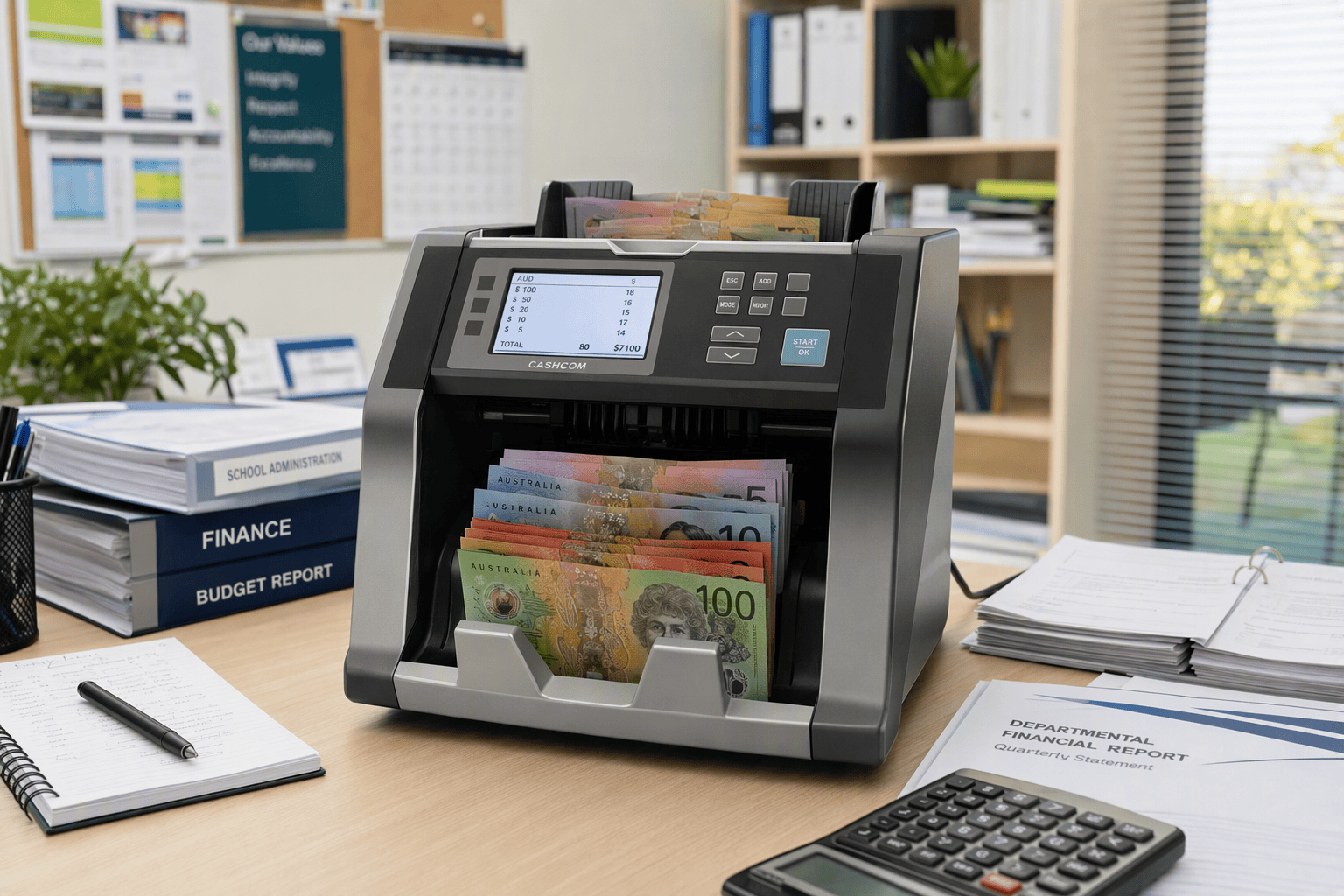
| Quick Answer
For the large majority of Australian schools, councils, universities, hospitals, and government departments, the Cashcom H110 is the right notes counting machine: • School canteens, daily operations: H110. Counts a full day’s canteen takings in under 30 seconds with four-method counterfeit detection. • P&C fundraisers, school fetes, community events: H110 in Add mode. Accumulates the total across multiple loads from multiple stalls without resetting. • Council counter, government payment desk: H110. Serial number logging and LAN connectivity meet the audit trail expectations of public sector finance. • Universities, hospitals, large departments with higher daily volume: H110 for most; consider the LS-200 only if daily note counts consistently exceed 600 notes per session. |
Why Public Sector Cash Handling Has Specific Requirements
Schools, local councils, government departments, and public institutions handle cash in a context that differs from private retail in one important way: the accountability standard is higher, not lower.
A retailer reconciles the till against the POS and keeps an internal record. A school P&C treasurer reconciling a fundraiser must produce financial records that can withstand scrutiny from the school principal, the P&C committee, the Department of Education, and potentially an external auditor. A council officer processing rate payments at a counter must produce records consistent with the Local Government Act requirements in their state. A public hospital cafeteria cashier operates within procurement and financial management frameworks that private businesses are not subject to.
The cash volumes involved are often modest compared to a busy retailer — but the accountability requirements are not. A notes counting machine for public sector use needs to be accurate, to produce a traceable record, and to be reliable enough to be trusted over many years of use across potentially multiple operators.
This guide sets out what Australian public sector organisations should look for, and confirms that the same commercial-grade equipment that serves banks and CIT operators is accessible and appropriate for schools and government departments — at a price point that fits public sector budgets.
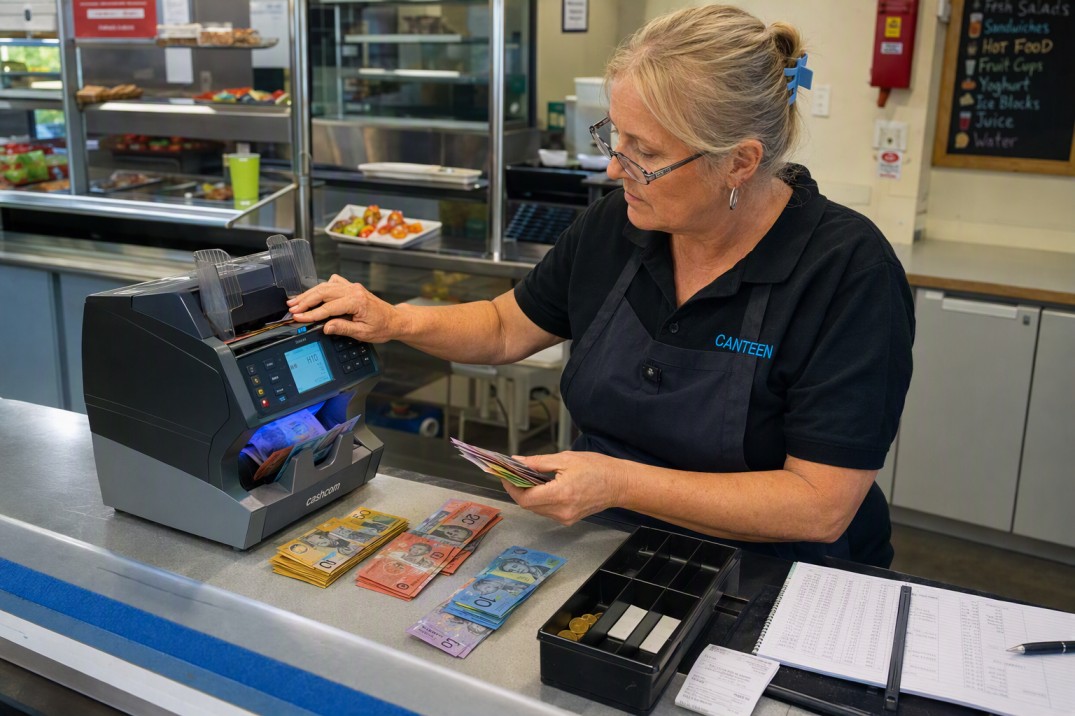
A Day in the LifeIt is 2:30 pm on a Wednesday at a busy primary school in the northern suburbs of Melbourne. The canteen manager has just closed service and is counting the day’s takings — a mixed stack of notes from lunch orders, tuckshop purchases, and a small event levy collected that morning for the upcoming excursion. Without a machine, she counts by hand — typically 8–10 minutes, with a recount to verify. The total goes into the cash book, which the school business manager reviews each week. If the count is wrong, tracing the error requires going back through manual records. With a Cashcom H110 on the canteen bench, the count takes under 30 seconds. The display shows the value total. She exports the session record via USB for the business manager’s weekly reconciliation. If a discrepancy appears, the serial number log identifies exactly which notes were in that session. The machine also flagged a $20 note with a degraded UV feature — set aside for inspection rather than going into the deposit. |
The Public Sector Cash Handling Context
Schools: Canteen, Events, and P&C
Australian school cash handling spans multiple contexts with different volume and frequency profiles. The school canteen may operate daily, handling 50–200 notes from student lunch orders. School events — sport carnivals, excursions, fundraising days — generate occasional high-volume cash counting requirements that dwarf the canteen’s daily take. The P&C committee’s annual fete may process $15,000–$30,000 in cash across a single day, arriving in multiple bags from different stalls.
Each of these contexts has different volume characteristics but the same accountability requirement: a traceable, accurate count record that can be presented to the school’s finance committee, auditors, or the relevant state education department.
Local Councils
Council offices handle cash at rates payment counters, permit desks, and venue hire collection points. Daily volumes are typically 100–350 notes, from a diverse mix of residents and businesses. The audit trail requirement is formal — council financial management is governed by the Local Government Act in each state, and cash handling procedures must produce records suitable for internal audit and, if required, external review.
State and Federal Government Departments
Government agencies with public-facing counter services — licensing, regulatory fees, court fines, passport offices — process cash from members of the public in controlled environments. The cash handling process is typically defined by internal financial management frameworks, and the machine’s output must integrate with departmental reporting systems via LAN or USB export.
Public Hospitals and Universities
Public hospitals handle cash at cafeterias, pharmacies, gift shops, and patient account desks. Universities process cash at student service centres, ticketing, and campus retail operations. Both operate within larger institutional financial management frameworks with regular audit cycles. Volume ranges from light (hospital gift shop) to moderate (university student services during enrolment period).
Emergency Services and Property Management
Police, courts, and emergency services handle cash in a specific accountability context — seized cash, court-ordered payments, and property management require per-note traceability at a standard comparable to CIT operations. Serial number logging on the H110 meets this requirement.
What to Look For in a Notes Counting Machine for Public Sector Use
| Feature | Why It Matters in Schools / Government | H110 |
| UV + MG + IR + CIS detection | Public sector cash often comes from community members and events — diverse note sources mean real counterfeit exposure despite lower volume | Dual CIS |
| Value counting (mixed denoms) | Canteen floats, event takings, and council payment counters all produce mixed-denomination stacks needing a dollar total for reconciliation | Yes |
| Serial number logging | Public accountability requirements mean every cash transaction should be traceable — serial logs support audit and fraud prevention | Yes |
| LAN / USB connectivity | Exportable count records for finance team, school business manager, or department audit without physical presence at the machine | LAN + 2x USB + Serial |
| Optional receipt printer | Physical signed count receipts for event floats, P&C handovers, or council counter transactions requiring a paper record | Optional |
| Add mode | Counting event cash in multiple hopper loads without losing the running total — essential for school fetes and community fundraisers | Yes |
| 12-type fitness detection | School fete and community event cash includes heavily circulated notes — fitness detection separates unfit notes for RBA return | Yes |
| Commercial-grade build | A school or government machine may be used by multiple people across its life — build quality for intermittent but long-term use | Yes |
| Local AU service and support | Machines in schools and government departments need service support without long overseas wait times for parts or repairs | Cashcom AU |
Notes Counting Machine Use Cases: Australian Public Sector
The table below maps common public sector cash handling contexts to their typical session volume and the recommended Cashcom configuration.
| Organisation Type | Cash Handling Context | Frequency | Notes/Session | Recommended |
| Primary / secondary school | Canteen, excursions, P&C fetes, sport carnivals | Daily (canteen) + occasional events | 50–300 | H110 |
| University / TAFE | Student services, events, campus retail | Daily to weekly | 100–400 | H110 |
| Local council | Rates counter, permits, parking fines, venue hire | Daily | 100–350 | H110 |
| State government department | Counter fees, licensing, regulatory payments | Daily | 100–500 | H110 |
| Public hospital | Cafeteria, pharmacy, gift shop, patient accounts | Daily | 150–400 | H110 |
| Community / sporting club | Bar, canteen, entry fees, raffles | Event-based | 100–600 | H110 |
| Emergency services / police | Property management, seized cash processing | Irregular but high accountability | Variable | H110 |
| School P&C / fete committee | Annual or biannual fundraising events | Occasional — high volume in bursts | 200–1,500 | H110 (Add mode) |
Why Consumer-Grade Machines Are Not Appropriate for Public Sector Use
The temptation for schools and government departments on constrained budgets is to purchase a low-cost consumer-grade cash counting machine from a general retailer. This is understandable — the upfront cost is lower. But consumer machines are not appropriate for public sector cash handling for three reasons:
- UV-only detection: consumer machines typically check UV only. Modern counterfeit AUD polymer notes can pass UV detection. A school or council accepting cash from the public through a UV-only machine is accepting more counterfeit risk than its financial management framework assumes. For the full explanation, see: Cash Counting Machine with UV Detection: Is It Enough in 2026?
- No serial number logging: consumer machines display a count total and nothing more. There is no per-note record, no exportable session data, and no audit trail. For a school business manager or council finance officer, this is a material accountability gap.
- Not rated for sustained use: consumer machines are designed for occasional, light use. A school canteen running the machine daily, or a council counter using it across staff shifts, will exceed the design parameters of a consumer machine within 12–18 months. Commercial-grade build quality — standard on the H110 — is what sustains reliable daily operation across a multi-year service life.
See also: Commercial vs Consumer Cash Counting Machines: Why the Difference Matters — for a full side-by-side breakdown.
The School Fete and Community Event Scenario
The school fete is one of the most challenging cash counting machines scenarios in any sector — not because the volume is overwhelming, but because it arrives in an unpredictable pattern across a single day, from multiple independent stall operators, with volunteers who may not be experienced cash handlers.
A P&C treasurer counting the day’s fete proceeds at 5:00 pm faces a collection of bags from each stall — each containing a mixed, uncounted pile of notes accumulated over five or six hours. The total may be $12,000–$25,000 across 10–15 bags. Counting by hand takes 1–2 hours. A counting error in any bag creates a reconciliation problem that is difficult to trace after the stall operators have gone home.
With a Cashcom H110 in Add mode:
- Each bag is processed in a separate hopper load. The machine accumulates the running total across all loads without resetting.
- Each load’s subtotal is recorded before moving to the next bag — providing a per-stall breakdown for the committee’s report.
- The full fete total is confirmed in under 20 minutes for a typical community event.
- Serial number logging provides a per-note record for the complete day’s collection.
For a P&C committee that holds an AGM the following month and presents financial accounts to the school community, this is the kind of verifiable record that protects the treasurer and the organisation.
Using Add Mode for Event CountingAdd mode accumulates a running total across multiple hopper loads without resetting between them. For school fetes, community fundraisers, and multi-stall market events: • Load bag 1 → machine counts and displays subtotal. Record the subtotal against the stall name. • Stay in Add mode → load bag 2. Machine adds to the running total. • Continue → load each stall bag in sequence. Running total accumulates. • Final load → display shows the combined total for the entire event. The H110’s 500-note hopper handles most individual stall bags in a single load. For very large stalls, a second load in Add mode continues the accumulation seamlessly. |
The Recommended Machine: Cashcom H110
| Cashcom H110 — Best for Schools and Government Departments
The right machine for public sector organizations needing reliable daily or event-based cash counting machine with a full audit trail Detection: Dual CIS + UV + MG + IR (4-method simultaneous) Speed: 720 notes per minute Hopper / Stacker / Reject: 500-note / 200-note / 100-note Fitness Detection: 12-type fitness detection Serial Numbers: Full serial number logging Connectivity: LAN + 2x USB + Serial + optional printer Compliance: CE, CB, FCC certified Verdict: The H110 is the right machine for the large majority of Australian schools, councils, universities, hospitals, and government departments. Its 500-note hopper handles a full school canteen day or a council counter shift in a single load for most operations; Add mode accumulates across multiple loads for high-volume event counting. Serial number logging, LAN connectivity, and the optional printer port meet the audit trail and accountability standards that public sector organisations require. Commercial-grade build quality means the machine serves a school or department reliably for years, not months. View product → https://cashcom.com.au/products/h110 |
| Quick Calculation
A school canteen business manager spending 10 minutes per day manually counting and verifying the day’s takings, across a 200-day school year, spends approximately 33 hours per year on canteen cash counting machines. With a Cashcom H110, the same count takes under 60 seconds per session — returning approximately 30 hours per year to the business manager for other tasks. Across a five-year machine life, that is 150 hours of administrative time recovered from a single piece of equipment. |
Procurement and Budget Considerations for Public Sector Buyers
Fitting Within Procurement Frameworks
Australian schools, councils, and government departments typically purchase equipment through structured procurement frameworks — either a direct purchase threshold, a quote process, or a panel arrangement. For most public sector buyers, a Cashcom H110 sits well within the direct purchase or minor procurement threshold, avoiding the need for a formal tender process.
If your organisation requires three quotes, Cashcom can provide a formal quotation on official letterhead for procurement purposes. Contact the team on 0451 353 676 or sales@cashcom.com.au.
Asset Registration and Useful Life
Public sector financial management typically requires capital assets to be registered and depreciated. A commercial-grade notes counting machine like the H110 has a useful life of five or more years under normal public sector use — appropriate for asset register classification. Consumer-grade machines purchased at lower upfront cost typically do not reach this useful life under sustained use, creating a hidden total cost of ownership that exceeds the commercial machine over the same period.
Multi-User Environments
Schools and government departments often have multiple staff members who may use the machine across its life — administration staff, canteen managers, finance officers, volunteers. The H110’s straightforward operating procedure requires minimal training. Serial number logging means each session’s count is traceable regardless of which operator ran it.
Signs Your Organisation Should Buy — and Signs You Can Probably Wait
Why You Should Buy Now?
- Your daily or regular cash counting is taking more than 5 minutes by hand.
- Your current machine is a consumer-grade model without serial number logging or multi-layer detection.
- Your audit framework requires a traceable, exportable count record that your current process does not produce.
- You run an annual fete or community fundraiser where cash counting at the end of the day takes over an hour.
- You have had a discrepancy that was difficult to trace due to the absence of a per-note record.
Signs You Can Probably Wait
- Your cash volume is genuinely minimal — under 30 notes per session, a few times per month — and manual counting takes under two minutes.
- Your organisation is primarily cashless or moving toward cashless operations, with only occasional small cash transactions.
- Your current machine is commercial-grade, functioning reliably, and your volume is well within its rated capacity.
| Our Honest Assessment
Public sector organisations are often more cautious buyers than private businesses — which is entirely appropriate. We are not going to suggest that a primary school with a canteen averaging $200 per day in cash needs anything more than an H110, or that a council counter with light daily volume needs the throughput of an LS-200. What we will say clearly is this: the accountability requirements of public sector cash handling are real, and a consumer-grade machine without serial number logging, multi-layer detection, and commercial-grade build quality does not meet those requirements — regardless of its price. The H110 is priced to be accessible to public sector budgets while meeting the accountability standard that government and educational institutions need. |
Frequently Asked Questions
| Question | Answer |
What is the best notes counting machine for a school in Australia? |
For most Australian schools — canteen operations, P&C fundraisers, and event cash counting — the Cashcom H110 is the right machine. It provides four-method counterfeit detection, value counting, serial number logging, and Add mode for accumulating totals across multiple event bag loads. |
Do government departments need a commercial-grade cash counter? |
Yes. Public sector cash handling has audit trail and accountability requirements that consumer-grade machines — which typically have UV-only detection and no serial number logging — cannot meet. A commercial machine like the H110 provides the traceable count records that government financial management frameworks require. |
How does a notes counting machine help with school fete cash counting? |
Using Add mode, the H110 processes each stall’s bag as a separate load while accumulating a running total across all loads. A 15-stall school fete with $20,000 in total cash can be fully counted and verified in under 20 minutes, with a per-stall breakdown and a complete serial number log for the P&C treasurer’s records. |
Can a school or government department use a cheap cash counter from a general retailer? |
Consumer-grade machines are not appropriate for public sector use. They typically offer UV-only detection (insufficient for commercial use in 2026), no serial number logging, and a build quality not rated for sustained daily use. Over a three-to-five-year asset life, the total cost of replacement consumer machines typically exceeds the cost of a single commercial machine with better performance throughout. |
What connectivity does the Cashcom H110 offer for government reporting systems? |
The H110 includes LAN, 2x USB, and Serial connectivity, plus an optional printer port. Count records and serial number logs are exportable via USB to a connected computer, or via LAN to a network-connected reporting system. Contact Cashcom to confirm data format compatibility with your department’s financial management system. |
Is the Cashcom H110 suitable for procurement through a government quote process? |
Yes — Cashcom can provide a formal quotation on official letterhead for organisations requiring three quotes or formal procurement documentation. Contact the team on 0451 353 676 or sales@cashcom.com.au. |
Talk to Cashcom About Your Organisation
Whether you are a school business manager, a council finance officer, or a government department procurement contact, Cashcom can provide product specifications, formal quotation documentation, and advice on the right configuration for your cash handling requirements.
Call: 0451 353 676 | Email: sales@cashcom.com.au | Web: cashcom.com.au
Also see: How to Use a Cash Counting Machine: Step-by-Step Guide — for the correct operating procedure, including how to use Add mode for multi-load event counting.
About the Author
This article was prepared by the Cashcom Team, Australian Cash Handling Specialists since 2015. Cashcom supplies and services cash counting, sorting and recycling equipment for retail, hospitality, banking, gaming, cash-in-transit, and public sector organisations across Australia.
Get in touch: 0451 353 676 | sales@cashcom.com.au | cashcom.com.au