
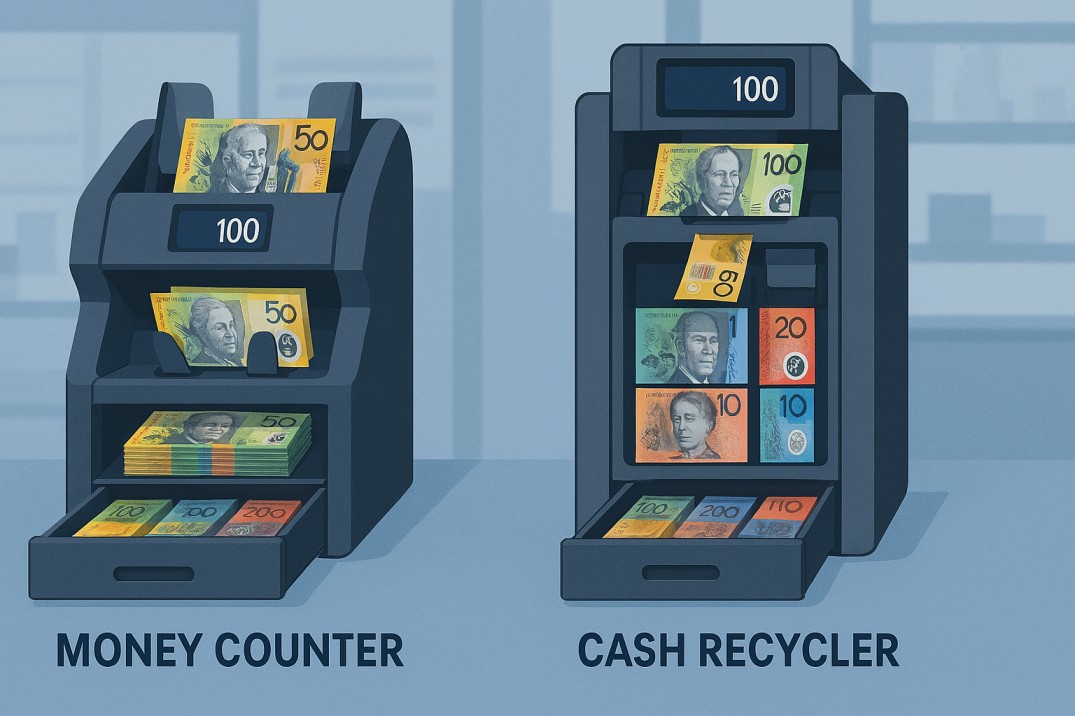
If you have been researching cash handling equipment for your business, you may have come across two terms used almost interchangeably — money recycler and money counter. They sound similar. They both process banknotes. They both count and authenticate. But they are fundamentally different pieces of equipment designed for different operational needs, and choosing the wrong one is an expensive mistake.
This guide explains exactly what separates a money recycler from a money counter, which businesses in Australia need each one, and how to make the right decision without overcomplicating the process.
| Quick answer:
A money counter counts and authenticates banknotes, then requires manual redistribution. A money recycler — also called a cash recycler or notes recycler — does all of that plus stores notes and dispenses them on demand as change or float without any manual handling. For most Australian small and medium businesses, a money counter is the right tool. For high-volume operations with active float distribution needs, a money recycler pays its way. |
What Is a Money Counter?
A money counter — also called a notes counting machine, cash counter, or cash counting machine — is an automated device that processes a batch of banknotes through a sensor array, counting the quantity and value of notes while simultaneously authenticating them for counterfeits and damage.
You load a stack of notes into the hopper, press start, and within seconds you have a total value, a denomination breakdown, and any suspect notes separated into a reject pocket. The process is one-directional: notes go in, get counted and authenticated, and come out in a sorted stack.
What the money counter does not do is store notes for later dispensing. After counting, a person physically takes the notes and does whatever is needed with them — preparing banking bundles, replenishing a till float, or transferring cash to a safe. The money counter’s job ends when the count is complete.
| Examples of professional money counters in the Cashcom range:
H110 Cash Counting Machine (720 notes/min, Dual CIS, bank-grade detection) — ideal for small to medium businesses. |
What Is a Money Recycler?
A money recycler — also called a cash recycler, notes recycler, or cash recycling machine — processes banknotes through the same counting and authentication steps as a money counter, but then stores the authenticated notes in secured internal cassettes and makes them available to be dispensed on demand.
This is the defining characteristic: a money recycler closes the loop. Notes go in, get authenticated, get sorted and stored — and can come back out again as change, float replenishment, or petty cash, all without a person physically handling the notes. Every transaction, both deposit and withdrawal, is logged with a timestamp, an employee identifier, and a denomination breakdown.
The term money recycler, cash recycler, and notes recycler all describe the same type of equipment. The terminology varies by industry — banks typically say cash recycler, gaming venues often say money recycler, and some retail operations use notes recycler. The function is identical regardless of the label.
| Example of a money recycler in the Cashcom range:
K2 Cash Recycler Sorter Machine — 1,000-note hopper, 1,000 notes/min value counting, UV + MG + IR + CIS full 4-method detection, denomination-to-fitness sorting in one pass, up to 7 currencies simultaneously, optional TITO ticket detection for gaming environments. |
The 7 Key Differences Between a Money Recycler and a Money Counter
The table below puts the two side by side across every dimension that matters for a buying decision:
| Feature | Money Counter | Money Recycler |
| Primary function | Count + authenticate notes | Count + authenticate + store + dispense notes |
| Note dispensing | ❌ | ✅ |
| Denomination sorting | ✅ | ✅ |
| Counterfeit detection | ✅ | ✅ |
| Serial number logging | ✅ | ✅ |
| Per-employee audit trail | ❌ | ✅ |
| Float replenishment | Manual | Automated |
| Cash available on demand | ❌ | ✅ |
| Multiple staff access | Varies | Built-in PIN access control |
| Typical business scale | 1–3 tills | 5+ tills or continuous cash flow |
| Price point | Lower | Higher |
| Complexity | Simple | More complex setup |
| Best for | End-of-day reconciliation | All-day cash cycle management |
The table tells the story clearly. A money counter is a tool for reconciliation — you bring cash to it at end of shift, it tells you what you have, and you prepare your banking. A money recycler is a tool for cash cycle management — it handles deposits and withdrawals throughout the day as part of ongoing operations.
How Each Machine Works in a Real Business — Day in the Life
A Day with a Money Counter
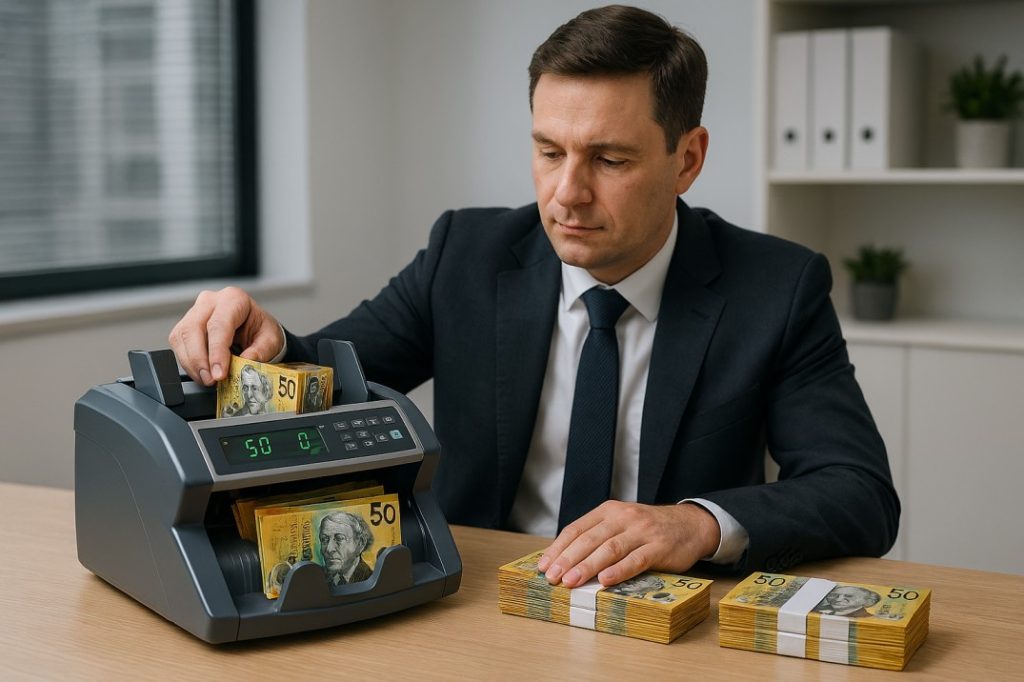
A retail store with three tills closes at 6pm. The manager removes the cash drawer from each till and brings it to the back office. Each drawer is counted through the Cashcom H210 Money Counter and Sorter — denomination totals appear on screen, suspect notes go to the reject pocket, and the authenticated stack is sorted by denomination automatically. The manager records the totals, prepares the banking bundles, and locks the day’s takings in the safe. Total time: approximately 15 minutes per till, 45 minutes for all three. Tomorrow morning, the manager manually prepares each till’s opening float from the safe.
This is the right workflow for this business. The money counter does everything needed, costs appropriately for the scale, and requires no additional complexity.
A Day with a Money Recycler
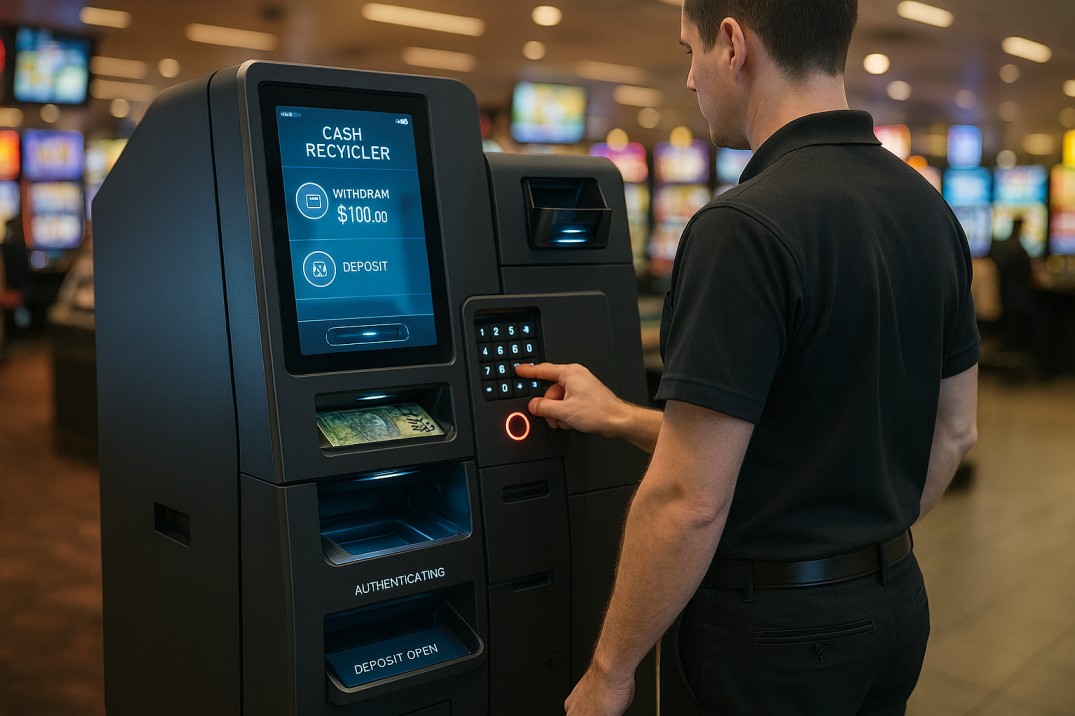
A licensed club opens at 10am. Throughout the day, multiple cashiers rotate across the bar, gaming floor, and membership desk. Every hour or two, gaming machine attendants make cash drops to the central cash recycler. When a bar cashier runs low on $10 notes, they log in with their PIN and request a $100 withdrawal in $10s — the machine dispenses exactly $100 in $10 notes. When a membership cashier collects $500 in $50s from a private function, they deposit it via the machine. At 11pm close, the manager pulls the day’s transaction report — a complete log of every deposit and withdrawal, by employee, denomination, and timestamp. Banking preparation is largely automatic because the machine has been sorting and authenticating notes throughout the day.
This is the right workflow for this business. The money recycler manages cash flow actively throughout the operating day, not just at close. The audit trail provides accountability across a large rotating staff. A money counter could not replicate this workflow.
Who Needs a Money Counter vs Who Needs a Money Recycler
Choose a Money Counter If…
- You count cash once per day — typically at end of trading
- You have 1–4 tills or service points
- Your daily note volume is under 5,000 notes
- You do not need to dispense notes from a central machine during the trading day
- You are a: café, restaurant, small retail store, boutique, market stall, small club, hotel reception, or service counter
Choose a Money Recycler If…
- Multiple staff make cash deposits and withdrawals throughout the day
- You have 5+ tills or service points with active float management
- Your daily note volume exceeds 5,000 notes regularly
- You need a complete per-transaction audit trail by employee
- Cash is handled continuously across multiple shifts, not just end-of-day
- You are a: licensed club, gaming venue, large supermarket, casino, entertainment venue, large hospitality group, or hotel with multiple revenue points
If you are still unsure which category your business falls into, the simplest test is this: do you currently need to physically carry change from a cash room or office to your service points multiple times per day? If yes, a money recycler machine automates that process. If your cash flow is primarily one-directional (tills collect cash all day, you count it all once at close), a money counter is the right tool.
5 Real-World Scenarios — Which Machine Wins?
| Scenario 1: A Café with 2 Tills
Daily cash takings of approximately $1,500. One manager counts both tills at 5pm. Staff are experienced and consistent. No float replenishment needed during trading. |
| Scenario 2: A Licensed Club with Gaming and Bar
Operating 10am–midnight, 3 bar staff per shift, gaming machine runs every 2 hours. Cash deposits and float withdrawals happen throughout the day. Large rotating staff across 7 days. Best choice: Money Recycler — K2 Cash Recycler |
| Scenario 3: A 10-Till Supermarket
Continuous trading, till top-ups needed 3–4 times per day, shift changes every 4 hours. Cash office manager handles all float distribution manually — currently taking 3 hours per day. Best choice: Money Recycler — K2 Cash Recycler |
| Scenario 4: A Small Hotel with Bar and Restaurant
Two separate revenue points, one manager does end-of-day count for both. No mid-day float issues. Daily note volume under 2,000. |
| Scenario 5: A Medium Retail Store, 4 Tills, Growing
Currently counting manually, expanding to 6 tills next year. No gaming or continuous float needs. End-of-day reconciliation is the primary use case. Best choice: Money Counter now (LS-200) — upgrade path to Recycler when volume justifies |
Money Recycler vs Money Counter: Cost Comparison
The price difference between a professional money counter and a money recycler machine reflects the significant difference in capability and complexity. Here is a realistic framework:
| Cost Factor | Money Counter | Money Recycler |
| Purchase price range | Lower | Higher |
| Installation complexity | Simple — plug and use | Moderate — setup and config |
| Staff training time | Minutes | Hours |
| Maintenance requirements | Low | Moderate |
| Annual running cost | Minimal | Moderate |
| ROI driver | Staff time saved at reconciliation | Staff time + shrinkage + float management |
| Payback period (typical) | Weeks to months | 12–24 months |
The ROI calculation for a money recycler machine is compelling when the conditions are right — primarily when labour cost of manual float management is high and shrinkage is a genuine issue. When these conditions are not present, the simpler economics of a money counter almost always win.
Cashcom’s Recommendation: Which Should You Buy?
Having supplied both money counters and money recycler machines to Australian businesses, banks, clubs, and CIT operators since 2015, we give every client the same honest answer: buy the machine that matches your actual workflow today, with a clear upgrade path for when your operation grows.
If you need a money counter:
Start with the H110 (720 notes/min, Dual CIS, bank-grade detection, LAN connectivity) or step up to the H210 (900 notes/min, denomination sorting) or LS-200 (1,500 notes/min, 18-channel MG) based on your volume and sorting requirements. All three provide professional-grade counterfeit detection and are configured for Australian polymer notes.
If you need a money recycler:
The K2 Cash Recycler Sorter Machine is the recommended solution — 1,000-note hopper, 1,000 notes/min, full 4-method detection, denomination-to-fitness sorting in one pass, up to 7 currencies, and optional TITO integration for gaming. It is the most capable back-office cash recycler in the Cashcom range.
If you are not sure:
Call the Cashcom team on 0451 353 676. We will ask you three questions — how many tills you have, your daily note volume, and whether you need mid-day float dispensing — and give you a direct recommendation in under five minutes. No obligation, no sales pressure.
Frequently Asked Questions
Q: Is a money recycler the same as a cash recycler or notes recycler?Yes — money recycler, cash recycler, and notes recycler are all terms for the same type of equipment. They describe an automated cash handling machine that accepts, authenticates, sorts, stores, and dispenses banknotes as part of a continuous cash cycle. The terminology varies by industry but the function is identical. In Australia, gaming and hospitality venues tend to use ‘money recycler’, retail operations often say ‘cash recycler’, and the broader cash handling industry uses all three interchangeably. |
Q: Can a money counter dispense notes like a money recycler?No. A money counter processes notes in one direction only — notes go in, get counted and authenticated, and come out in a sorted stack. A money counter cannot store notes internally or dispense them on demand. If your operation requires automated note dispensing as well as counting, a money recycler machine is the appropriate equipment. For counting only, a professional money counter is simpler, cheaper, and does the job perfectly. |
Q: Do money recyclers also detect counterfeit notes?Yes. Professional money recycler machines include the same counterfeit detection methods as professional money counters — UV, magnetic (MG), infrared (IR), and CIS colour image detection. The Cashcom K2 Cash Recycler uses all four methods simultaneously on every note. Counterfeit and damaged notes are rejected to a separate reject pocket and never enter the storage cassettes. The authentication step is built into the deposit process, not a separate pass. |
Q: How much more does a money recycler cost than a money counter?Money recycler machines are more expensive than professional money counters, reflecting the significantly greater complexity of the equipment. Contact Cashcom on 0451 353 676 for current pricing on both the K2 Cash Recycler and the H110/H210/LS-200 money counters. Our team can help you build a business case for which investment is justified based on your daily volume and current staff time costs. |
Q: Which businesses in Australia use money recycler machines?Licensed clubs, gaming venues, large supermarkets, casinos, entertainment venues, and large hospitality groups are the most common users of money recycler machines in Australia. These businesses share common characteristics: high daily cash volumes, multiple staff accessing the same cash pool across multiple shifts, active float distribution throughout the day, and strong accountability requirements. Most small and medium businesses — cafés, retail stores, restaurants, small clubs — are better served by a professional money counter. |
Q: What is the difference between a money recycler and a smart safe?A smart safe accepts deposits and records them but cannot dispense notes — it is a one-way secure storage device with counting capability. A money recycler accepts deposits AND dispenses notes on demand, completing the full cash cycle. Smart safes are useful for overnight secure storage and branch-level accountability. Money recyclers are used for active all-day cash management where dispensing is a genuine operational requirement. |
Q: Where can I buy a money recycler machine in Australia?Cashcom supplies the K2 Cash Recycler Sorter Machine — our recommended back-office money recycler — to businesses across Australia from our Sydney base at 181 Parramatta Rd, Haberfield NSW 2045. We ship to all states and territories. View the K2 at cashcom.com.au/product/k2-cash-recycler/, call 0451 353 676, or email sales@cashcom.com.au. Available Monday to Friday, 9am–6pm. |
A money recycler and a money counter are not competing products — they are tools for different operational needs. Understanding which one matches your workflow is the most important decision in the buying process.
For the vast majority of Australian businesses — a café, restaurant, retail store, small club, or hospitality venue — a professional money counter is the right answer. It counts, authenticates, sorts, and provides a denomination breakdown faster and more reliably than any manual process, at a cost that makes clear financial sense. The H110, H210, and LS-200 cover the full range of business sizes from single-till operations to multi-till commercial environments.
For businesses where cash flows continuously throughout the day, multiple staff handle the same cash pool, and automated dispensing would genuinely replace manual float runs — a money recycler machine like the K2 Cash Recycler pays its way. The operational savings in staff time and the accountability gains from per-transaction logging justify the higher investment for the right operation.
To discuss which machine is right for your business, call Cashcom on 0451 353 676, email sales@cashcom.com.au, or browse the full range at cashcom.com.au/products. Our team has been helping Australian businesses choose the right cash handling equipment since 2015.