
| Quick Answer
For most Australian petrol stations and service centres, the right cash counting setup is: · Single till, standard volume: Cashcom H110. Covers a full shift count in a single hopper load with four-method counterfeit detection. · Multi-till or attached convenience store: Cashcom H110 or H210. H210 if denomination sorting for banking is part of the closing process. · High coin volume (car wash, convenience, forecourt vending): pair the H110 or H210 with a Cashcom Con200 coin sorter. Note counters do not handle coins. · 24-hour operations or multi-shift: H110 with serial number logging for per-shift accountability across staff handovers. |
Why Petrol Stations Are a Distinct Cash Handling Environment
A petrol station is not a standard retail outlet. The cash handling environment at an Australian servo has a specific character that shapes what the machine needs to do — and how quickly it needs to do it.
First, the cash mix is genuinely diverse. A busy service centre takes cash from fuel sales (typically $50–$100 note transactions), convenience store purchases (mixed denominations including frequent $5 and $10 notes), car wash tokens, and sometimes food service. The result is a mixed-denomination note stack that varies significantly in composition between shifts.
Second, the turnaround pressure is real. A petrol station running multiple shifts across a 16- or 24-hour day needs shift changeovers completed quickly. The outgoing attendant’s float needs to be counted and the incoming attendant’s float prepared in a minimal window — a process that manual counting makes slow and error-prone at the end of a long shift.
Third, coin volume is genuinely significant. Car wash machines, forecourt drink vending, and convenience store change all generate coin accumulation that manual counting makes particularly time-consuming. A note counter alone does not solve this.
Finally, counterfeit exposure is elevated. A 24-hour servo running minimal staff during overnight hours, under artificial lighting, accepting cash from a wide range of customers — including interstate travellers and after-hours transactions — is one of the more vulnerable cash-accepting environments in retail.
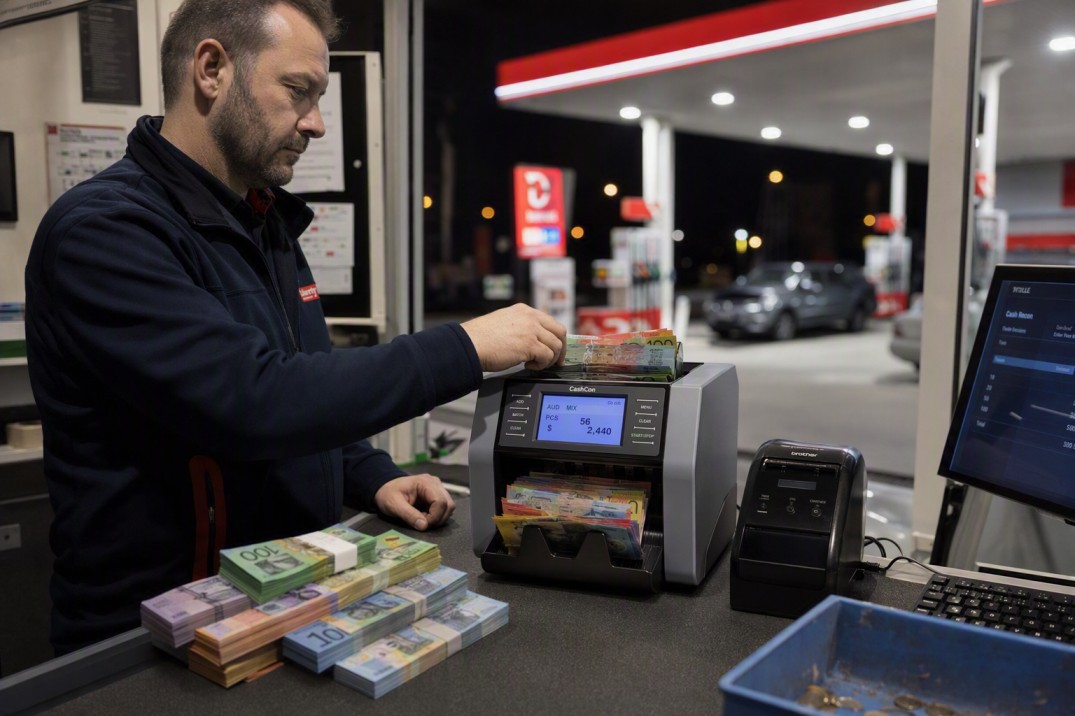
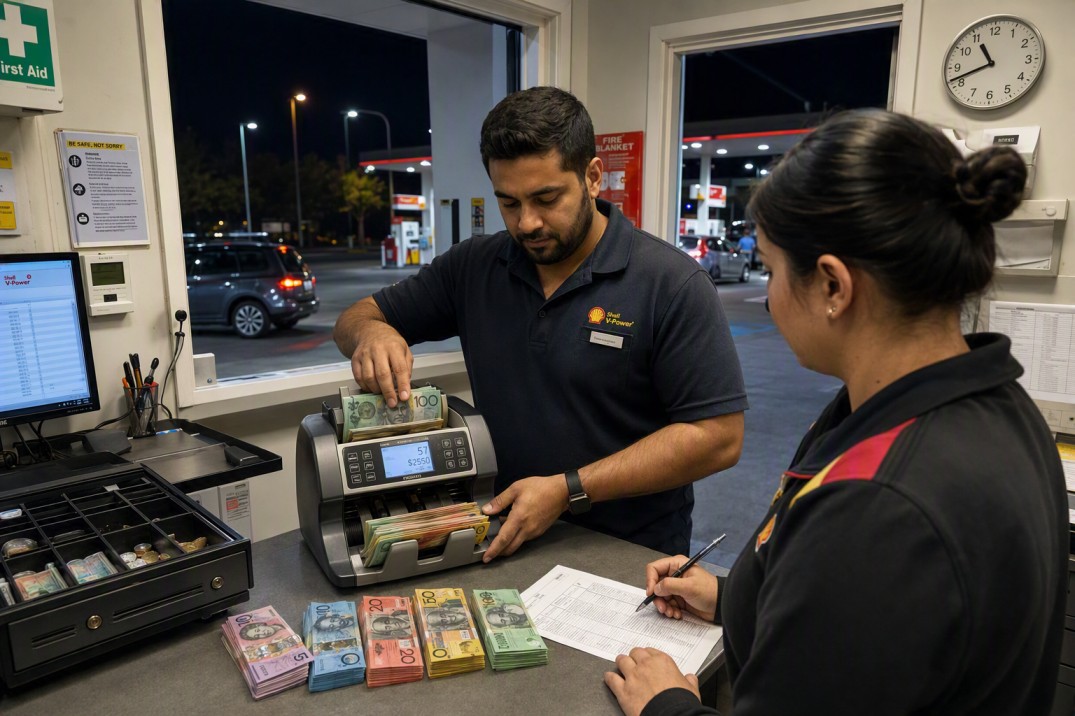
A Day in the LifeIt is 10:45 pm on a Friday night at a busy servo on the outskirts of Brisbane. The afternoon shift is handing over to the overnight attendant. The outgoing staff member has a till drawer with a mixed stack of approximately 280 notes from fuel sales, convenience, and a car wash machine collection. Without a machine, the handover count takes 12–15 minutes — manual counting, recounting, and writing the tally for the incoming staff member. With a Cashcom H110 on the back-office bench, the stack is fanned, loaded, and counted in under 25 seconds. The display shows the value total. The outgoing staff member writes the number, the incoming attendant witnesses it, and both sign the handover record. The physical count is done in under two minutes. The machine also authenticated every note across four detection layers — including a $50 note from the car wash collection that flagged in the reject pocket and turned out to be a low-quality counterfeit. |
What a Cash Counting Machine Needs to Do at a Petrol Station
Count Quickly Enough for Shift Changeover Windows
Shift handovers at a petrol station happen in the forecourt, with a customer queue potentially waiting. The cash count needs to be completed in the back office in minutes — not quarter of an hour. At 720 notes per minute, the H110 processes a 280-note shift stack in under 25 seconds. Including load time and reading the display, a full shift count is done in under two minutes. That is the difference between a handover that keeps the forecourt moving and one that backs it up.
Handle Mixed Denominations from Multiple Revenue Streams
Fuel sales, convenience store purchases, and car wash collections all feed into the same till, generating a mixed-denomination stack that changes character shift by shift. Value counting mode — standard on both the H110 and H210 — identifies each denomination automatically and produces a combined dollar total without manual addition. This is the figure used to verify the shift against the POS total and prepare the banking deposit.
Detect Counterfeits Accepted Under Pressure
Overnight and peak-hour transactions at a petrol station are accepted under conditions that are not ideal for manual counterfeit detection: artificial forecourt lighting, time pressure, a queue of waiting customers. A machine with four-method detection (UV + MG + IR + CIS) provides consistent authentication regardless of those conditions.
UV-only detection — common on consumer-grade machines and some budget commercial models — is not adequate for a high-volume public-facing cash environment in 2026. See our companion guide: Cash Counting Machine with UV Detection: Is It Enough in 2026? for the full explanation of why UV alone falls short.
Support Multi-Staff Shift Accountability
A petrol station running multiple shifts across multiple staff members needs a way to attribute each shift’s cash count to the specific attendant who conducted it. Serial number logging — standard on the H110 — records every note processed in a session, exportable via LAN or USB for management records. Combined with a signed handover record, this creates the shift-level accountability trail that franchise operators and independent managers both need.
Handle the Coin Volume Problem
Car wash machines, forecourt vending, and convenience store change all generate significant coin accumulation at a busy servo. A note counter does not handle coins — this is a separate machine requirement. For petrol stations with meaningful daily coin volume, pairing the H110 with a Cashcom Con200 coin sorter completes the cash handling setup: notes through the H110, coins through the Con200, both processed simultaneously at end of shift.
For the full decision on when a coin sorter is needed alongside a note counter, see: Coin Counter and Note Counter Combo: Do You Need Both, or Will One Machine Do?
Features to Look For in a Petrol Station Cash Counting Machine
| Feature | Why It Matters at a Petrol Station | H110 | H210 |
| Dual CIS + UV + MG + IR | High public-facing cash volume; time-pressured acceptance; counterfeit risk real | Yes | Yes |
| Value counting | Mixed denominations from fuel + store sales counted to a dollar total for POS reconciliation | Yes | Yes |
| 500+ note hopper | Busy servo counts 300–500 notes per shift — single-load operation essential | 500 | 500 |
| Denomination sorting | Multi-till servos with attached store benefit from sorted output for banking | No | 3-pocket |
| Serial number logging | Accountability across multiple shift staff; discrepancy tracing | Yes | Yes |
| LAN / USB connectivity | Digital count record exportable for manager or franchisor reporting | Yes | Yes |
| 12-type fitness detection | High note wear from fuel/convenience mix — fitness triage for RBA compliance | Yes | Yes |
| Optional receipt printer | Shift handover requires a signed physical count record in many franchise operations | Optional | — |
| Commercial-grade build | Run every day, multiple shifts — not a consumer machine tolerance level | Yes | Yes |
| Local AU service and support | Breakdown at a 24-hour servo is a real operational problem — local service matters | Cashcom AU | Cashcom AU |
Recommended Setup by Servo Type
The table below maps common Australian petrol station configurations to their typical daily note volume and the recommended Cashcom setup.
| Servo Type | Typical Daily Notes | Coin Volume | Tills | Recommended Setup |
| Small rural servo | 100–250 | Moderate | 1 | H110 |
| Metro service station | 200–450 | High | 1–2 | H110 + Con200 |
| Large highway servo / truckstop | 350–700 | High | 2–3 | H110 or H210 + Con200 |
| Franchise servo (e.g. BP, Ampol) | 300–600 | High | 2–3 | H110 + Con200 |
| Servo with attached café/store | 300–700 | Very High | 2–4 | H210 + Con200 |
| Fleet fuel / card-dominant | 50–150 | Low | 1 | H110 (coin volume minimal) |
The Right Cashcom Machines for Petrol Stations
Cashcom H110 — Best for Most Petrol StationsBest for single-till servos and standard volume service stations needing fast, reliable shift counting Detection: Dual CIS + UV + MG + IR (4-method simultaneous) Speed: 720 notes per minute Hopper / Stacker / Reject: 500-note / 200-note / 100-note Fitness Detection: 12-type fitness detection Serial Numbers: Full serial number logging Connectivity: LAN + 2x USB + Serial + optional printer Compliance: CE, CB, FCC certified Verdict: The H110 is the right machine for the large majority of Australian petrol stations. A single-till servo counting a 280-note shift stack processes the entire load in under 25 seconds with full four-method authentication. The 500-note hopper handles even busy peak-day volumes in a single load for most servos. Serial number logging and the optional printer port cover the shift accountability and handover receipt requirements. For servos with significant coin volume, pair with the Cashcom Con200. View product → https://cashcom.com.au/products/h110 |
Cashcom H210 — Best for Multi-Till Servos or Attached StoresBest for larger service centres where denomination sorting supports the banking preparation process Detection: Double-face counterfeit ID, multi-level damage detection Speed: 900 notes/min counting, 750 notes/min sorting Output: 3 pockets — 2 sorted exits + 1 reject Audit: Real-time serial ID queryable by serial number, operator, or batch Verdict: For larger service stations running two or three tills across a convenience store and forecourt operation, the H210 adds denomination sorting in the same pass as counting — producing sorted output ready for banking bundles without a secondary manual sort. The queryable serial ID by operator makes multi-staff shift accountability straightforward. For most standard-volume single-till servos, the H110 is simpler and sufficient. View product → https://cashcom.com.au/products/h210 |
The Counterfeit Risk Context for Petrol Stations
Petrol stations sit in a specific counterfeit risk profile that is worth understanding before choosing a machine:
- High transaction volume from diverse customers: fuel purchases attract a wide range of customers including interstate and long-haul travellers — a more diverse note source than a local neighbourhood café.
- Overnight and after-hours transactions: the overnight shift is particularly vulnerable. Reduced staff, artificial lighting, and time pressure from a waiting queue are conditions under which a counterfeit $50 or $100 note is most likely to be accepted without scrutiny.
- Large denomination transactions: fuel transactions at $80–$150 commonly involve $50 and $100 notes — the denominations most frequently targeted by counterfeiters because the return on a successful fake is highest.
A machine with UV-only detection does not adequately address this risk profile. The H110’s Dual CIS detection — capturing a full-image comparison on every note alongside UV, MG, and IR — provides authentication depth appropriate for a high-volume overnight cash environment.
Building a Fast, Reliable Shift Handover Process
The shift handover at a petrol station is the most time-pressured cash handling event in the operation. A clear, fast process prevents float discrepancies, reduces handover disputes, and gets the incoming attendant onto the forecourt quickly. Here is the recommended procedure with a Cashcom H110:
- Step 1 — Remove float first: before counting, remove the standard float amount from the till drawer and set it aside. Count only the trading notes — the surplus over the float — through the machine.
- Step 2 — Fan and load: fan the trading note stack, load into the H110 hopper, press start. In Add mode if the stack exceeds 500 notes (rare for a single shift at most servos).
- Step 3 — Read and record: the display shows the value total. Both the outgoing and incoming attendant read and record the figure. Both sign the handover sheet.
- Step 4 — Coins separately: if the servo runs a Con200 coin sorter, process the shift’s coin collection simultaneously — both machines can run in parallel.
- Step 5 — Check the reject pocket: inspect any notes in the H110’s reject pocket. Set aside and label for morning review, not overnight investigation.
Total time for steps 1–5: typically under five minutes for a standard single-shift servo count.
Quick CalculationA petrol station running two shift handovers per day — morning and afternoon/evening — with each handover count taking 12 minutes manually versus 3 minutes with the H110, saves 9 minutes per handover. Across 365 days per year, that is approximately 109 hours of staff time returned annually. At award retail wages, that is roughly $2,900–$3,300 in labour value — from a single piece of equipment running every day of the year. |
Signs Your Servo Should Buy — and Signs You Can Probably Wait
Why You Should Buy Now?
- Shift handovers are taking more than 10 minutes and slowing the changeover.
- You have had a counterfeit note accepted during an overnight or after-hours shift.
- Your current machine is a consumer-grade model that is producing inconsistent counts or degrading under daily use.
- You run multiple shifts and have no per-shift accountability trail for cash.
- Manual coin counting at shift end is taking 15+ minutes — you need a coin sorter alongside your note counter.
- A franchise requirement specifies a minimum cash counting standard that your current equipment does not meet.
Signs You Can Probably Wait
- Your servo is primarily card-based with minimal cash transactions — common in newer metro franchise sites.
- You count cash fewer than five times per week and manual counting takes under five minutes.
- Your current commercial machine is working reliably and your daily volume is well within its rated capacity.
Our Honest AssessmentThe H110 is the right machine for most Australian petrol stations — single-till or dual-till operations with standard daily volumes. The shift from manual counting to a machine at a busy servo is one of the clearest time-saving cases in the small business market: the handover count is a daily, non-negotiable task with a predictable time cost that a machine reduces to a fraction. The one caveat worth naming: if your servo is moving increasingly toward card-only transactions and cash volume is genuinely declining, the urgency of the purchase is lower. But for any servo still running meaningful cash volume across multiple daily shifts — and most Australian servos still do — the H110 is the straightforward answer. |
Frequently Asked Questions
| Question | Answer |
What is the best cash counting machine for a petrol station? |
For most Australian petrol stations and service centres, the Cashcom H110 is the right machine — Dual CIS plus UV, MG, and IR detection, 720 notes per minute, 500-note hopper, value counting, and serial number logging. For busy servos with attached convenience stores or multiple tills, the H210 adds denomination sorting in the same pass. |
Do petrol stations need a coin sorter as well as a note counter? |
Most Australian servos benefit from a coin sorter alongside their note counter, particularly those with car wash machines, forecourt vending, or a convenience store. Note counters handle banknotes only. The Cashcom Con200 coin sorter pairs with the H110 to cover both note and coin counting at shift end. |
How long does it take to count a servo till with a cash counting machine? |
A 280-note shift stack takes under 25 seconds at 720 notes per minute on the H110. Including load time and reading the display, a full shift count is done in under two minutes — compared to 12–15 minutes by hand. |
Are petrol stations at higher risk of counterfeit notes? |
Yes — high transaction volume, diverse customer base, large denomination fuel purchases, and overnight/after-hours transactions with minimal staff create elevated counterfeit risk. Four-method detection (UV + MG + IR + CIS) is the appropriate standard for a petrol station cash environment. UV-only detection is not adequate. |
Can a cash counting machine help with shift handovers at a 24-hour servo? |
Yes — a fast, consistent count produced by the machine gives both the outgoing and incoming attendant a verifiable figure at handover, signed and recorded in under two minutes. Serial number logging on the H110 provides a per-shift note record for management accountability. |
| Does the Cashcom H110 work with Australian polymer banknotes? | Yes — the H110 is calibrated and tested for the full family of current and older-series AUD polymer banknotes, including mixed denomination stacks from fuel, convenience, and car wash revenue streams. |
Talk to Cashcom About Your Servo Setup
Whether you are equipping a new service station or replacing a machine that is not keeping up with your shift handover requirements, Cashcom can recommend the right configuration for your till count, shift structure, and cash mix.
Call: 0451 353 676 | Email: sales@cashcom.com.au | Web: cashcom.com.au
Also see: How to Use a Cash Counting Machine: Step-by-Step Guide — for the correct operating procedure to get the most from your machine from the first shift.
About the Author
This article was prepared by the Cashcom Team, Australian Cash Handling Specialists since 2015. Cashcom supplies and services cash counting, sorting and recycling equipment for retail, hospitality, banking, gaming and cash-in-transit businesses across Australia.
Get in touch: 0451 353 676 | sales@cashcom.com.au | cashcom.com.au