
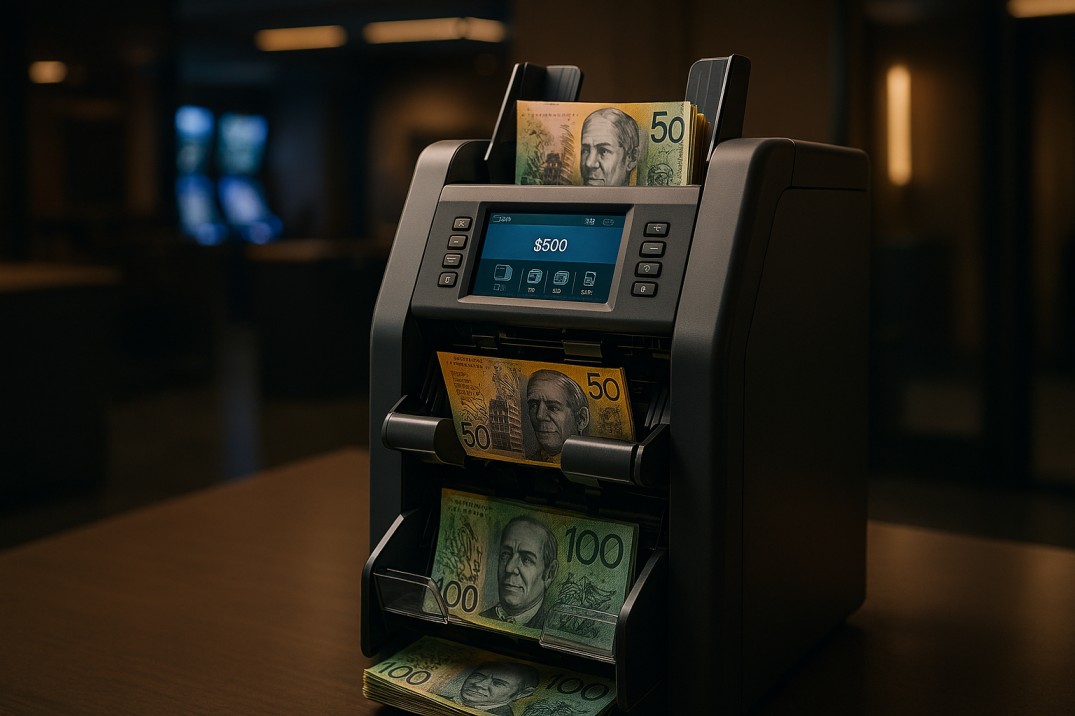
If your business processes significant daily cash — a licensed club, a gaming venue, a large retail operation, or a busy hospitality business — you may have heard the term cash recycler machine without being entirely sure what one does or whether you actually need one.
The short answer: a cash recycler machine is not just a faster money counter. It is a fundamentally different type of equipment that completes the full cash cycle — accepting notes, authenticating them, sorting them, and making them available for redistribution — all in a single automated process. For the right business, a cash recycler machine eliminates multiple manual steps and significantly reduces the labour cost of daily cash management.
For the wrong business, it is an overcomplicated and expensive solution when a professional money counter would do the job better and more cost-effectively. This guide explains both sides honestly, so you can make the right decision for your operation.
| 💡 Quick summary:
A cash recycler machine — also called a money recycler or notes recycler — counts, authenticates, and sorts banknotes while making them available for reuse as change or float without manual handling. Cashcom’s K2 Cash Recycler Sorter Machine is the recommended solution for high-volume Australian businesses. If your daily note volume is below 3,000–5,000 notes, a professional money counter like the H110 or LS-200 is the better fit. |
What Is a Cash Recycler Machine?
A cash recycler machine — sometimes called a money recycler, notes recycler, or cash recycling machine — is an automated cash handling device that processes banknotes through a complete cycle: authentication, counting, sorting, and storage in a way that allows the same notes to be dispensed again as change or float replenishment.
This is the key distinction from a standard money counter. A money counter processes notes and then requires a person to physically redistribute them. A cash recycler machine closes the loop — the notes that go in can come back out in a controlled, auditable way without additional manual handling.
The Cash Recycling Cycle
Understanding how a cash recycler machine works in practice makes the value proposition clearer:
- A cashier deposits notes into the cash recycler at the end of a shift or during a till drop.
- The machine authenticates each note using UV, magnetic, infrared, and CIS detection — counterfeits and damaged notes are rejected automatically.
- Authenticated notes are sorted by denomination and stored in secured internal cassettes.
- When a cashier needs change or float replenishment, the machine dispenses the exact denominations required from the stored notes.
- Every transaction — deposit and withdrawal — is logged with timestamp, employee ID, and denomination detail.
- The manager can view a complete audit trail of all cash movements without physically handling the notes.
| Example in practice:
A gaming club cashier collects $1,200 in $50 notes from a gaming machine run. They deposit these into the cash recycler. An hour later, another cashier needs $200 in $50 notes for a customer change request. The machine dispenses exactly $200 from the stored notes — no manual cash room visit, no counting, no supervisor sign-off, no physical transfer. The system logs both transactions automatically. |
Cash Recycler Machine vs Money Counter: The Key Differences
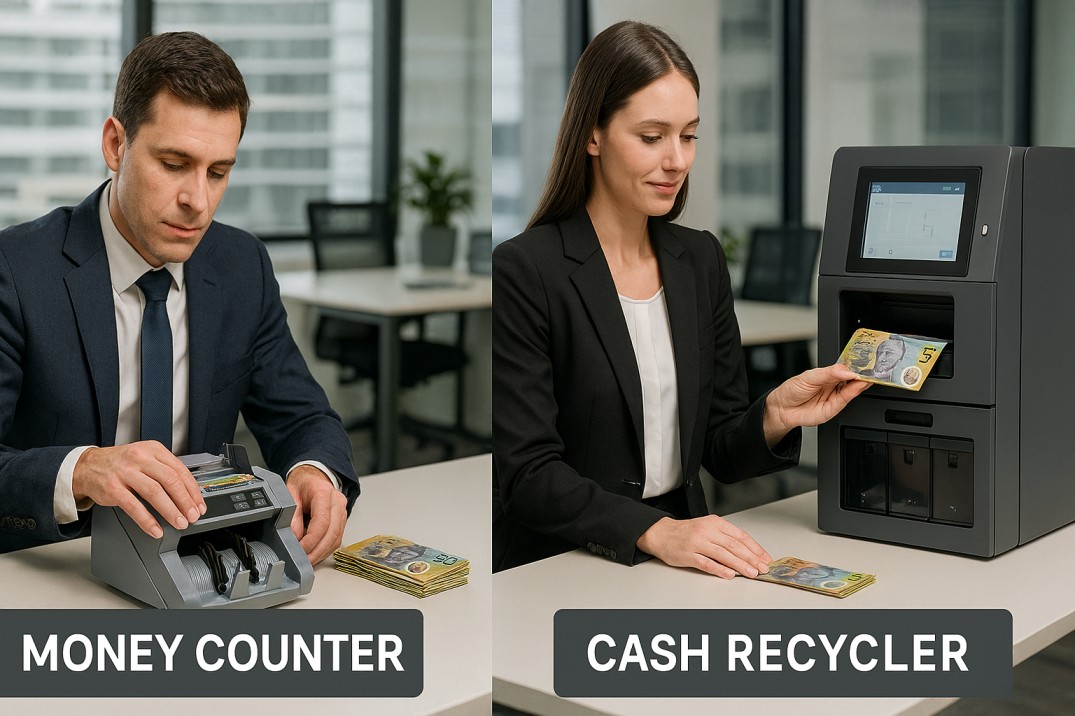
The most common question businesses ask when considering a cash recycler machine is how it compares to a professional money counter. They are related but fundamentally different tools. Here is the honest comparison:
| Feature | Cash Recycler Machine | Professional Money Counter |
| Primary function | Count + sort + store + dispense | Count + authenticate + sort |
| Cash dispensing | ✅ | ❌ |
| Denomination sorting | ✅ | ✅ |
| Counterfeit detection | ✅ | ✅ |
| Serial number logging | ✅ | ✅ |
| Per-employee audit trail | ✅ | ❌ |
| Float replenishment | Automated | Manual process |
| Cash available 24/7 | ✅ | ❌ |
| Cost | Higher | Lower |
| Best for (note volume/day) | 5,000+ notes | 500–5,000 notes |
| Best for (business type) | Clubs, gaming, large retail | All business sizes |
The table above illustrates why the choice is not about which machine is better — it is about which tool matches your actual workflow. For most small and medium Australian businesses, a professional money counter like the Cashcom H110 or LS-200 is the right answer. For businesses where automated cash dispensing, 24/7 availability, and per-transaction accountability are genuine operational requirements, a cash recycler machine changes the economics significantly.
Types of Cash Recycler Machines: What the Market Offers
Before diving into who needs one, it helps to understand the different types of cash recycler machines available in the Australian market. These fall into three main categories:
-
Teller Cash Recyclers (TCR)
Used primarily in banks and credit unions. These sit at teller windows and handle both note acceptance from customers and note dispensing for withdrawals and change. They are large, expensive, and designed for institutional environments with high daily transaction volumes. Not relevant for most commercial businesses.
-
Back-Office Cash Recyclers
These are the most relevant type for Australian businesses outside banking. Back-office cash recyclers sit in the cash room, counting area, or supervisor’s office. Staff bring cash to the machine, make deposits, and withdraw float as needed. The Cashcom K2 Cash Recycler Sorter Machine falls into this category — a high-capacity back-office machine with a 1,000-note hopper, full 4-method detection, and denomination sorting in one pass.
-
Smart Safes with Counting
A related category — not true cash recyclers but sometimes marketed as such. These are secured storage units with built-in note validation. They accept deposits, authenticate notes, and record totals — but cannot dispense notes. Useful for security and audit but do not complete the recycling cycle. For a detailed comparison, see our guide on money counting safes.
| 💡 For most Australian businesses outside banking — clubs, gaming venues, large retail, entertainment — a back-office cash recycler like the K2 is the relevant machine. Teller cash recyclers are institutional equipment at institutional prices. |
Which Australian Businesses Actually Need a Cash Recycler Machine?
This is the most important question in this guide. Not every business that handles cash benefits from a cash recycler machine. Here are the specific business types where the operational case is strongest:

Licensed Clubs and Gaming Venues
This is the strongest use case for cash recycler machines in Australia. Licensed clubs — particularly those with electronic gaming machines — generate cash from multiple sources throughout their trading day: gaming machine collections, bar transactions, membership payments, and bistro sales. Staff need constant access to change float. A cash recycler machine centralises this — deposits go in from multiple staff, withdrawals happen as needed, and the audit trail automatically tracks every transaction by employee.
The TITO (Ticket-In, Ticket-Out) integration available on the K2 Cash Recycler is particularly valuable for gaming environments — the machine can process both cash notes and gaming tickets in a single unit, eliminating separate processing steps.
Large Retail Stores with Multiple Tills
A supermarket or large format retailer with 15–20 active tills generates significant daily cash movement — till top-ups throughout the day, shift-change float preparation, and end-of-day collections from each lane. A cash recycler machine sitting in the cash room means the cash office manager can manage all of this without physically handling and counting individual denomination stacks for every transaction. The machine knows exactly what denominations are available at any time.
Entertainment Venues and Stadiums
Event-based cash operations generate extremely high note volumes over short periods — a Saturday afternoon sporting event, a Friday night concert, a market day. A cash recycler machine can process the inflow quickly, make change available for active outlets during the event, and produce a complete reconciliation at the end. The 1,000-note hopper on the K2 means it rarely needs reloading during high-volume processing periods.
Casinos
The most demanding cash recycler environment commercially available. Round-the-clock operation, extremely high note volumes, maximum detection requirements, and full transaction accountability for regulatory compliance. Industrial-grade machines are the standard in this environment.
Large Hospitality Groups
A hotel group or hospitality chain operating multiple restaurants, bars, and event spaces under one management structure benefits from centralised cash management. A cash recycler machine at the back-of-house level handles float distribution and end-of-shift collections across multiple outlets, with one consolidated audit trail for the finance team.
| Honest assessment:
If your business counts cash once per day at end of shift, has fewer than 3 tills, and does not need to dispense cash from a central machine during the trading day — a cash recycler machine is likely more complexity than you need. A professional money counter like the H110 or H210 will be faster, simpler, and more cost-effective for your workflow. |
5 Clear Signs Your Business Needs a Cash Recycler Machine
-
You Are Making Multiple Float Runs Per Day
If a supervisor or cash office manager is physically carrying change to tills or outlets multiple times during a trading day — you are doing manually what a cash recycler machine automates. Each float run involves counting, recording, transporting, and receiving cash — all manual steps with error and shrinkage risk. A cash recycler machine makes the right denominations available on demand, dispensed automatically, with a logged transaction record.
-
Your Till Reconciliation Takes More Than 20 Minutes Per Till
End-of-day till reconciliation that consistently runs over 20 minutes per till indicates either high volume or an inefficient process — often both. A cash recycler machine’s audit trail means the reconciliation question is not ‘how much cash is in this till’ but ‘does this till’s recorded activity match the machine’s transaction log.’ The latter takes minutes, not the former’s twenty.
-
You Have Multiple Staff Accessing the Same Cash Float
When more than two people handle the same cash float during a shift — relieving each other, splitting duties, sharing change — accountability gaps emerge. A cash recycler machine with per-employee PINs creates a transaction log that shows exactly who deposited and withdrew what, and when. This dramatically reduces internal shrinkage risk in environments with high staff turnover or multiple concurrent cashiers.
-
Your Daily Note Volume Exceeds 5,000 Notes
At this volume, the difference between a machine that simply counts and one that manages the entire cash cycle becomes operationally meaningful. High-volume note processing combined with active float distribution is where the cash recycler machine’s integrated workflow pays its way in staff time saved.
-
You Process Cash Across Multiple Sessions or Shifts
A business that opens at 10am and closes at midnight, with three shift changes and active cash handling throughout, faces a fundamentally different cash management challenge than one that counts the till once at 6pm. Cash recycler machines are designed for this — they run all day, handle multiple staff across multiple sessions, and maintain a continuous audit trail without requiring a dedicated cash room attendant.
The Cashcom K2 Cash Recycler Sorter Machine — Recommended Solution
Cashcom has supplied cash handling equipment to Australian businesses since 2015 — retail stores, banks, clubs, gaming venues, CIT operators, and hospitality groups across every state and territory. The K2 Cash Recycler Sorter Machine is our recommended solution for businesses that have determined they need a cash recycler machine.
| Specification | K2 Cash Recycler Details |
| Counting Speed | 1,000 notes per minute (value counting) |
| Fitness Sort Speed | 800 notes per minute |
| Hopper Capacity | 1,000 notes — largest in the Cashcom range |
| Stacker Capacity | 200 notes |
| Reject Pocket | 100 notes — automatically separates counterfeits and damaged notes |
| Detection | UV + Magnetic (MG) + Infrared (IR) + CIS — full 4-method |
| Sorting | Denomination, orientation, facing, and fitness — all in one pass |
| Currency Support | Up to 7 currencies simultaneously with auto-detect |
| Display | 4.3-inch touch screen — intuitive, minimal training required |
| Optional Add-ons | Barcode and TITO ticket detection — ideal for gaming venues |
| Design | Compact — relatively portable for its performance level |
| Best For | Licensed clubs, gaming venues, large retail, entertainment, hospitality groups |
The K2’s 1,000-note hopper is the standout specification for high-volume operations. For a gaming club collecting from multiple machines throughout a trading day, this means the cash recycler can process a full collection run in a single load — no mid-process reloading, no waiting for the machine to clear before the next cashier can use it.
The TITO ticket detection option makes the K2 particularly suited to gaming environments where both cash notes and gaming tickets need processing. Rather than running cash and tickets through separate machines, the K2 handles both in a single unit.
For businesses processing foreign currencies alongside AUD — large tourist-area hospitality, entertainment venues attracting international visitors — the K2’s 7-currency simultaneous processing means no separate foreign currency counting pass is required.
To enquire about the K2 Cash Recycler or discuss whether it is the right machine for your business, visit cashcom.com.au/product/k2-cash-recycler, call 0451 353 676, or email sales@cashcom.com.au. Our team is available Monday to Friday, 9am–6pm.
Return on Investment: Is a Cash Recycler Machine Worth It for Your Business?
The investment in a cash recycler machine is higher than a professional money counter. The question is whether the operational savings justify the difference. Here is a realistic framework for calculating the return:
Staff Time Saved
If a cash recycler machine reduces the time your cash office manager spends on float distribution and reconciliation by 2 hours per day across a 250-day operating year — at an average staff cost of $30 per hour — that is $15,000 in recovered staff time per year. For operations where the time saving is 3–4 hours, the number doubles.
Shrinkage Reduction
Per-employee transaction logging makes it significantly harder for internal cash handling discrepancies to go undetected. For businesses where till shortfalls and float discrepancies have been a recurring issue, the accountability layer of a cash recycler machine can reduce shrinkage materially. Even a modest reduction in shrinkage on a high-cash-volume operation recovers significant value per year.
Banking Preparation Time
A cash recycler machine’s denomination sorting and fitness separation means banking bundles are largely prepared automatically. What currently takes a staff member 30–45 minutes of manual denomination sorting per day becomes a background function of the machine. At scale, this is another meaningful labour saving.
The Honest Calculation
| If your combined staff time saving, shrinkage reduction, and banking preparation saving exceed the annual cost of the machine (amortised over 5–7 years) — a cash recycler machine is financially justified. If they do not — a professional money counter is the smarter investment for your current operation, with a clear upgrade path when volume grows. |
When a Cash Recycler Machine Is NOT the Right Answer
Because we supply both money counters and cash recycler machines, we can give you an honest answer that many suppliers will not: a cash recycler machine is not the right solution for most Australian small and medium businesses.
You probably do not need a cash recycler machine if:
- You count cash once per day, at end of trading, in a single session
- You have fewer than 3 tills or service points
- Your daily note volume is below 3,000–5,000 notes
- You do not need to dispense change from a central machine during the trading day
- Your cash handling team is small (1–2 people) and accountability is not a current issue
For these businesses — which describes the majority of Australian cafés, restaurants, small retail stores, and service counters — a professional money counter like the Cashcom H110, H210, or LS-200 provides everything needed at a fraction of the complexity and cost. You get bank-grade counterfeit detection, denomination counting, serial number logging, and a clean denomination breakdown for banking, all in a compact machine that takes 2 minutes to learn.
See our full machine comparison at Money Counter & Sorter: Complete Buying Guide 2026 for a complete breakdown of which machine fits which business type.
Frequently Asked Questions
Q: What is a cash recycler machine?A cash recycler machine — also called a money recycler or notes recycler — is a cash handling device that accepts, authenticates, sorts, and stores banknotes, then makes them available for dispensing as change or float replenishment. Unlike a standard money counter, which counts notes and requires manual redistribution, a cash recycler machine automates the full cash cycle. Every deposit and withdrawal is logged with timestamp and employee ID. |
Q: What is the difference between a cash recycler machine and a money counter?A money counter processes notes — counting, authenticating, and sorting them — and requires a person to physically handle the cash afterwards. A cash recycler machine does all of this plus stores notes internally and can dispense them on demand. The money counter is the right tool for end-of-day till reconciliation. The cash recycler is the right tool when you also need automated float distribution and per-transaction accountability throughout the trading day. |
Q: Are cash recycler machines the same as money recyclers or notes recyclers?Yes — these terms describe the same type of equipment. Cash recycler machine, money recycler, and notes recycler are all used interchangeably in Australia to describe automated note processing machines that complete the full cash handling cycle including dispensing. The terminology varies by industry — banks tend to say cash recycler, gaming venues often say money recycler, and some retail operations use notes recycler. The Cashcom K2 is marketed as a Cash Recycler Sorter Machine. |
Q: Which businesses in Australia use cash recycler machines most?Licensed clubs, gaming venues, large retail stores, casinos, entertainment venues, and large hospitality groups are the most common users of cash recycler machines in Australia. These businesses share common characteristics: high daily cash volumes, multiple staff handling cash across multiple sessions, active float distribution throughout the day, and strong accountability and audit trail requirements. For businesses without these characteristics, a professional money counter is typically the better solution. |
Q: Does the K2 Cash Recycler support TITO for gaming machines?Yes — TITO (Ticket-In, Ticket-Out) ticket detection is an optional feature on the K2 Cash Recycler Sorter Machine. For gaming venues processing both cash notes and gaming tickets, this option allows the K2 to handle both in a single unit, eliminating a separate processing step. Confirm this option is specified at the time of ordering. Contact Cashcom on 0451 353 676 to discuss TITO configuration for your specific gaming environment. |
Q: How much does a cash recycler machine cost in Australia?Cash recycler machines for business use — as distinct from bank teller recyclers — vary significantly in price depending on specification and capability. Contact Cashcom on 0451 353 676 or email sales@cashcom.com.au for current pricing on the K2 Cash Recycler Sorter Machine. Our team can also advise on whether a cash recycler machine or a professional money counter is the more cost-effective solution for your specific volume and workflow. |
Q: Can the K2 handle Australian polymer banknotes?Yes. The K2 Cash Recycler is configured for Australian currency as part of its multi-currency support. All detection parameters — UV, magnetic, infrared, and CIS imaging — are calibrated for Australian polymer banknote denominations ($5, $10, $20, $50, $100). The K2 also supports up to 7 currencies simultaneously, making it suitable for businesses that handle foreign notes alongside AUD. |
Q: Where can I buy a cash recycler machine in Australia?Cashcom supplies the K2 Cash Recycler Sorter Machine — Australia’s most capable back-office cash recycler in our range — to businesses nationwide from our Sydney base at 181 Parramatta Rd, Haberfield NSW 2045. We ship to all states and territories. Browse the K2 at cashcom.com.au/product/k2-cash-recycler/, call 0451 353 676, or email sales@cashcom.com.au. Our team is available Monday to Friday, 9am–6pm. |
Do You Need a Cash Recycler Machine?
A cash recycler machine — whether you call it a money recycler, notes recycler, or cash recycling machine — is a powerful operational tool for businesses where cash flows continuously, multiple staff interact with the same cash pool, and automated dispensing provides real efficiency gains.
For licensed clubs, gaming venues, large retail operations, entertainment venues, and hospitality groups processing thousands of notes daily across multiple shifts, the case is compelling. The time saved, the accountability gained, and the shrinkage reduction typically justify the investment within the first operating year.
For most Australian small and medium businesses — a café, a boutique retail store, a restaurant, a small club — the right answer is a professional money counter. It does everything you need, costs less, and creates less operational complexity. The step up to a cash recycler machine is there when your volume and workflow genuinely demand it.
To discuss the right solution for your business — money counter or cash recycler — call Cashcom on 0451 353 676, email sales@cashcom.com.au, or visit cashcom.com.au/products. Our team has been matching Australian businesses to the right cash handling equipment since 2015.