
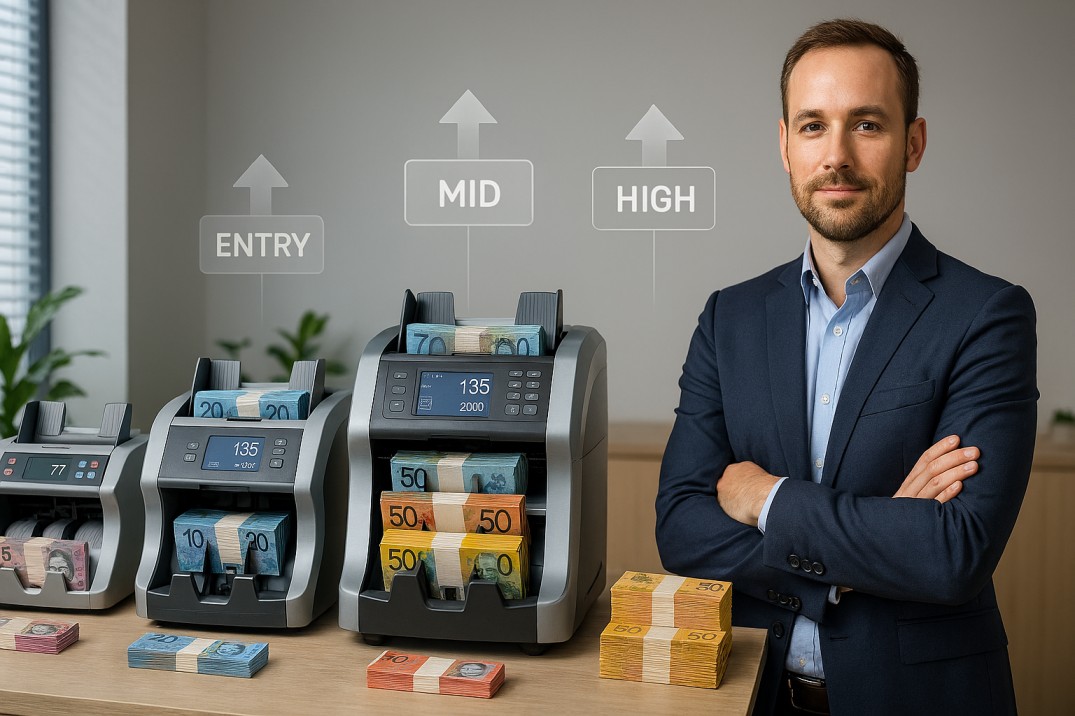
When Australian businesses start researching a money counting machine, price is almost always one of the first questions. What does a machine actually cost? Is there a meaningful difference between the cheapest option and the mid-range? And how do you know what your budget is actually buying?
This guide answers those questions directly. It breaks down the money counting machine price landscape in Australia in 2026 — what each price tier delivers, where the real quality differences lie, and which Cashcom machine matches which budget and business type.
The short answer: professional money counting machines suitable for daily business use in Australia start from a price point most small businesses can absorb within a single month’s operating budget. The more useful question is not “how cheap can I go?” but “what does my business actually need — and what’s the cost of getting it wrong?”
| Bottom line upfront: For most Australian small businesses, the Cashcom H110 Cash Counting Machine is the right combination of price and capability — bank-grade Dual CIS detection, 720 notes per minute, mixed value counting, serial number logging, and LAN connectivity at a price point accessible to any business counting cash daily. For denomination sorting or high-volume requirements, the H210 or LS-series step up with clear justification. Contact Cashcom on 0451 353 676 for current pricing. |
Why Money Counting Machine Price Varies So Much in Australia
Search ‘money counting machine’ in Australia and you will find options ranging from under $100 to well over $5,000. That spread is not arbitrary — it reflects genuine differences in what each machine actually does, how reliably it does it, and how long it will last under daily business use.
The core variables that drive money counting machine price are:
Counterfeit detection depth. A machine with UV-only detection costs less than one with UV + MG + IR + Dual CIS. The detection hardware is more expensive to build, and it is this difference — more than any other single factor — that separates a consumer-grade machine from a professional one. In 2026, with the quality of counterfeit Australian polymer notes at its highest ever level, this is not a place to economise.
Counting speed. Machines that process 1,200–1,500 notes per minute use more sophisticated mechanical components than those running at 600–800. Speed costs money in engineering and build quality.
Hopper capacity. A 500-note hopper requires less hardware than a 1,000-note one. Larger hoppers mean fewer interruptions in high-volume environments — and a higher price.
Denomination sorting capability. A machine that physically separates notes into denomination-specific pockets requires additional mechanical hardware. That adds to the price and adds genuine value for businesses that currently sort manually.
Build quality and design lifespan. A machine built for 8–10 years of daily operation uses different components to one designed for occasional or light use. The latter fails under the pressure of daily business use — often within 12–18 months.
Local warranty and support. A money counting machine supplied with Australian warranty coverage and local service availability costs more than a generic import. But when something goes wrong, the difference in total cost of ownership is significant.
The Four Price Tiers: What Each Budget Buys
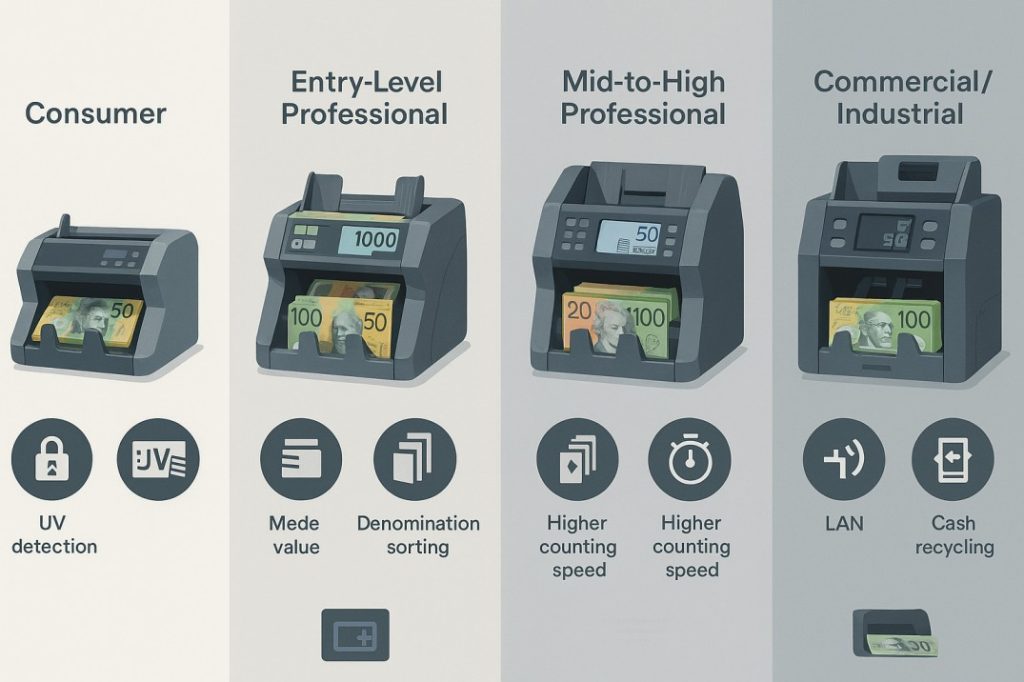
Tier 1: Under $200 — Consumer Grade
Machines at this price point are widely available through general retail marketplaces and consumer electronics channels. They count notes at basic speed and include UV detection.
What you are getting: a machine designed for occasional home or light retail use. UV-only counterfeit detection that can be beaten by the quality of counterfeit polymer notes circulating in Australia in 2026. Build quality suited to light use — not the pressure of daily business counting. Limited or no Australian warranty coverage. No mixed value counting on most models at this tier — notes must be pre-sorted by denomination before the machine will count them.
Our honest assessment: At this price, the machine is not adequate as a primary counterfeit detection tool for any business regularly handling $50 and $100 AUD notes. If a counterfeit polymer $50 passes UV-only detection and makes it to your bank, the loss is yours — the bank does not compensate for counterfeit notes that have been accepted. One accepted fake $50 can represent a significant fraction of the machine’s purchase price in loss.
Right for: Very low-volume home use or businesses processing fewer than 50 notes per day, primarily in small denominations.
Tier 2: $200–$800 — Entry-Level Professional
This is where professional-grade money counting machines for Australian businesses begin. At this price tier, you should expect to find UV + MG + IR detection as a minimum, mixed value counting, AUD polymer note configuration, and build quality suited to daily business use.
The H110 Cash Counting Machine sits at the accessible end of this tier and represents Cashcom’s recommendation for most small-to-medium Australian businesses — cafés, boutique retail, restaurants, and service counters counting one or two tills daily.
At this price tier, you are paying for:
- Multi-method counterfeit detection (UV + MG + IR + Dual CIS on the H110) — reliable protection for Australian polymer $50 and $100 notes
- Mixed value counting — load an unsorted stack and receive denomination breakdown and total value automatically
- Serial number logging — an audit trail for every note processed
- AUD polymer note configuration — sensors and detection parameters calibrated for Australian currency
- Build quality appropriate for daily business use over multiple years
- Local Australian warranty coverage and support
Right for: Small-to-medium Australian businesses counting one to three tills daily. Cafés, boutique retailers, restaurants, market operators, and service businesses with regular cash volumes.
Tier 3: $800–$3,000+ — Mid-to-High Professional
At this price level, you are moving into machines built for higher daily volumes, denomination sorting capability, and in some cases all-day continuous operation. The H210, LS-200, and LS-300 sit across this tier.
The H210 Money Counter and Sorter Machine adds denomination sorting to the detection and counting capability of the H110 — physically separating $5s, $10s, $20s, $50s, and $100s into individual output pockets in the same pass as counting. For businesses currently spending 15–20 minutes manually sorting notes before or after banking, the H210 recovers that time every trading day.
The LS-200 steps up counting speed to 1,500 notes per minute (1,200 in value counting mode), adds an 18-channel magnetic detection system for greater authentication depth, and increases hopper capacity to 600 notes. At this price point, the machine is built for businesses counting three or more tills daily, or those processing particularly high volumes of $50 and $100 notes where authentication depth is a priority.
The LS-300 is built for all-day operation — the vertical path design lets fine particles fall clear rather than accumulating on sensors, making it suitable for environments where the machine runs continuously throughout the trading day. LAN connectivity and remote management capability suit multi-site retail groups or businesses with centralised cash management requirements.
At the upper end of this tier, you are paying for:
- Denomination sorting — eliminates manual sorting before banking
- Higher counting speed — meaningful for 3+ till operations
- Enhanced authentication depth — 18-channel MG on the LS-200
- All-day mechanical design — for continuous rather than session-based use
- Remote management and LAN reporting — for multi-till or multi-site operations
- Large hopper capacity — fewer reloads in high-volume environments
Right for: Medium-to-large retail and hospitality, licensed clubs and venues, cash-intensive businesses with multiple daily counts, and professional cash room environments.
Tier 4: $3,000+ — Commercial and Industrial
At this price level, machines are built for banks, large retail chains, cash-in-transit operations, and gaming venues where the machine runs continuously and the cost of a counting error or a missed counterfeit is significant.
The K2 Cash Recycler Sorter Machine represents the high end of the Cashcom range — it counts, sorts, authenticates, and physically recycles notes for re-dispensing, with a 1,000-note hopper and the ability to run throughout a trading day without the same maintenance requirements as lighter-duty machines.
At this price tier, the ROI calculation shifts: the investment is justified not by staff time saving alone, but by the reduction in manual cash handling errors at scale, the elimination of separate counting and dispensing processes, and the compliance and audit trail requirements of large regulated operations.
Right for: Banks, large licensed venues, gaming operations with TITO integration requirements, cash-in-transit, and large retail chains managing multiple cash rooms.
Money Counting Machine Price vs Total Cost of Ownership
The purchase price of a money counting machine is not the same as its total cost of ownership. This distinction matters more in the money counting machine category than in most equipment purchases.
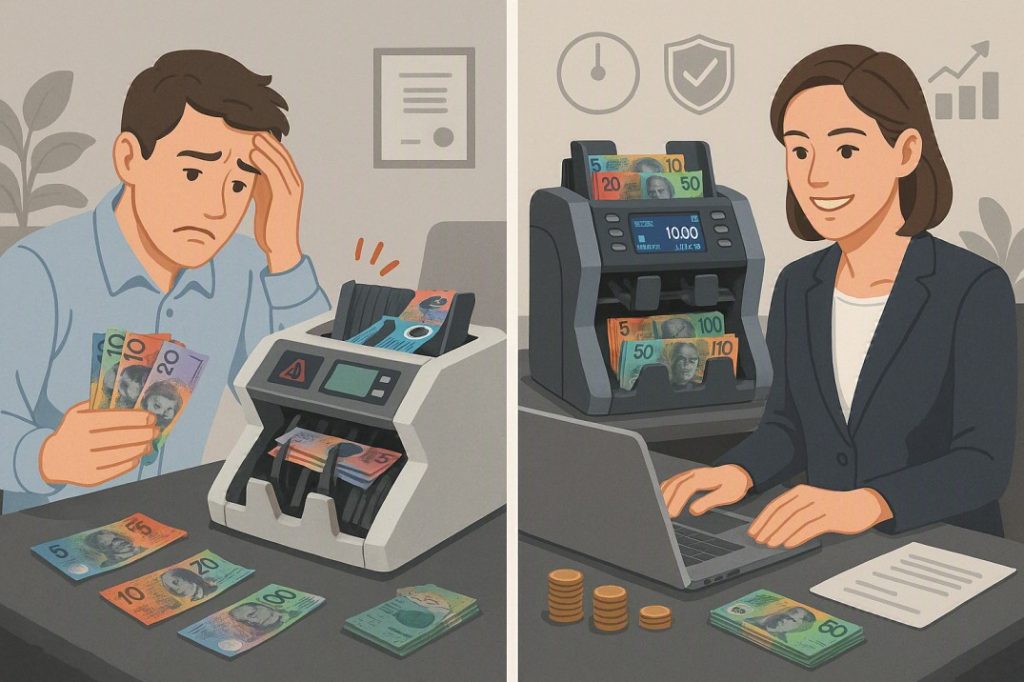
A cheap consumer-grade machine at $150 that fails after 14 months of daily business use and requires replacement costs more over three years than a professional machine at $400 that runs reliably for eight years with basic maintenance. More importantly, it costs more in ways that are harder to measure — the counterfeit notes that passed through undetected, the miscounts that caused reconciliation problems, the staff time spent troubleshooting a machine that jams under load.
When evaluating money counting machine price in Australia, consider:
| Cost Factor | Consumer Grade ($100–$200) | Professional Grade ($200–$800+) |
| Purchase price | Low | Higher |
| Expected daily-use lifespan | 12–18 months | 5–10 years |
| Counterfeit detection reliability | UV only — can be beaten | UV + MG + IR + CIS — reliable |
| Warranty coverage | Limited / no Australian coverage | Australian warranty and support |
| Firmware / currency updates | Typically unavailable | Available on professional models |
| Miscounting risk | Higher under load | Minimal under correct use |
| True 3-year cost | 2–3 replacements + losses | 1 machine + minimal maintenance |
The price difference between Tier 1 and Tier 2 becomes smaller — and often inverts — when measured over the realistic working life of each machine type.
What Drives the Price Difference Between Cashcom Machines
Within the Cashcom range, the price difference between machines reflects specific capability differences. Here is what each step up in price adds:
| Machine | Price Tier | What the Higher Price Adds | Best For |
| H110 Cash Counting Machine | Entry Professional | Dual CIS + UV + MG + IR, mixed value counting, serial number logging, LAN | Small–medium business, 1–2 tills daily |
| H210 Money Counter and Sorter | Mid Professional | All H110 features + physical denomination sorting into separate pockets | Businesses sorting notes daily before banking |
| LS-200 | Mid–High Professional | 1,500 notes/min, 18-channel MG detection, 600-note hopper | Multiple tills, 3+ daily counts, high $50/$100 volume |
| LS-300 | High Professional | 1,200 notes/min value counting, vertical path all-day design, remote management | All-day continuous operation, multi-site management |
| K2 Cash Recycler | Commercial | Counts, sorts, and recycles notes for re-dispensing; 1,000-note hopper | Banks, gaming venues, large retail, CIT |
The step-up logic is clear: pay more when the capability added by that step directly addresses a cost or inefficiency in your current operation. If your business does not currently spend 15 minutes sorting notes before banking, the H210’s denomination sorting does not justify the step up. If it does, the H210 pays for itself quickly. The same logic applies at every price tier.
Is There a Right Time to Buy?
Unlike some capital equipment categories, money counting machine price in Australia does not typically fluctuate significantly with seasonal promotions or product cycles. The more relevant timing question for most businesses is: when does the cost of not having a professional machine exceed the cost of buying one?
For most small businesses counting cash daily, that point arrives earlier than expected. At $35/hour in staff cost, a 20-minute end-of-day count adds up to over $2,400 per year in reconciliation time alone. That calculation does not include the cost of a single accepted counterfeit $100 note.
If you have been deferring the purchase while counting by hand, the break-even point has very likely already passed.
How to Get the Right Machine at the Right Price
The most common money counting machine purchasing mistake in Australia is buying on price alone without confirming:
AUD polymer note configuration. A machine not calibrated for Australian polymer notes will produce unreliable results on AUD banknotes regardless of its specifications. Confirm this explicitly.
Detection method. UV-only detection is not adequate for $50 and $100 AUD notes in 2026. Confirm UV + MG + IR as a minimum.
Mixed value counting. Without this, the machine requires manual pre-sorting. Confirm it is included.
Australian warranty. Confirm what warranty is offered and whether service is available locally. A money counting machine without Australian warranty coverage is a meaningful operational risk.
Firmware update capability. The Reserve Bank of Australia updates banknote security specifications periodically. A machine that cannot receive firmware updates will become outdated as note specifications change.
All Cashcom machines satisfy every point on this checklist. Every machine is configured for Australian polymer notes, includes multi-method detection, supports mixed value counting, is supplied with Australian warranty coverage, and can receive firmware updates.
Frequently Asked Questions
| Q: How much does a money counting machine cost in Australia?
Professional money counting machines for Australian businesses start from the $200–$800 range for entry-level professional models like the Cashcom H110. Mid-range machines with denomination sorting or higher counting speed fall in the $800–$3,000 range. Commercial and recycler machines start above $3,000. Consumer-grade machines below $200 are generally not adequate for daily business use. Contact Cashcom on 0451 353 676 for current pricing on specific models. |
| Q: Is a cheap money counting machine suitable for a business?
Consumer-grade money counting machines under $200 typically provide UV-only counterfeit detection, which is not adequate for Australian polymer $50 and $100 notes in 2026. They are also not built for the pressure of daily business use and frequently fail within 12–18 months under load. For any business counting cash daily, a professional-grade machine with multi-method detection is the correct investment — the price difference is typically recovered within the first year through staff time saving and counterfeit protection alone. |
| Q: What is the best value money counting machine for a small business?
For most Australian small businesses, the Cashcom H110 Cash Counting Machine offers the best combination of price and professional capability. Bank-grade Dual CIS + UV + MG + IR detection, 720 notes per minute, mixed value counting, serial number logging, and LAN connectivity — at an entry-level professional price accessible to any business that handles cash daily. Call Cashcom on 0451 353 676 to confirm current pricing. |
| Q: Why is there such a big price difference between money counting machines?
The price difference between money counting machines reflects differences in counterfeit detection depth, counting speed, denomination sorting capability, hopper capacity, build quality, and expected lifespan under daily use. A UV-only consumer machine at $150 and a professional Dual CIS machine at $500 are fundamentally different pieces of equipment providing very different levels of protection and durability. The price difference is real — and the consequences of choosing on price alone are also real. |
| Q: Is it better to buy a money counting machine online or through a specialist?
Buying through a specialist cash handling supplier ensures the machine is configured for Australian polymer notes, comes with Australian warranty coverage, and has local support available when needed. Generic machines purchased through consumer marketplaces frequently lack AUD configuration, come with no local warranty, and have no firmware update support when banknote specifications change. The price difference between a reputable supplier and a consumer marketplace listing is usually modest — the difference in after-purchase support is significant. |
| Q: How long does a professional money counting machine last?
A professional money counting machine used daily in a single-till small business typically lasts 5–10 years with basic maintenance — periodic cleaning, roller care, and sensor maintenance using manufacturer-approved cleaning cards. Consumer-grade machines under the same daily load typically fail within 12–18 months. This difference in expected lifespan is one of the most significant factors in the true cost comparison between Tier 1 and Tier 2 machines. |
| Q: Do money counting machines need ongoing costs after purchase?
Professional money counting machines have minimal ongoing costs. Consumables are limited to periodic cleaning cards and occasional replacement rollers after heavy use. Firmware updates are available from Cashcom for AUD specification changes and are part of the machine’s normal service lifecycle. The main ongoing cost is staff time for daily operation — which the machine itself reduces significantly. |
Money counting machine price in Australia in 2026 ranges from consumer-grade under $200 to commercial-tier above $3,000. For most Australian businesses counting cash daily, the correct investment sits in the $200–$800 range — a professional machine with multi-method detection, mixed value counting, and AUD polymer note configuration that will run reliably for years and recover its cost within the first 12 months.
The question to ask is not “what is the cheapest money counting machine?” but “what does my business actually need, and what is the cost of getting it wrong?” A missed counterfeit $100 note is a direct loss. A machine that fails under daily use needs to be replaced. The price of getting the specification right is almost always lower than the cost of getting it wrong.
To get a direct recommendation and current pricing for the right machine for your business, call Cashcom on 0451 353 676, email sales@cashcom.com.au, or visit cashcom.com.au/products. Monday to Friday, 9am–6pm.
Call Cashcom on 0451 353 676 | sales@cashcom.com.au | cashcom.com.au/products