
| Quick Answer
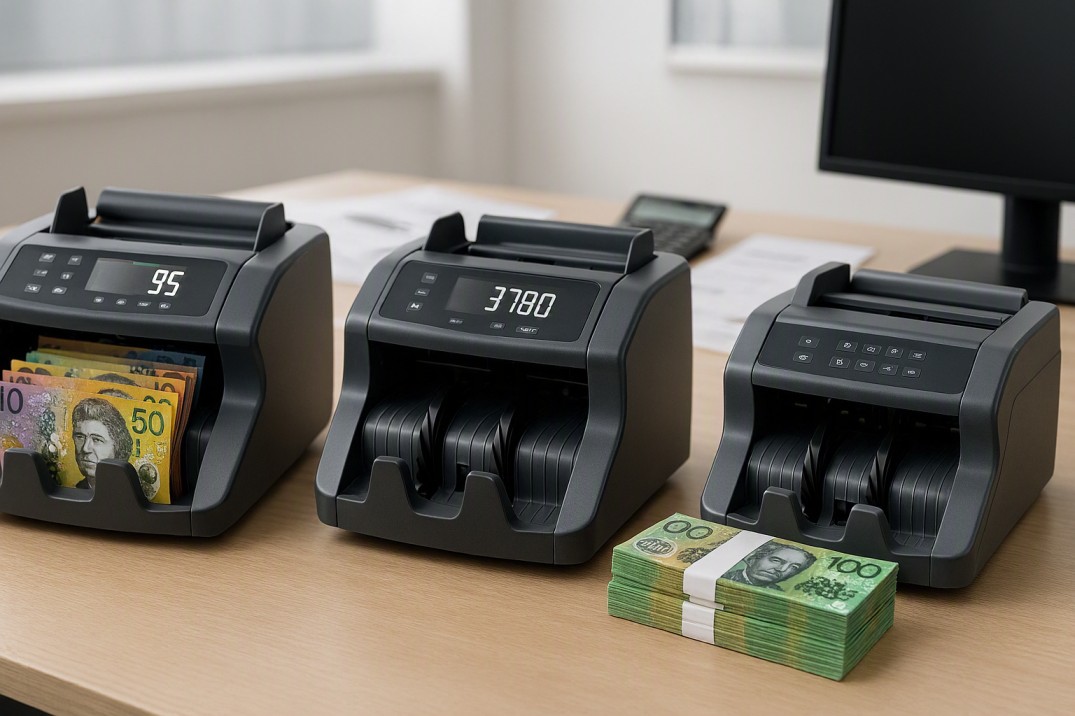
Cash counter, money counter, and notes counter all refer to the same piece of equipment — a machine that counts banknotes and checks them for counterfeits. There is no technical difference between these terms. The same is true for their longer-form equivalents: cash counting machine, money counting machine, and notes counting machine all describe the same product category. The terms that do describe genuinely different machines are: • Coin counter: counts coins, not notes — a separate machine entirely. • Cash sorter: counts notes and sorts them by denomination into separate output pockets. • Cash recycler / money recycler / notes recycler: counts, authenticates, stores, and re-dispenses notes as change — the most capable category. If you searched for ‘difference between cash counter and money counter’ and ended up here — they’re the same thing. The rest of this guide explains why the terminology varies, what actually does differ between machines, and how to choose the right one for your business. |
Why Does the Same Machine Have So Many Names?
The short answer is that different industries developed their own vocabulary for the same equipment, and Australian search habits reflect all of them simultaneously.
Retailers and hospitality operators typically call it a cash counter or money counter — terms that feel natural when you’re thinking about the cash in a till. Financial institutions and cash-in-transit operators tend to use notes counter or notes counting machine — language that emphasises the physical notes being processed rather than the dollar value. Suppliers and procurement officers use cash counting machine or money counting machine in formal specifications.
None of these groups are wrong. The equipment is the same. The name just reflects where you encountered it first.
| The Full Synonym Map
All of the following terms describe the same core product category — a machine that counts banknotes and checks them for counterfeits: • Cash counter • Money counter • Notes counter • Cash counting machine • Money counting machine • Notes counting machine • Banknote counter • Bill counter (used in North American markets — less common in Australia but appears in some imported product listings) When you see any of these terms on a supplier website or in a procurement catalogue, they refer to the same category of equipment. The features that actually differ — speed, detection method, sorting capability — are what you should be comparing, not the name. |
The Complete Terminology Reference
The table below covers every term you’re likely to encounter in the Australian market — what each refers to and which industries tend to use it.
| Term | Refers To | Commonly Used By |
| Cash counter | Note-counting + authentication machine | Retailers, hospitality, general business |
| Money counter | Note-counting + authentication machine | General public, online search, retailers |
| Notes counter | Note-counting + authentication machine | Banks, financial institutions, CIT operators |
| Cash counting machine | Note-counting + authentication machine | Suppliers, procurement, technical specs |
| Money counting machine | Note-counting + authentication machine | General public, online search |
| Notes counting machine | Note-counting + authentication machine | Banks, financial institutions, formal specs |
| Coin counter | Coin-sorting + counting machine | Any business with significant coin volume |
| Cash sorter | Note sorting by denomination machine | Banks, retail, CIT — needs denomination sort |
| Cash recycler | Count + store + dispense notes machine | Gaming, high-traffic retail, banking |
So If the Names Don’t Differ, What Does?
The name on the box tells you almost nothing about the machine’s capabilities. Here is what you should actually be comparing when choosing between machines in this category:
Detection Method and Depth
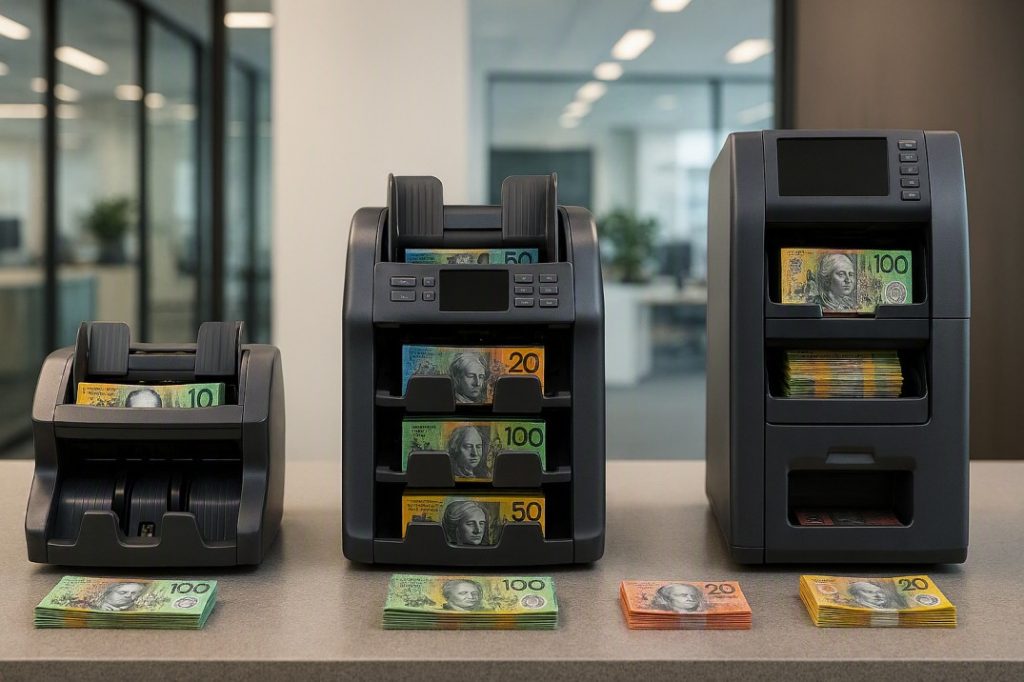
This is the most important variable in the entire category, and it’s where the market splits most sharply. Detection layers, from basic to most advanced:
- UV (ultraviolet): detects ultraviolet-reactive security features in genuine notes. Present on virtually all machines, including entry-level consumer models. UV alone is not sufficient for commercial use in 2026 — modern counterfeit polymer notes can pass a UV check.
- MG (magnetic): detects the magnetic ink used in genuine Australian currency. Harder to replicate than UV features. Standard on commercial-grade machines.
- IR (infrared): detects infrared-absorbing security patterns invisible to the naked eye. Combined with UV and MG, this forms the baseline commercial detection standard.
- CIS (Contact Image Sensor): captures a full-width image of the note and compares it against a stored reference image — the most thorough check available. The Cashcom H110 runs Dual CIS plus UV, MG, and IR simultaneously. The LS-200 runs 18-channel full-width magnetic detection for the deepest MG coverage available at high speed.
Counting Speed
Speed matters in proportion to your daily note volume — not in absolute terms. A 1,500-notes-per-minute machine running on a single quiet till is not a better outcome than a 720-notes-per-minute machine; it’s just more machine than the job needs. Speed specifications to know:
- Up to 720 notes/min: Cashcom H110 — right for small-medium business, 1–3 tills.
- Up to 900 notes/min: Cashcom H210 — right for multi-till retail needing denomination sorting.
- Up to 1,000 notes/min: Cashcom K2 Cash Recycler — value counting in recycler mode.
- Up to 1,500 notes/min: Cashcom LS-200 — high-volume branch or multi-till operations.
Note Counting vs Value Counting
A basic note counter tells you how many notes you have. A value counter totals mixed denominations and gives you the dollar amount directly. Most commercial machines now support both modes — confirm this before purchasing if mixed-denomination value counting is part of your closing procedure.
Denomination Sorting
A standard counter outputs all notes into a single stacker. A sorter — such as the Cashcom H210 — separates notes by denomination into multiple output pockets in the same pass. This is a genuinely different machine function, not just a naming variation. If your process requires pre-sorted denomination bundles for banking or float preparation, you need a sorter, not just a counter.
Recycling — The Category That’s Actually Different
The cash recycler (also called money recycler or notes recycler) is the one term in this space that genuinely describes a distinct machine category. A recycler counts, authenticates, stores, and re-dispenses accepted notes — meaning cash deposited by one customer can be used as change for the next transaction without the notes ever leaving the machine. The Cashcom K2 Cash Recycler is the only recycler in Cashcom’s range. It is not simply a counter with a different name — it is a fundamentally more capable piece of equipment.
Audit Trail and Connectivity
Serial number logging, LAN connectivity, and per-operator audit trails are features that appear on commercial-grade machines and are absent from entry-level consumer models — regardless of what either is called. If your use case requires an audit trail (financial institutions, gaming, CIT), confirm these features are present in the spec sheet, not just the product name.
Read More: Notes Counting Machine for Banks and Credit Unions in Australia (2026)
Feature Differences at a Glance
The table below shows which features vary between machines — not between names.
| Feature | Counter / Sorter / Recycler? | Why It Matters |
| Counting speed | All three | Higher speed = less time per session; match to your daily volume |
| Detection layers (UV/MG/IR/CIS) | All three | More layers = harder to fool; CIS adds full-image check |
| Value counting | Most counters | Totals mixed denominations automatically — saves manual addition |
| Denomination sorting | Sorters only | Separates notes by value into output pockets; counters don’t |
| Serial number logging | Commercial models | Creates audit trail per note; essential for banks and CIT |
| Fitness detection | Commercial models | Flags worn/damaged notes for removal from circulation |
| Note recycling | Recyclers only | Stores + re-dispenses accepted notes as change; most advanced |
| LAN connectivity | Higher-end models | Enables remote data collection and multi-site management |
| Coin handling | Coin counters only | Note counters don’t handle coins — a separate machine is needed |
| Our Honest Assessment
The terminology confusion in this product category is genuine, and it costs Australian buyers real money. People searching for a ‘notes counter’ and a ‘money counter’ are often looking at the same machines under different names, paying different prices, and sometimes assuming one is more capable than the other because it sounds more technical. It isn’t. The vocabulary you use to search doesn’t change what you need. What changes what you need is your daily cash volume, your counterfeit detection risk, whether you need denomination sorting, and whether you need an audit trail. Those are the four questions worth spending time on — not which of the six interchangeable names to put in the search bar. |
Which Term Should You Use When Searching?
For Australian buyers, all six main terms return overlapping results — the same machines appear under multiple names across supplier websites and product listings. That said, there are some practical patterns worth knowing:
- ‘Cash counter’ and ‘money counter’: return the broadest results and include both commercial and consumer-grade machines. Good starting terms for general research.
- ‘Notes counter’ and ‘notes counting machine’: skew slightly toward commercial and financial-institution-grade equipment in Australian search results — useful if you’re looking for higher-spec machines.
- ‘Cash counting machine’: tends to return supplier and distributor sites rather than retail marketplace listings — useful when you want to compare commercial-grade options rather than consumer products.
- ‘Cash recycler’ / ‘money recycler’ / ‘notes recycler’: these terms actually do narrow the results meaningfully, because recyclers are a distinct product category. If you’re searching for recycling capability specifically, these terms return relevant results.
For the Cashcom range specifically, every product is findable under any of the six main counter/counting machine terms — because the equipment is the same regardless of which name you arrive with.
Read More: How to Use a Cash Counting Machine: Step-by-Step Guide
Which Cashcom Model Matches Which Search Term?
Regardless of which term brought you here, the table below maps each Cashcom model to the search terms most likely to describe what you’re looking for — and to the use case it’s built for.
| Model | Category | Best Search Term Match | Best For |
| Cashcom H110 | Counter | Cash counter / money counter / notes counter | Small-medium business, 1–3 tills, strong detection |
| Cashcom H210 | Sorter | Cash counter / cash sorting machine | Multi-till retail, denomination sorting needed |
| Cashcom LS-200 | Counter | Notes counter / notes counting machine | High-volume branch, 3+ tills, 1,500 notes/min |
| Cashcom LS-300 | Counter | Notes counting machine / cash counting machine | All-day continuous use, multi-site management |
| Cashcom K2 Recycler | Recycler | Cash recycler / money recycler / notes recycler | High-traffic venues, gaming, automated float mgmt |
| Cashcom Con200 | Coin | Coin counter / coin sorting machine | Any business with significant coin volume |
Cutting Through the Terminology: A Practical Decision Guide
Ignore the name. Answer these four questions instead:
- How many notes do you count per day? Under 500: H110. 500–2,000: H110 or LS-200. Over 2,000 or all-day continuous: LS-200 or LS-300.
- Do you need denomination sorting in the same pass? Yes: H210. No: H110, LS-200, or LS-300.
- Do you need to store and re-dispense cash automatically? Yes: K2 Cash Recycler. No: any of the counters above.
- Do you handle significant coin volume? Yes: add the Con200 Coin Sorting Machine alongside your note counter. Note counters do not handle coins.
For a full feature comparison across all models, see our Cash Counting Machine Australia: The Ultimate Buyer’s Guide 2026.
Frequently Asked Questions
| Question | Answer |
| Is a cash counter the same as a money counter? | Yes — cash counter and money counter are two names for the same piece of equipment. Both count banknotes and check for counterfeits. The difference is purely linguistic, not technical. |
| Is a notes counter different from a cash counter? | No. Notes counter, cash counter, and money counter all describe the same machine category. Notes counter is more commonly used in banking and financial institution contexts; cash counter and money counter are more common in retail and general business. |
| What is the difference between a cash counter and a cash recycler? | A cash counter counts and authenticates notes and outputs them to a stacker. A cash recycler (also called a money recycler or notes recycler) counts, authenticates, stores, and re-dispenses accepted notes as change. A recycler is a genuinely different and more capable machine — not just a name variation. |
| What is the difference between a cash counter and a coin counter? | A cash counter or money counter processes banknotes. A coin counter processes coins. These are separate machines — note counters cannot handle coins, and coin counters cannot handle notes. If you need to count both, you need two separate machines. |
| Is a notes counting machine better than a cash counting machine? | No — they’re the same equipment. Neither term implies better quality or capability. What determines quality is the detection method (UV, MG, IR, CIS), counting speed, and features like serial number logging and fitness detection — not the name. |
| Why do some machines say ‘bill counter’ — is that different? | ‘Bill counter’ is a North American term for the same equipment. It appears on some imported product listings in Australia. It refers to the same machine — a banknote counter and authenticator. |
| Which Cashcom model should I buy if I’m not sure what I need? | For most Australian small-to-medium businesses, the Cashcom H110 is the right starting point — Dual CIS plus UV, MG, and IR detection, 720 notes per minute, serial number logging, and LAN connectivity. If your daily volume is high or you need denomination sorting, call the Cashcom team on 0451 353 676 for a recommendation based on your actual operation. |
Explore the Cashcom Range
Whether you arrived here searching for a cash counter, a money counter, or a notes counting machine — you’re in the right place. Cashcom supplies the full range of note counting, sorting, and recycling equipment to Australian businesses across retail, hospitality, banking, gaming, and cash-in-transit.
Call: 0451 353 676 | Email: sales@cashcom.com.au | Web: cashcom.com.au
Ready to compare models? See: Cash Counter Machine: 7 Best Options for Australian Businesses.
About the Author
This article was prepared by the Cashcom Team, Australian Cash Handling Specialists since 2015. Cashcom supplies and services cash counting, sorting and recycling equipment for retail, hospitality, banking, gaming and cash-in-transit businesses across Australia.
Get in touch: 181 Parramatta Rd, Haberfield NSW 2045 | 0451 353 676 | sales@cashcom.com.au | cashcom.com.au