
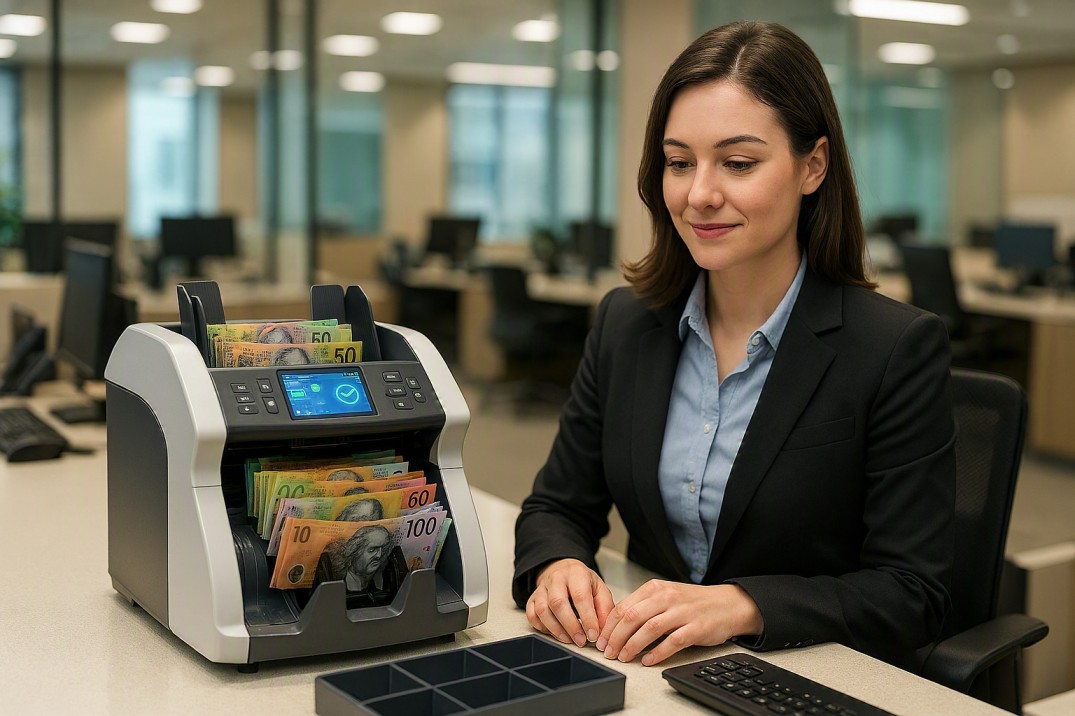
Why Banks and Credit Unions Need a Different Level of Equipment
A retail store or hospitality venue reconciling one or two tills at closing has different cash handling requirements from a bank branch processing customer deposits, teller floats, vault management, and CIT (cash-in-transit) handovers across an entire trading day. The machine needs to match that context.
For Australian financial institutions, the key differences from general retail requirements come down to four things: detection depth, audit trail capability, throughput reliability, and fitness assessment. A machine that works adequately for a café till is not the right tool for a bank teller processing mixed-age note stacks from customer deposits — and using one in that context creates real risk exposure, both for counterfeit detection and for audit compliance.
This guide sets out what Australian banks and credit unions should require from a notes counting machine in 2026, maps those requirements to the available Cashcom models, and explains which configuration fits which branch type.
| 💡 A Day in the Life
It is 4:15 pm at a busy suburban branch of a regional credit union. Three tellers are processing end-of-day reconciliation simultaneously — each counting down their drawer, verifying their deposit stack, and preparing their CIT handover bundle. Without the right equipment, that process takes 20–30 minutes per teller and introduces meaningful human error risk into the audit trail. With a Cashcom LS-200 on the teller bench, each stack is processed in under two minutes — counted, authenticated across UV, MG, IR and 18-channel magnetic detection, and logged by serial number for the branch audit record. The CIT handover bundle is verified and sealed before 4:45 pm. The branch manager has a complete electronic record of every note that passed through the machines that day. |
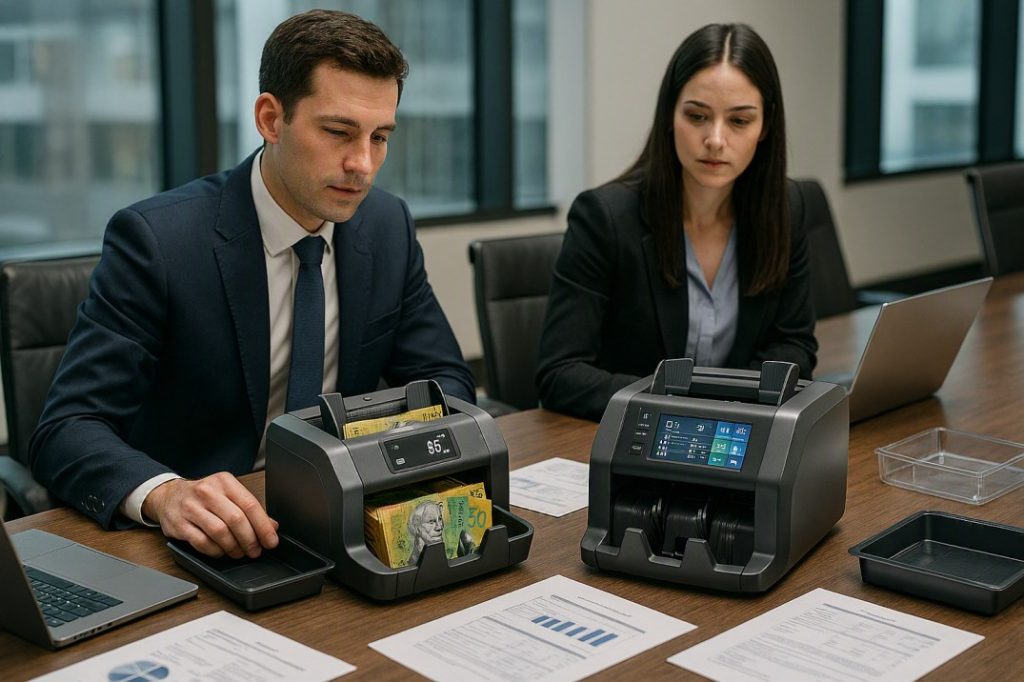
What Australian Banks and Credit Unions Should Require
1. Multi-Layer Counterfeit Detection — Not UV Alone
Australian polymer banknotes carry multiple security features specifically because no single detection method catches everything. A machine that checks only UV is insufficient for financial institution use in 2026 — modern counterfeit polymer notes can pass a UV check. The minimum acceptable standard for bank and credit union use is UV plus magnetic (MG) plus infrared (IR) detection operating simultaneously.
For high-volume processing — vault management, large customer deposits, CIT verification — CIS (Contact Image Sensor) detection adds a full-image verification layer that checks the printed face of each note against a stored reference. The Cashcom H110 runs Dual CIS alongside UV, MG, and IR simultaneously; the LS-200 adds 18-channel full-width magnetic detection for the deepest available authentication at high throughput speeds.
2. Serial Number Logging — Non-Negotiable for Audit
In a retail environment, serial number logging is a useful accountability tool. In a financial institution, it is a compliance and audit requirement. Serial number logging creates an electronic record of every note that passes through the machine — queryable by serial number, operator, batch, or time — which supports:
- Counterfeit tracing and reporting to the Reserve Bank of Australia.
- Dispute resolution when a deposited note is later identified as suspect.
- Internal audit trails for vault and teller reconciliation.
- CIT handover documentation, where a complete note-level record supports chain-of-custody verification.
Every Cashcom model recommended for financial institution use includes serial number logging. The H110 captures serial numbers via LAN, USB, or Serial port; the H210 supports real-time serial ID queryable by serial number, operator, or batch.
3. Fitness Detection for Note Quality Assessment
Banks and credit unions are responsible for removing unfit notes from circulation — torn, heavily soiled, or damaged notes that no longer meet the Reserve Bank of Australia’s fitness standards should be separated and returned to the RBA rather than recirculated. A notes counting machine with multi-type fitness detection automates this triage step, flagging notes that fall below fitness thresholds rather than requiring manual inspection of each note in a deposit stack.
The Cashcom H110 includes 12-type fitness detection. For high-volume branches processing large numbers of customer deposits, this feature significantly reduces the manual inspection burden on teller staff.
4. Throughput Speed Matched to Branch Volume
A branch processing 50 customer transactions per day has different speed requirements from a regional processing centre handling tens of thousands of notes per shift. Speed specifications should be matched to actual volume — not selected for the highest number on a spec sheet — but financial institution environments generally require machines at the higher end of the commercial speed range:
- Small branch or credit union (light to moderate daily volume): 700–1,000 notes per minute is sufficient. The Cashcom H110 at 720 notes per minute covers this tier with Dual CIS detection.
- Busy branch (moderate to high daily volume): 1,000–1,200 notes per minute. The LS-200 at 1,500 notes per minute (1,200 in value-counting mode) provides headroom for peak periods.
- High-volume processing or multi-machine environments: 1,500 notes per minute. The LS-200 is the right choice here, with all-day continuous operation covered by the LS-300.
5. All-Day Continuous Operation Reliability
Retail machines are typically used for minutes per day. A bank branch machine may run continuously across a full trading day — and in some environments, across multiple shifts. A machine not rated for continuous operation will experience motor wear, sensor drift, and accuracy degradation at a rate incompatible with financial institution use.
The Cashcom LS-300 is specifically built for all-day continuous operation, with a vertical note path design that lets debris fall clear of the sensor array during operation rather than accumulating between cleaning sessions. For financial institutions where the machine runs from opening to closing, this is the right engineering choice.
6. LAN Connectivity and Remote Management
For multi-branch financial institutions, LAN connectivity enables centralised data collection — serial number logs, count records, and operator activity — without manually pulling data from individual machines at each location. The LS-300 includes LAN connectivity with remote management capability, supporting the kind of network-level oversight larger financial institutions require for compliance and audit purposes.
Read More: Cash Counter Machine: 7 Best Options for Australian Businesses
Requirements by Branch Type
The table below maps the key requirements to branch size and use case, to help procurement officers identify which features are essential versus beneficial for their specific context.
| Requirement | Small Branch / CU | Multi-Branch Bank | High-Volume Processing |
| Detection: UV + MG + IR minimum | ✅ | ✅ | ✅ |
| CIS (Contact Image Sensor) | ✅ Recommended | ✅ Essential | ✅ Essential |
| 18-channel full-width MG detection | — | ✅ Recommended | ✅ Essential |
| Serial number logging | ✅ | ✅ | ✅ |
| Fitness detection (12-type) | ✅ | ✅ | ✅ |
| LAN connectivity / remote management | — | ✅ | ✅ |
| Counting speed ≥ 1,000 notes/min | — | ✅ | ✅ |
| All-day continuous operation rating | — | ✅ | ✅ |
| Vertical path (debris self-clearing) | — | — | ✅ |
| Denomination sorting (multi-pocket) | — | ✅ Beneficial | ✅ |
Recommended Cashcom Models for Financial Institutions
| Cashcom LS-200 — Best for Branch-Level High-Speed Counting
📌 Best for busy branches and credit unions needing authentication depth at high throughput Speed: 1,500 notes/min (1,200 notes/min in value-counting mode) Detection: 18-channel magnetic detection across the full note width Hopper: 600-note capacity Use Case: High-volume note authentication; busy branch teller use; deposit verification Verdict: The LS-200’s 18-channel full-width magnetic detection is a step above standard MG detection — it reads magnetic ink across the entire width of the note, rather than a central strip, which catches counterfeits that narrow-field MG would miss. At 1,500 notes per minute, it processes a 300-note deposit stack in under 15 seconds. For any branch handling significant daily note volume, this is the core machine to evaluate. View product → LS-200 Note Counter Machine |
| Cashcom LS-300 — Best for All-Day Continuous Operation
📌 Best for branches running machines continuously across full trading hours, or multi-site networks Design: Vertical note path — debris falls clear of sensors during operation Operation: Built for all-day continuous use across full branch trading hours Connectivity: LAN connectivity with remote management for multi-branch oversight Use Case: Continuous teller bench use; centralised note processing; multi-location management Verdict: The LS-300’s engineering choices are specifically targeted at the continuous-operation environment: the vertical path design reduces sensor contamination during operation (a meaningful advantage when a machine runs all day), and LAN connectivity with remote management makes it the right choice for financial institutions managing cash handling data across multiple branch locations. For a single quiet branch, the LS-200 is likely sufficient; for continuous all-day use or network-wide deployment, the LS-300 earns its place. View product → LS-300 Note Counter Machine |
| Cashcom H110 — Best for Smaller Branches and Credit Unions
📌 Best for smaller branches, community credit unions, and building societies with moderate daily volume Detection: Dual CIS + UV + MG + IR (4-method simultaneous) Speed: 720 notes per minute Hopper / Stacker / Reject: 500-note / 200-note / 100-note Fitness Detection: 12-type fitness detection Serial Numbers: Full serial number logging Connectivity: LAN + 2x USB + Serial + optional printer Compliance: CE, CB, FCC certified Verdict: The H110’s Dual CIS detection — capturing a full image of each note and cross-referencing it against a stored reference — provides the deepest available single-machine counterfeit detection, running alongside UV, MG, and IR simultaneously. For a smaller branch or credit union where daily note volume doesn’t justify the LS-200’s throughput, the H110 delivers financial-institution-grade detection at a more accessible price point. Serial number logging and 12-type fitness detection are included as standard. View product → H110 Cash Counting Machine |
| Cashcom H210 — Best Where Denomination Sorting Is Required
📌 Best for branches needing counted and denomination-sorted output in the same pass Speed: 900 notes/min counting, 750 notes/min sorting Detection: Double-face counterfeit ID, multi-level damage detection Output: 3 pockets — 2 sorted exits + 1 reject Audit: Real-time serial ID queryable by serial number, operator, or batch Verdict: Where a branch’s workflow requires notes to be separated by denomination as well as authenticated — for vault preparation, teller float building, or denomination-specific banking bundles — the H210 handles both tasks in a single pass. The real-time serial ID queryable by operator or batch is particularly useful for branches where multiple staff members are processing notes on the same machine across a shift. View product → H210 Money Counter and Sorter Machine |
| ⚠️ Our Honest Assessment
The notes counting machine market includes a wide range of equipment at very different price points. For general retail use, mid-range commercial machines are adequate. For financial institutions, the detection standard, audit trail capability, and reliability under continuous operation are requirements, not optional upgrades — and buying under-specified equipment to save cost creates real compliance and accuracy risk. The machines recommended above are not the cheapest options available in Australia. They are the options that meet the detection, logging, and reliability standard appropriate for bank and credit union use. If budget is a constraint, the H110 is the most accessible entry point that still meets financial-institution-grade detection requirements — Dual CIS plus UV, MG, and IR, with full serial number logging. |
| 💡 Quick Calculation
A branch teller manually counting and verifying a 200-note deposit stack typically takes 8–12 minutes, including a recount. A Cashcom LS-200 processes the same stack — counting, authenticating across 18-channel MG plus UV, IR, and fitness detection, and logging serial numbers — in under 10 seconds. Across a branch processing 15 deposits per day, that’s 2–3 hours of teller time returned to customer-facing work every single day. |
A Note on AUD Polymer Banknote Compliance
All Cashcom machines recommended in this guide are configured and tested for the current family of Australian polymer banknotes — including both older and newer note series currently in circulation. For financial institutions, this matters because:
- Older notes with degraded security features generate more borderline reads on poorly calibrated machines. Cashcom machines are tuned to handle worn older-series AUD notes alongside current-series notes without elevated false reject rates.
- The Reserve Bank of Australia periodically updates note security features. Cashcom provides firmware updates to keep denomination recognition current — relevant for financial institutions where a machine may be in continuous use for several years across note series transitions.
- Multi-currency capability: while the LS-200, LS-300, H110, and H210 are primarily configured for AUD, the K2 Cash Recycler handles up to 7 currencies simultaneously — relevant for branches serving high-volume foreign currency exchange or international business clients.
Multi-Branch and Network Considerations
Financial institutions managing cash handling across multiple branch locations benefit from standardising on a single machine model across the network where possible. Standardisation simplifies:
- Staff training: a teller trained on the LS-300 at one branch can operate the same model at any other branch without retraining.
- Maintenance scheduling: a single model across the network means a single maintenance protocol, simplified parts inventory, and consistent service intervals.
- Data aggregation: LAN-connected machines running the same firmware produce compatible data formats for centralised audit and compliance reporting.
- Procurement efficiency: volume purchasing across a branch network is worth discussing directly with the Cashcom team — contact us on 0451 353 676 for network pricing.
Read More: Cash Counting Machine Australia: The Ultimate Buyer’s Guide 2026
Signs Your Branch Should Upgrade Its Notes Counting Equipment
- Your current machine uses UV-only detection — insufficient for financial institution use in 2026.
- Serial number logging is not available on your current machine — a compliance gap for bank and credit union audit requirements.
- Your machine was purchased as a general retail or consumer-grade model and is now running continuously in a branch environment it wasn’t designed for.
- Reject rates have increased without a clear cause — often a sign of sensor drift on an older machine that needs replacement rather than repair.
- Your branch has grown and the machine’s throughput speed no longer keeps up with daily note volume, creating teller bottlenecks at peak times.
- Your current machine has no LAN connectivity and you’re managing data manually across multiple locations.
Frequently Asked Questions
| Question | Answer |
| What detection standard should a bank or credit union require from a notes counting machine? | At minimum, UV plus magnetic (MG) plus infrared (IR) detection running simultaneously. For financial institution use, CIS (Contact Image Sensor) detection is strongly recommended as an additional layer. The Cashcom H110 runs Dual CIS plus UV, MG and IR simultaneously; the LS-200 adds 18-channel full-width magnetic detection for high-volume processing. |
| Is serial number logging mandatory for Australian banks and credit unions? | Serial number logging is not universally mandated by a single regulation, but it is a standard expectation in financial institution cash handling for audit trail, counterfeit tracing, and dispute resolution purposes. All Cashcom models recommended for financial institution use include serial number logging as a standard feature. |
| What is the difference between the LS-200 and LS-300 for bank use? | The LS-200 is optimised for high-speed branch counting — 1,500 notes per minute with 18-channel full-width MG detection. The LS-300 is built for all-day continuous operation, with a vertical path design that reduces sensor contamination during extended use, and LAN connectivity for remote management across multiple locations. For a busy single branch, the LS-200 is typically the right choice; for continuous all-day operation or multi-branch networks, the LS-300 earns its specification. |
| Can Cashcom machines handle both old and new AUD polymer banknotes? | Yes — all Cashcom machines are configured and tested for the full current family of Australian polymer banknotes, including older notes still in circulation. Mixed stacks of old and new series notes are handled accurately without elevated false reject rates. |
| What should a small credit union or building society look for? | For smaller financial institutions with moderate daily note volume, the Cashcom H110 provides financial-institution-grade detection — Dual CIS plus UV, MG, and IR, with full serial number logging and 12-type fitness detection — at a more accessible price point than the LS-200 or LS-300. It is the right starting point for branches that don’t need the throughput speed of the larger models. |
| Does Cashcom supply to multiple branches across a network? | Yes — Cashcom supplies and services cash handling equipment for multi-branch financial institutions across Australia. For network procurement, contact the Cashcom team on 0451 353 676 or at sales@cashcom.com.au to discuss configuration, volume pricing, and service arrangements. |
Talk to Cashcom About Your Branch Requirements
Whether you’re equipping a single credit union branch or standardising across a multi-location network, Cashcom can recommend the right configuration and provide local servicing across Australia. We’ve supplied cash handling equipment to Australian financial institutions since 2015.
Call: 0451 353 676 | Email: sales@cashcom.com.au | Web: cashcom.com.au
About the Author
This article was prepared by the Cashcom Team, Australian Cash Handling Specialists since 2015. Cashcom supplies and services cash counting, sorting and recycling equipment for retail, hospitality, banking, gaming and cash-in-transit businesses across Australia.
Get in touch: 181 Parramatta Rd, Haberfield NSW 2045 | 0451 353 676 | sales@cashcom.com.au | cashcom.com.au